







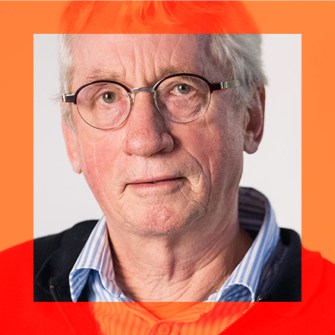
Alva Noë

Alva Noë

Professor of Philosophy, UC Berkeley

Alva Noë is a writer and a philosopher who lives in New York City and Berkeley. His work focuses on the nature of mind and human experience. He is the author of Action in Perception (The MIT Press, 2004), Out of Our Heads (Farrar Straus and Giroux, 2009), Varieties of Presence (Harvard University Press, 2012), and Strange Tools (2015). Noë, who received his Ph.D. from Harvard in 1995, is Professor of Philosophy at the University of California in Berkeley, where he is also a member of the Institute for Cognitive and Brain Sciences and the Center for New Media. He has been Distinguished Professor of Philosophy at the Graduate Center of the City University of New York. He has been philosopher-in-residence with The Forsythe Company and has recently begun a performative-lecture collaboration with Deborah Hay. Noë is a 2012 recipient of a Guggenheim fellowship and a weekly contributor to National Public Radio's science blog 13.7: Cosmos and Culture.
 

A human eye is drawn in pencil on the left, blending into a stylized version of the same eye overlaid with blue and red concentric circles on the right.
3mins
What is perception, really? Philosopher Alva Noë on why perception is a puzzling phenomenon:
2mins
Whether it's bacteria or consciousness itself, science and philosophy examine a specific object that stands apart from the observer. Art is more collaborative, says Alva Noë. It changes us as we change it.
2mins
Can pornography be art? No, argues Alva Noë, because porn is an instrument with a certain function in mind (sexual arousal) and works of art are not instruments.
There is nothing qualitatively different about the way the internet is changing our human experience now than the way the invention of writing did some thousands of years ago. 
Alva Noë: Too many cognitive scientists tend to take a 17th century conception of the person as an individual island trapped inside his or her head and we need to break free of that. 
Alva Noë: I'm very optimistic that we can make breakthroughs precisely by trying to take steps in the direction of a more integrated, contextualized neuroscience of consciousness.  
3mins
We are conscious of both more and less than affects our nervous system
I'm very optimistic that we can make breakthroughs precisely by trying to take steps in the direction of a more integrated, contextualized neuroscience of consciousness.
There is nothing qualitatively different about the way the Internet is changing our human experience now than the way the invention of writing did some thousands of years ago.
One of the problems in the contemporary neuro-scientific study of consciousness is really a basic fundamental one, which is that we’ve been looking for consciousness in the wrong place.  We’ve […]
3mins
We've been looking for consciousness in all the wrong places.