




















Search


Our mission is to answer the biggest questions of all, scientifically.
What is the Universe made of? How did it become the way it is today? Where did everything come from? What is the ultimate fate of the cosmos?
For most of human history, these questions had no clear answers. Today, they do. Starts With a Bang, written by Dr. Ethan Siegel, explores what we know about the universe and how we came to know it, bringing the latest discoveries in cosmology and astrophysics directly to you.
Read Less
with
Full Profile
Ethan Siegel is an award-winning PhD astrophysicist and the author of four books, including The Grand Cosmic Story, published by National Geographic.

Ask Ethan: What’s the biggest misconception in astronomy?
Many facts are well-known to professionals, but are unappreciated or even rejected outright by the public. "How stars work" takes the cake.


For decades, theorists have been cooking up "theories of everything" to explain our Universe. Are all of them completely off-track?

Our dream of journeying to other star systems has a big obstacle to overcome: the vast interstellar distances. Can antimatter get us there?

On cosmic scales, only dark matter (or something equivalent) gives us the Universe we observe. Now, the Sunyaev-Zel'dovich effect agrees.

Although a star's "birth" is well-defined, it doesn't correspond to an ignition event in its core. Here's how stars are actually born.

Every time a new star forms, there's an opportunity to form planets alongside and around it. How does it happen, and how long does it take?

"Color" with respect to the strong force is just an analogy. Here's how to understand it without colors, group theory, or any advanced math.

From 2004 through 2017, Saturn was imaged many times and from many angles up close by Cassini. This new viral image isn't real; it's AI.

One parameter, alone, sets the dividing line between rocky planets, gas giants, brown dwarfs, stars, and much more. Here's why mass matters.

The distance ladder and the CMB give incompatible values for the expansion rate. A new study shows just how robust the Hubble tension is.

By looking at a giant, remarkable, edge-on protoplanetary system, astronomers have found a proto-protoplanet for the first time.

Human beings have now traveled farther from Earth than ever before with Artemis II's flyby of the lunar far side. Here's how it happened.

Known as the "past hypothesis" problem, the Universe's initially low entropy has long puzzled scientists. Now, cosmic inflation solves it.

As the world teeters on the brink of nuclear war, distant, advanced civilizations would never know it. Earth appears peaceful from far away.

The 1st generation of stars formed, lived, and died very early on. But 2nd generation stars could still persist today. Did we just find one?

As humanity journeys to the Moon for the first time since 1972, can we rediscover our shared responsibilities: to the world and each other?
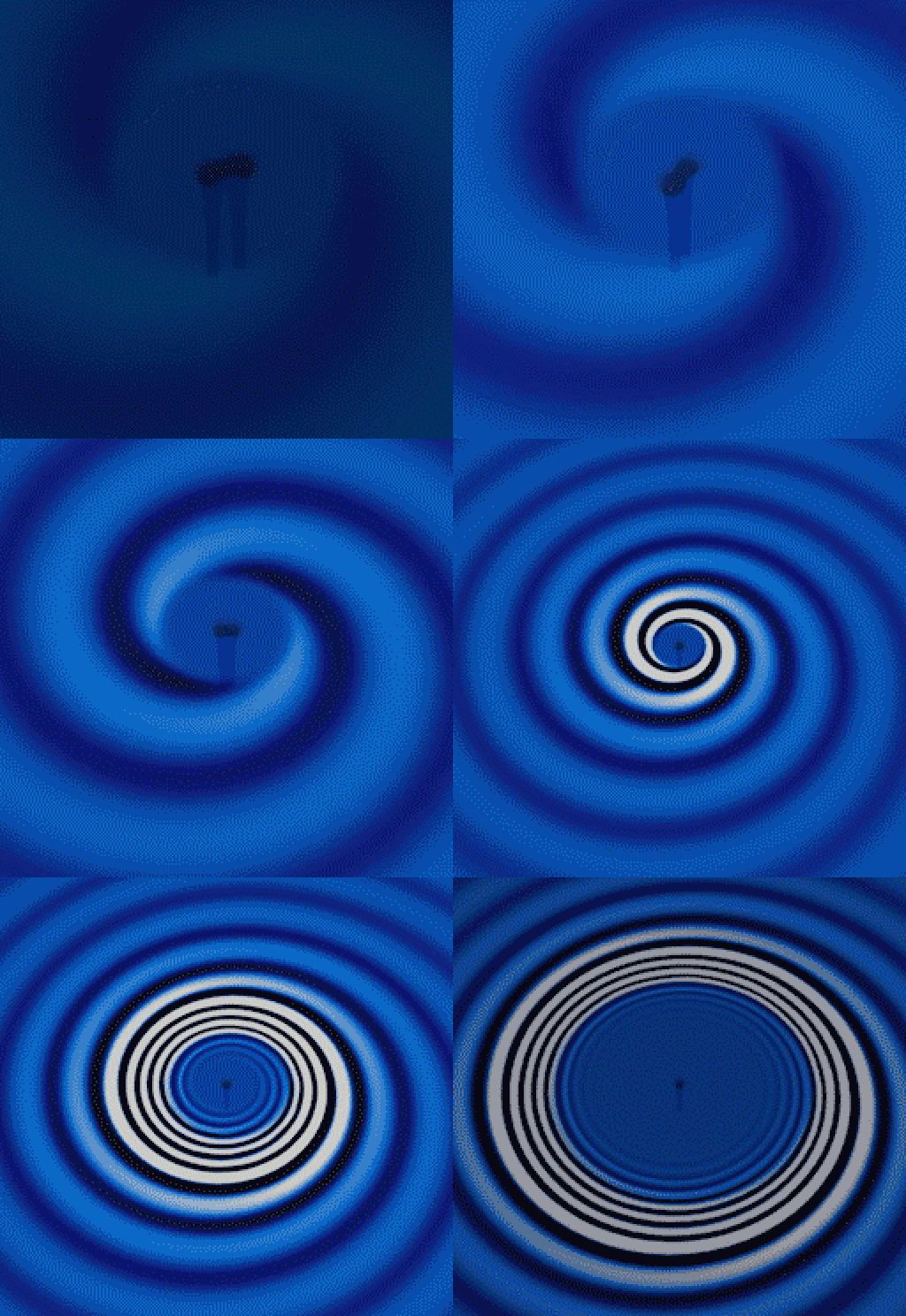
As light travels across the Universe, it's subject to cosmic expansion, changing fields, and relative motion. How about gravitational waves?

Even though no human has stepped foot on the Moon's surface in 50 years, the evidence of our presence there remains unambiguous.

Is dark energy evolving with at least 99.99% confidence? Despite the quality of recent data, scientists have every reason to be skeptical.

We’ve populated low-Earth orbit with satellites in record time — now we have to figure out how to keep it safe.

In a 13.8 billion year old Universe, a few seconds hardly seems like it matters. But these minuscule changes sure do add up over time.