[rebelmouse-image-imported /2011/02/18413590.jpg]As part of its "Works & Process" series of events, the Guggenheim
Museum in New York is presenting a lecture by legendary physicist, mathematician and futurist Freeman Dyson of Princeton's Institute
for Advanced Study in early March. The lecture is titled "How We Might Have Gone to
Mars in 1965" and will be illustrated with slides of people,
experiments, and documents:<!--</p><p>D(["mb","<br />A professor at the Institute for Advanced Study in Princeton, Freeman Dyson contributed to the unification of the three versions of quantum electrodynamics. In this lecture he speaks about Project Orion. &nbsp;Project Orion was a dream that didn't come true. &nbsp;It was a scheme to build a large manned space-ship for interplanetary exploration, propelled by a large number of nuclear bombs. &nbsp;The project began in 1958 as a technically superior alternative to chemical rockets. The intention was to land on Mars by 1965 and on Enceladus, one of the moons of Saturn, by 1970, collecting ice at the destination to use as propellant for the voyage home. &nbsp;The project demonstrated the feasibility of the concept with physics calculations, detailed engineering designs, and experimental measurements of the damage to surfaces exposed to hot plasmas. &nbsp;Small models using chemical explosives were flown at Point Loma in San Diego. However the nuclear test-ban treaty of 1963 brought the project to an end and a chance to combine space-exploration with nuclear disarmament was lost.<br /><br />WHEN: Sunday &amp; Monday, March 4th &amp; 5th, 2007, 7:30-9:30PM<br />WHERE: Solomon R. Guggenheim Museum (1071 Fifth Ave, at 89th St)<br />COST: Tickets are $24 General Admission, $20 for members and seniors, $15 for students<br />RSVP: Call the box office at 212-423-3587 between 1 and 5pm, Monday through Friday; you may also visit the website: <a onclicku003d"return top.js.OpenExtLink(window,event,this)" hrefu003d"http://www.guggenheim.org/education/worksandprocess/tickets.html" targetu003d_blank>http://www.guggenheim.org<wbr />/education/worksandprocess<wbr />/tickets.html</a><br /><br />**********<br />ABOUT US<br />The Princeton Association of New York City (PANYC) is a volunteer organization run by and for Princeton's undergraduate and graduate alumni, students, and parents in the New York City metropolitan area. Our mission is to promote the interests and welfare of Princeton and its connection with alumni, and to encourage association with Princeton through intellectual, volunteer and social activities.<br />",1]</p><p>);</p><p>//-->
"In this lecture he speaks about Project Orion.
Project Orion was a dream that didn't come true. It was a scheme to
build a large manned space-ship for interplanetary exploration,
propelled by a large number of nuclear bombs. The project began in
1958 as a technically superior alternative to chemical rockets. The
intention was to land on Mars by 1965 and on Enceladus, one of the
moons of Saturn, by 1970, collecting ice at the destination to use as
propellant for the voyage home. The project demonstrated the
feasibility of the concept with physics calculations, detailed
engineering designs, and experimental measurements of the damage to
surfaces exposed to hot plasmas. Small models using chemical
explosives were flown at Point Loma in San Diego. However the nuclear
test-ban treaty of 1963 brought the project to an end and a chance to
combine space-exploration with nuclear disarmament was lost."
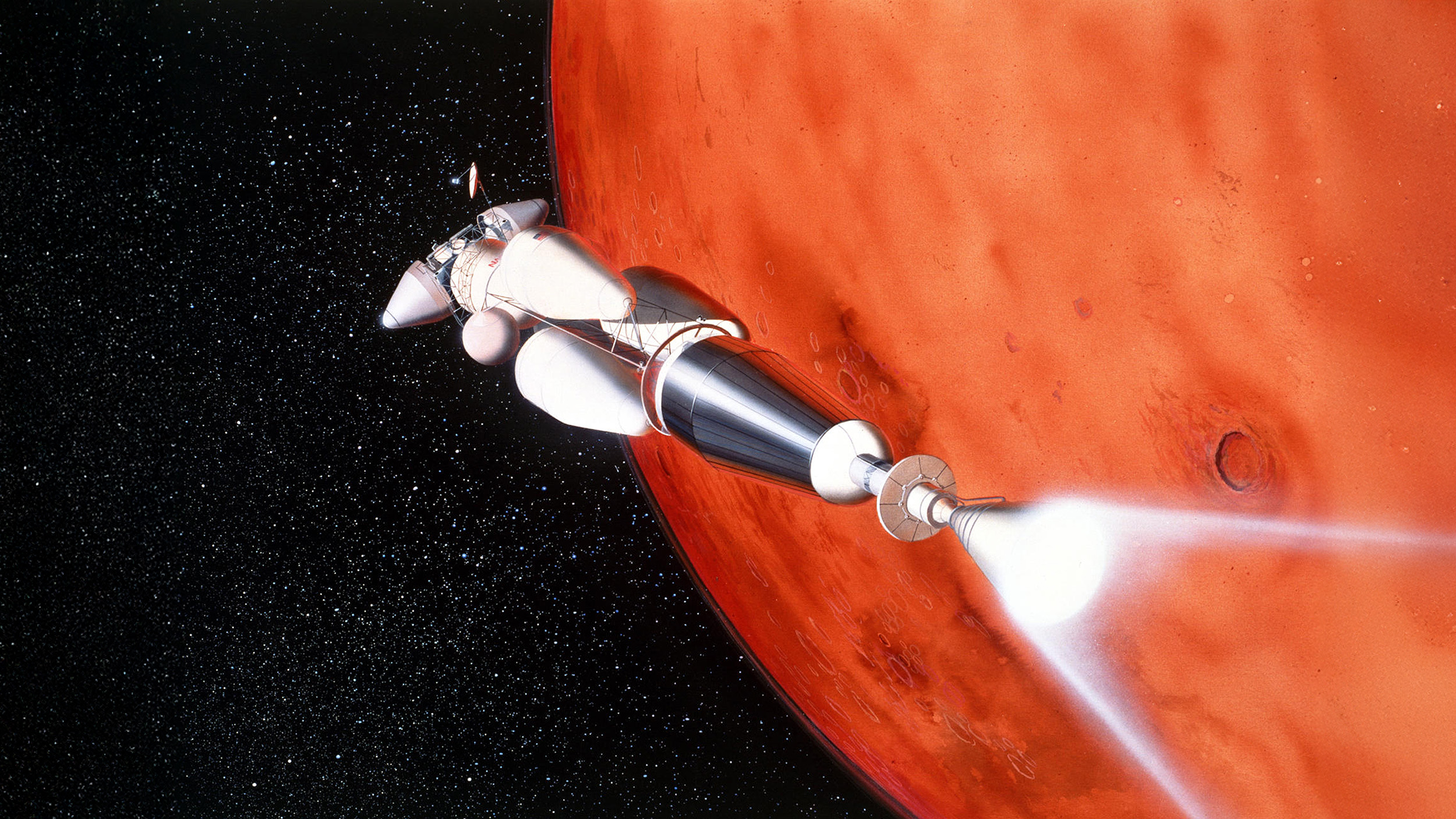
Anyway, the idea of using nuclear-powered rockets to visit Mars sounds fascinating. If you're interested, the lectures take place on March 4 and 5 at the Guggenheim Museum on the Upper East Side of Manhattan. If you can't make it, might I suggest renting Mission to Mars or Red Planet? (I know, I know, they both received lackluster ratings on IMDb, but if you're a space exploration junkie, it's usually possible to overlook bad acting, bad scripts and bad directing, eh?)
[image: Mission to Mars]























![[rebelmouse-image-imported /2011/02/18413590.jpg]](http://endlessinnovation.typepad.com/.shared/image.html?/photos/uncategorized/mission_to_mars.jpg)