






Here are my notes from ISTE’s annual digital equity summit at NECC. There is too much information to fit in one post so I’m breaking it up…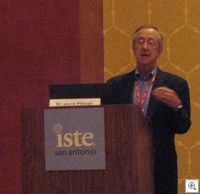
n
From Digital Divide to Digital Opportunities
Dr. Paul Resta, U. Texas-Austin
n
- n
- Current estimate of world repository of pictures/words/movies = 7 exabytes (Library of Congress is largest in world = 20 terabytes)
- It’s not just more information. More is now different.
- UNESCO Digital Opportunity Index allows the tracking and comparison of countries in different aspects of the information society
- Essential conditions – access to…
- Basic literacy skills
- 26% of world adult population (1 billion people) is non-literate (2/3 are women)
- ICT devices, software, and sufficient bandwidth for Internet connectivity
- Most of Latin America, Africa, Asia, and the Middle East has less than 10% of the population with personal computers
- High-income economies are far ahead (International Telecommunications Union, World Information Society 2007 Report)
- The top 1,000 companies in the world have over 70 million computers to dispose of
- Low-cost laptops: OLPC (600,000 orders from Birmingham (AL), Peru, Haiti, Afghanistan, Rwanda, Mexico, Uruguay, Mongolia), EeePC, Intel Classmate (150,000 orders from Nigeria, Libya)
- Cloud computing (virtual servers) means not much power has to reside on the computers themselves
- Asia and Europe both have more Internet users than North America; a near-perfect relationship between Internet use and income
- Broadband access takes up 2.1% of high-income (and 909% of low-income) yearly wages
- USA is now 15th in broadband penetration (see www.itif.org)
- Wireless access is increasing exponentially in many developing countries
- Meaningful, high-quality, culturally-relevant content in local languages
- 68% of Internet content is in English; next highest is Japanese (6%)
- 4Directions project is an indigenous model of education to create culturally-relevant curriculum resources
- Virtual museum partnerships
- Creating, sharing, and exchanging digital content
- The majority of the 7 billion videos streamed on the Internet each month are user-generated
- The number of blogs has roughly doubled every 6 months
- We need to enable indigenous voices and to use the Internat to foster cross-cultural understandings and share knowledge
- Educators who know how to use digital tools and resources in pedagogically-sound, culturally-responsible ways
- UNESCO ICT Competency Standards for Teachers
- Development of National Plans for ICT in Teacher Education
- Teacher Learning in E-Learning Age (UNESCO, forthcoming)
- Effective leadership in policy and planning
- Removing policy barriers and formulating new policy frameworks
- Broadband challenges require new thinking
- There is a need for ICTs customized to the needs of the poor in the developing world
- How do we ensure that the USA stays competitive?
- What is our role as educators to help address the global digital divide?
- From the Digital Divide to Digital Opportunities
n
n
n
n
- n
n
- n
n
n
- n
n
n
n
n
n
n
n
n
n
n
- n
n
n
n
n
- n
n
n
n
n
- n
n
n
n
n
- n
n
n
n
n
n
n
Special Issue
Leadership masterclass: Nike, Jordan, and James Baldwin
George Raveling — the iconic leader who brought Michael Jordan to Nike — shares with Big Think a lifetime of priceless wisdom learned at the crossroads of sports and business.
14 articles