












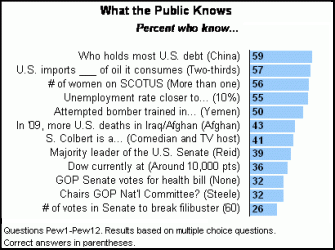
Less than a third of Republicans or Democrats can correctly identify the number of votes needed to end a filibuster (30% among Republicans, 25% among Democrats). College graduates fared better than other demographic groups on this question, but fewer than half of college graduates (45%) know that it takes 60 Senate votes to overcome a filibuster.
Does this mean that there is a “dangerous divide” and “a widening gulf” between political institutions and the public or a rising “anti-politics” attitude on the part of the public, calamitous claims that parallel the arguments made by commentators about the relationship between science and society? Hardly. Similar to science, Americans have scored low on quizzes of political knowledge since the first surveys were done on the topic in the 1940s and 1950s.
What these political knowledge surveys and studies show is the tendency of Americans to make up for their lack of knowledge by relying on heuristics and mental short cuts such as values, identity, and trust; by turning to trusted media sources and political leaders; and by sorting out personal uncertainty through conversations with friends and co-workers, just like they rely on the same heuristics and sources in making sense of science-related debates.
Importantly, if the public has limited knowledge of even the most visible and prominent political issues in the news or basic attributes of major institutions such as the U.S Senate, can we realistically expect that the public will be well informed about issues and institutions receiving much less media attention such as climate change or funding for the NSF?
Finally, of interest in the Pew survey, Republicans on average score significantly higher on public affairs knowledge than Democrats even after controlling for education, age, and gender. Democratic activists, similar to science advocates, tend to often imply that the policy preferences of their supporters derive from greater understanding and knowledge of the issues, yet these Pew findings appear to cut against this assumption.
Here’s how Pew describes the difference between Republicans and Democrats in terms of knowledge:
Republicans, on average, answered one more question correctly than Democrats (5.9 vs. 4.9 correct). These differences are partly a reflection of the demographics of the two groups; Republicans tend to be older, well educated and male, which are characteristics associated with political and economic knowledge. Still, even when these factors are held constant, Republicans do somewhat better than Democrats on the knowledge quiz.
Game Change