- Latest
-
Topics
Philosophy
Mind & Behavior
Business
-
Videos
Latest Videos
 Why Einstein called awe the fundamental emotion If you’ve gotten goosebumps when hearing a story about a stranger’s selfless heroism, or you’ve felt your chest swell at...
 How facing adversity can help you live a deeper, more meaningful life “There would be something very, very empty and meaningless about [a] sort of life with no problems.”
 Can you measure love? 3 experts discuss From neuroscience to philosophy, experts reveal why compassion may be the most important human skill we have.
 How accepting impermanence can end the struggle to “fix” your life “The idea is that we move from a place of wanting the world to conform to what we like [towards]...
 How your cognitive biases lead to terrible investing behaviors “Let me walk you through the biggest traps that you should be aware of that are a danger to your...
 Is free will a fallacy? Science and philosophy explain. Philosophy asks if free will is real. Neuroscience reveals why the answer is more complicated than we expected.
 Why 2025 is the single most pivotal year in our lifetime "We're living in an extraordinary moment in history. We are at a moment here in 2025 where we have world...
 Even AI is self-censoring. Here’s why that matters. If the people controlling AI are biased, the output will also be. Free speech scholar Jacob Mchangama makes the case...
 -
Columns
Columns
 Mini Philosophy Mini Philosophy is a space to explore ideas. It’s where we pause the busyness of life to reflect on ourselves,...
 Starts With A Bang Understand how the universe works with Ethan Siegel.
 Books Big Ideas. Thoughtful Conversations. One Book at a Time.
 The Long Game A Big Think Business column written by investor Eric Markowitz, focused on the philosophy and practice of long-term thinking.
 The Well Exploring life's biggest questions, publication by the John Templeton Foundation and Big Think.
 13.8 A series exploring the beauty and power of science in culture by Adam Frank and Marcelo Gleiser.
 -
Classes
Featured Classes
- My Account
- Sign In
- Membership
- More






String theory. M-theory. Quantum field theory.
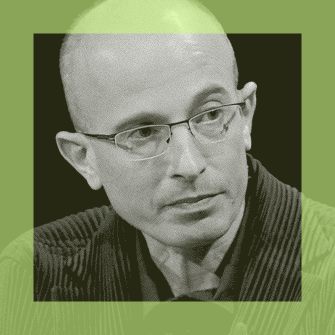
These ideas are about as far from our daily experience as being a super genius or a high priest. Fortunately, in the world of theoretical physics, there is a genius among geniuses and a high priest above them all—Edward Witten, featured in a recent Quanta magazine profile.
“Among the brilliant theorists cloistered in the quiet woodside campus of the Institute for Advanced Study in Princeton, New Jersey, Edward Witten stands out as a kind of high priest," writes Quanta's Natalie Wolchover.
“The sole physicist ever to win the Fields Medal, mathematics' premier prize, Witten is also known for discovering M-theory, the leading candidate for a unified physical 'theory of everything.' A genius's genius, Witten is tall and rectangular, with hazy eyes and an air of being only one-quarter tuned in to reality until someone draws him back from more abstract thoughts."
To better understand the universe as seen by a high priest of physics, we must start with a rudimentary grasp of string theory. For that, we turn to three videos from Brian Greene, another American physicist and expert string theorist.
In this brief video from Tech Insider, Greene describes string theory as a “cosmic symphony." (Extra credit if you understand the first 60 seconds. After that, you'll be fine.)
[youtube https://www.youtube.com/embed/eGxPGgPdTVw?feature=oembed]
In this 6-minute video from Smithsonian, Greene explains how string theory connects with a theory unifying relativity and quantum mechanics. And in this 19-minute Ted-Ed talk from 2005, Green shares some excellent visuals to help understand strings:
[youtube https://www.youtube.com/embed/kF4ju6j6aLE?feature=oembed]
Now that you're an expert on string theory, let's return to Witten and M-theory. In the mid-1990s, there were multiple competing superstring theories, describing the vibrating strings that some theorists believe constitute all the known fundamental particles in physics.
There were also concepts of multidimensional branes and supergravity—another idea physicists were pursuing in the effort to bridge gravitational physics and quantum mechanics. In a stroke of brilliance, Witten unified the five seemingly competing superstring theories with supergravity into what is known as M-theory:
[youtube https://www.youtube.com/embed/KQwhR-L2w9M?feature=oembed]
Still, M-theory is not at all complete. It looks nothing like the theory of general relativity or quantum theory with a mathematical formalism that maps onto physical reality and even allows us to make predictions. Instead, what Witten did was show similarities in all these competing ideas and noted some physics concepts and mathematical tools to allow physicists to pursue them further. The Quanta interview dives into some of these, especially the highly technical concept of dualities.
Theories are just, well, theoretical
There is so much more to be said about strings and unified theories, including extra dimensions? But we must keep in mind that all these ideas are purely theoretical. Despite all of the sophisticated mathematics, no one has actually seen empirical evidence to show that strings or branes actually exist. Perhaps that's due to limits in current methods and technologies. Or, as some similarly brilliant physicists suggest, strings like another purely hypothetical concept—the multiverse—may not even be scientific.
So a bit of humility is in order here as these high priests pursue things like M-theory, an idea that may prove to be as unprovable as the existence of the divine. Witten shows that humility in the Quanta interview. He wonders and guesses, he struggles to imagine, he admits his limits. He even says that “our understanding of [M-theory] is still very hazy."
Hazy, indeed. Perhaps we non-geniuses have more in common with Witten after all.
For more from Witten, read this interview with NOVA. Or check out his presentation, “On the Shoulders of Giants," from the 2015 World Science Festival:
[youtube https://www.youtube.com/embed/2UQ8teAebcg?feature=oembed]
And for a bit of his personal story, watch this interview, in which he says that as a kid he wanted to be an astronomer, but did not want to go into space—and in which he discusses his passion for peace in the Middle East:
[youtube https://www.youtube.com/embed/06yXsnTFF-U?feature=oembed]
No transcript available for this video.