






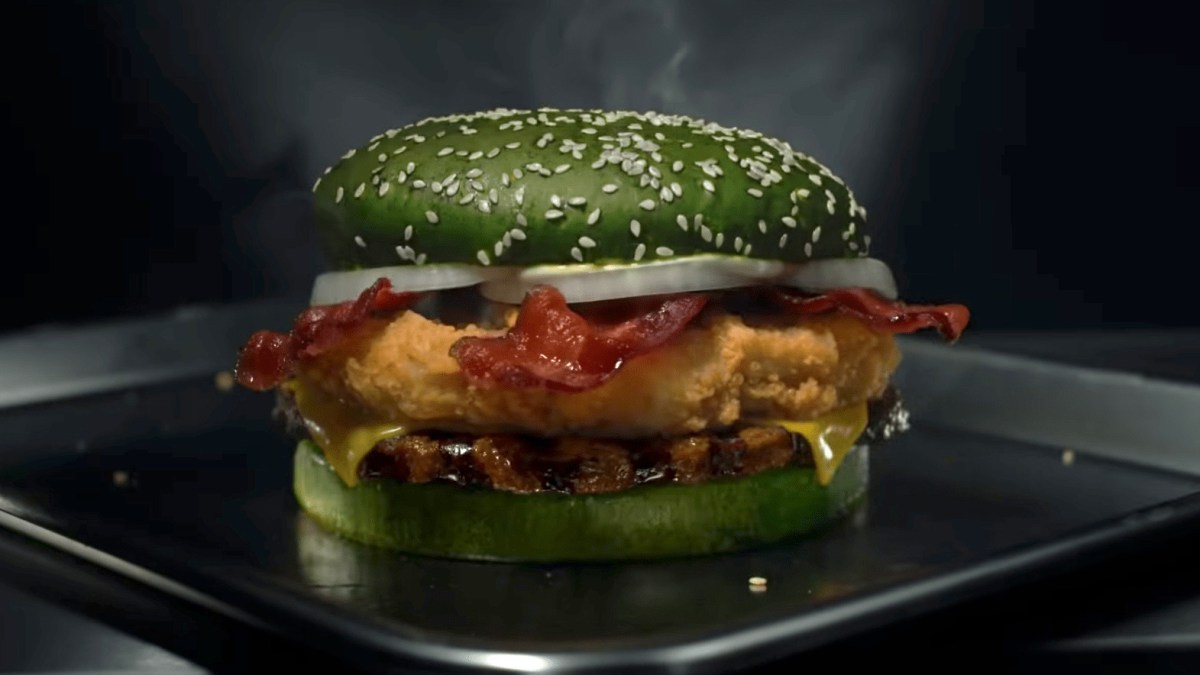
If you’re a fan of the podcast My Brother My Brother and Me, you’ll be aware of a segment of the show called Munch Squad, which focuses on food and drink companies doing their best to get you interested in their particular product through the ever successful love language of press releases. This past Monday, Munch Squad focused on a burger put out by Burger King called the ‘Nightmare King,’ which Burger King claimed was clinically proven to give you nightmares, a claim it said was backed up by a study it ran with Paramount Trials and Florida Sleep & Neuro Diagnostic Services, in which 100 people were given a Nightmare King for dinner for 10 nights and observed while they slept. (Probably the real cause of any nightmares that occurred.) The study reported a 3.5 increase in nightmares due to a particular combination of protein and cheese. It’s worth noting that the Burger King study has not been published in a peer-reviewed journal. Here – for those curious – are the contents of the burger:
… this spooky sandwich features ¼ lb* of savory flame – grilled beef, a 100% white meat crispy chicken fillet, melted American cheese, thick cut bacon, creamy mayonnaise, and onions all assembled on a glazed green sesame seed bun.
“According to previous studies, 4 percent of the population experiences nightmares in any given night,” said the study’s lead researcher and somnologist, Dr. Jose Gabriel Medina, in a statement. “But, after eating the Nightmare King, the data obtained from the study indicated that the incidence of nightmares increased by 3.5 times.”
While there is little joy to be found in attaching a list of facts to a comedy podcast like a teacherly barnacle, it’s worth making the point explicitly clear: there is no direct scientific proof that what you eat will have an impact on your dreams. A 2015 paper published by the Frontiers of Psychology that dug into this particular topic only found one study that even came close to getting at the subject, and it was a study featuring 7 men and 42 women which revealed that fast food may actually be linked to fewer nightmares:
… participants who expressed a preference for organic foods reported more frequent dream recall, recurring dreams and meaningful dreams, as well as more dreams containing particular themes such as flying, risk-taking, sex, and water. In contrast, participants who expressed a preference for fast foods reported less frequent dream recall, as well as fewer recurring dreams, nightmares, and sexual dreams.
Other attempts to examine the link between food and dreams have pursued a path simultaneously sublime and ridiculous. A 2005 study conducted by The British Cheese Board concluded that “eating Stilton cheese often led to crazy or vivid dreams while eating cheddar cheese often led to dreams of celebrities,” though information available about the study is—in the paper’s words—”extremely sparse.”
There is something of a link between food deprivation and dreams. Five of fifteen individuals deprived of water for 24 hours in 1958 had a dream that “contained thirst-related content, but these did not depict the dreamer as thirsty or in the act of drinking.” Individuals with eating disorders were found to have statistically higher reported incidents of dreaming about food. One study reported food dreams in 58% of patients with bulimia, 26% of patients with anorexia, and 44% of patients with anorexia and bulimia combined.
There’s also something of a link between eating late and dreams, but—in the main—”Disturbing dreams [as opposed to what the paper calls ‘vivid dreams’] were not, however, significantly related to the quality of participants’ diets, having only a marginal positive correlation with drinking coffee.”
And while a man named Hamburger once did work on looking at the link between food and dreams, there’s little evidence that you can hold the other hamburger responsible. At best, it can be said that “food sensitivities and intolerances, especially lactose intolerance, could play a significant role in food-dependent dreaming.” And that’s about it.