




















Search


In this excerpt from "Facing Infinity," Jonas Enander examines how John Michell conceived of "dark stars," or massive bodies with enough gravity to trap light, all the way back in 1783.

A dialogue with Angus Fletcher — author of the bestseller "Primal Intelligence" — exploring the unique engines of human progress.

The Holy Grail of physics is a Theory of Everything: where a single equation describes the whole Universe. But maybe there simply isn't one?

Reality TV star, music producer, and serial entrepreneur JoJo Simmons on the power of listening and the massive benefits of switching off.
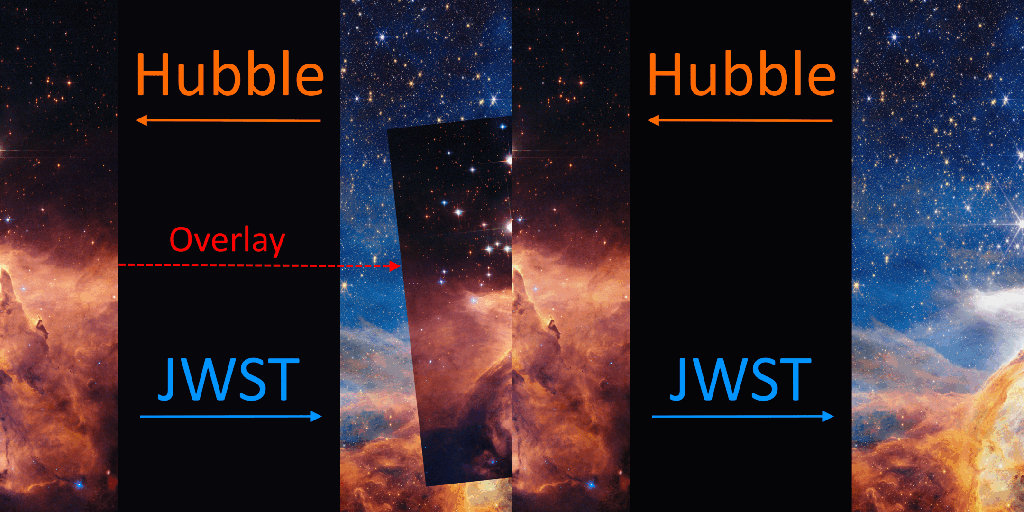
JWST isn't the first telescope to peer into this factory of star-birth some 5500 light-years away, but its views are the most educational.

Going back to 1990, we hadn't even found one planet outside of our Solar System. As we close in on 6000, we now see many of them directly.

Since even before Einstein, physicists have sought a theory of everything to explain the Universe. Can positive geometry lead us there?

About six million years ago, the Mediterranean was sealed off from the Atlantic, and over centuries it ran dry. One megaflood reversed that.

Welcome to The Nightcrawler — a weekly newsletter from Eric Markowitz covering tech, innovation, and long-term thinking.

Across all wavelengths of light, the Sun is brighter than the Moon. Until we went to the highest energies and saw a gamma-ray surprise.

It's OK to hate a frigid pond.

The Juno spacecraft, orbiting and imaging Jupiter since 2016, is still succeeding. Without a further extension, the mission now faces death.

The African Union argues that the Mercator projection distorts the continent, both in size and global attention.

In "That Book Is Dangerous," author Adam Szetela examines the rise of the “Sensitivity Era” in publishing and how outrage campaigns try to control what books authors can write and readers can read.

The predictions of evolutionary theorists and current advances in “multimodal AI” offer strong clues to the future of employment.

With several seemingly incompatible observations, cosmology faces many puzzles. Could early, supermassive stars be the unified solution?

A contemplative approach to leading others can help us accept the tension of not always knowing how things will play out.

As we look to larger cosmic scales, we get a broader view of the expansive cosmic forest, eventually revealing the grandest views of all.

Explanations for the cosmic speed limit often conflate mass with inertia.
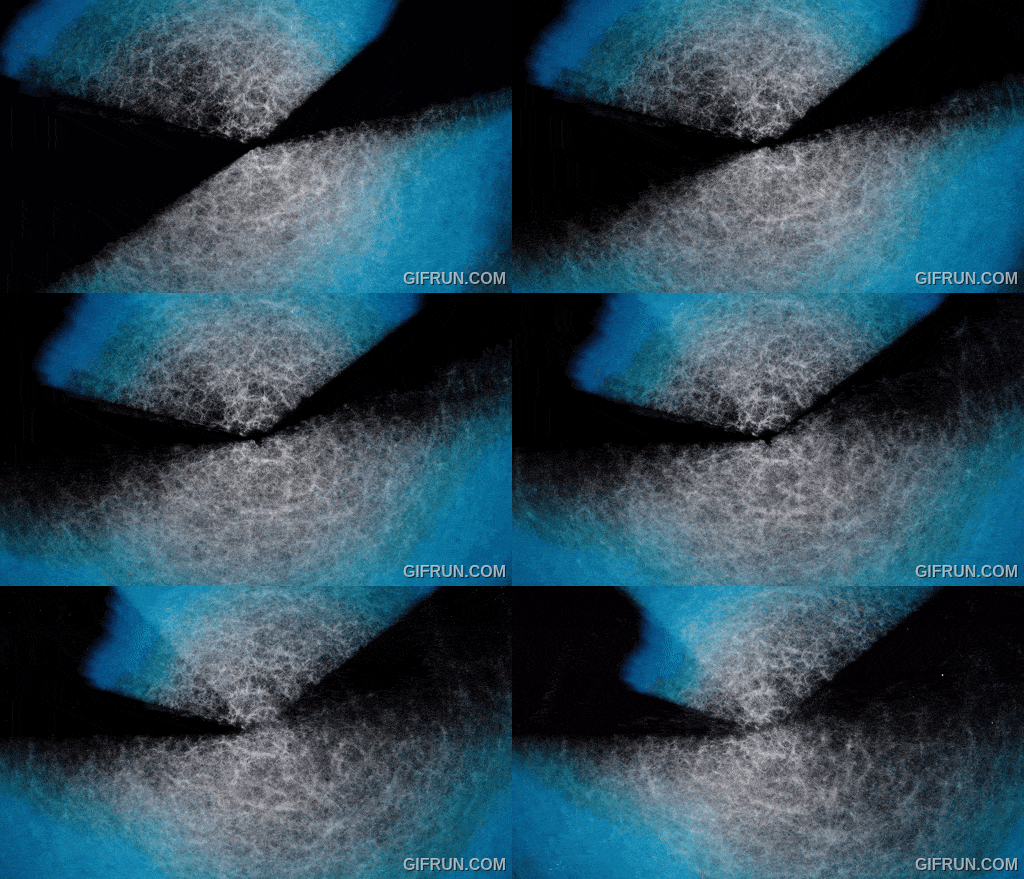
The Universe isn't just expanding; the expansion is accelerating. If different methods yield incompatible results, is dark energy evolving?