




















Search
Ethan Siegel
Theoretical astrophysicist and science writer

Ethan Siegel is a Ph.D. astrophysicist and author of "Starts with a Bang!" He is a science communicator, who professes physics and astronomy at various colleges. He has won numerous awards for science writing since 2008 for his blog, including the award for best science blog by the Institute of Physics. His two books "Treknology: The Science of Star Trek from Tricorders to Warp Drive" and "Beyond the Galaxy: How humanity looked beyond our Milky Way and discovered the entire Universe" are available for purchase at Amazon. Follow him on Twitter @startswithabang.
Read Less
The Universe isn't just expanding; the expansion is accelerating. If different methods yield incompatible results, is dark energy evolving?

When you don't have enough clues to bring your detective story to a close, you should expect that your educated guesses will all be wrong.
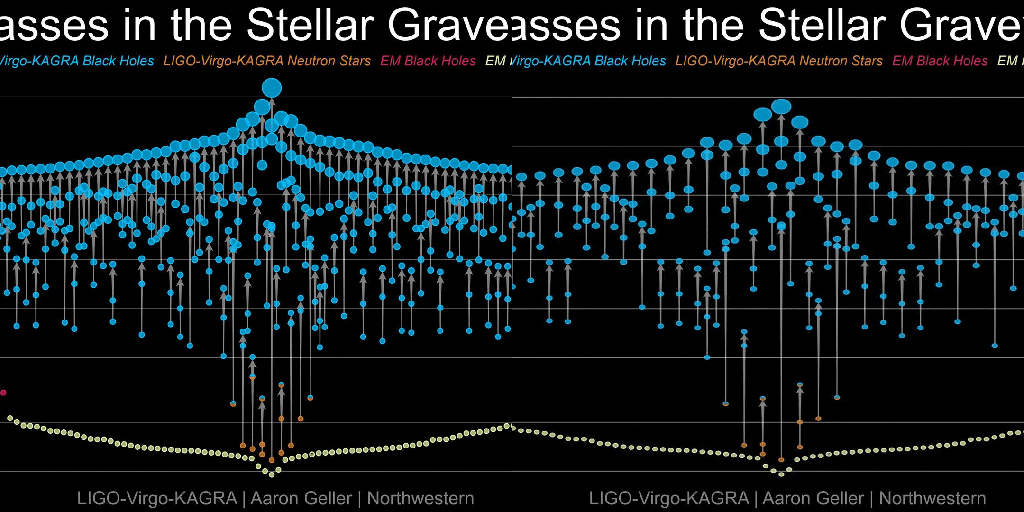
10 years ago, LIGO saw its first gravitational wave. After 218 detections, our view of black holes has changed forever. Can this era endure?
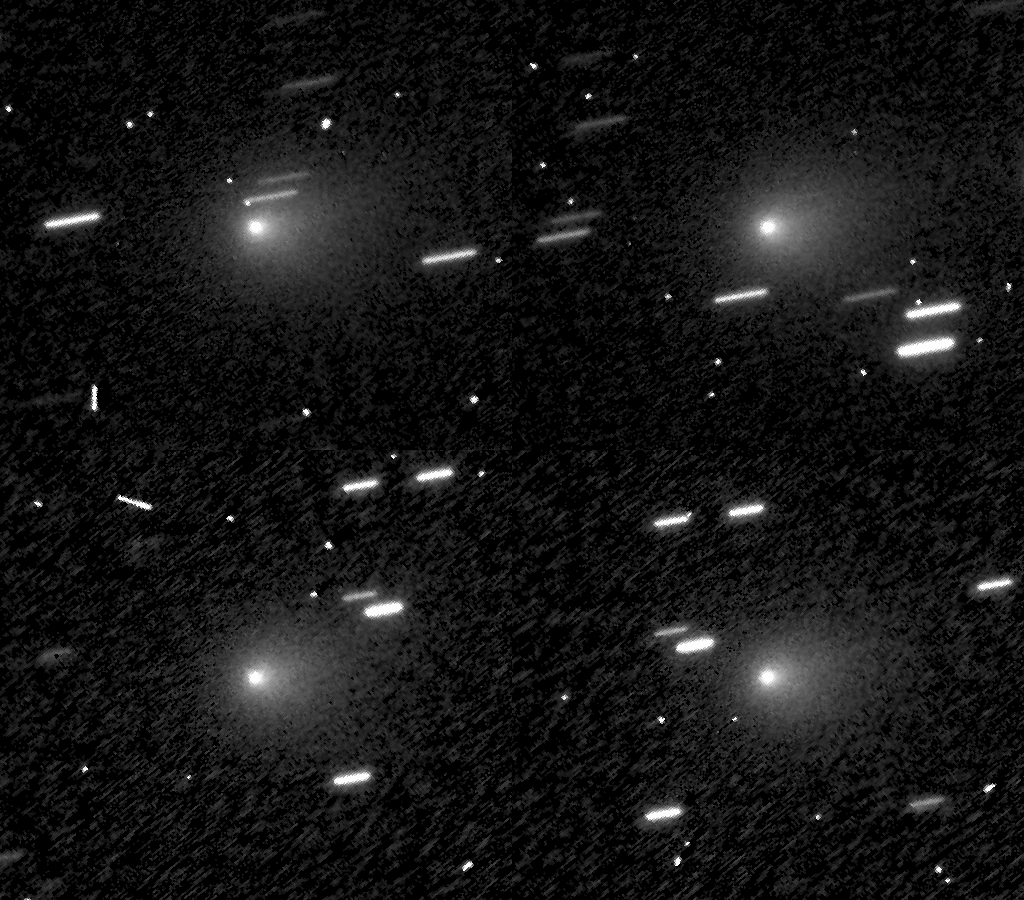
Designed to map galaxies, the SPHEREx mission's first science result is instead about interstellar interloper 3I/ATLAS. No, it's not aliens.

In our own Milky Way, a recently deceased star creates a ghostly, hand-like shape in X-rays some 150 light-years wide. Here's how it's made.

There could be variables beyond the ones we've identified and know how to measure. But they can't get rid of quantum weirdness.

NASA's 1958 charter's top priority was, "the expansion of human knowledge of phenomena in the atmosphere and space." Is this how it ends?

For many of us, our imperfect vision compels us to wear corrective lenses to see properly. Here's what everyone should know about LASIK.

Across planet Earth, dark and pristine night skies are an increasingly rare resource. These photos showcase the best of what we still have.

The Universe was born incredibly hot, and has expanded and cooled ever since. Could life have begun back when space was "room temperature?"

Just 13.8 billion years after the hot Big Bang, we can see 46.1 billion light-years away in all directions. Doesn't that violate...something?

Einstein is credited with saying, "If the facts don't fit the theory, change the facts." What he actually said has a very different meaning.

At the center of Hubble's famous "cosmic horseshoe," a very heavy supermassive black hole has been robustly measured. How is it possible?

A next-generation collider is required for studying particle physics at the frontiers. Here's the fastest, cheapest way to get it done.

In the search for life in the Universe, the ultimate goal is to find an inhabited planet beyond Earth. How will we know when we've made it?

Parallel universes are among the most profound notions in all of quantum physics. It's a compelling and fascinating idea, but is it true?

Amplifying the energy within a laser, over and over, won't get you an infinite amount of energy. There's a fundamental limit due to physics.

There are real concerns with long-term power generation on the Moon; nuclear could be the answer. But for NASA, will the cost be too high?

At the end of July, hundreds of scientists convened to plan NASA's upcoming astrophysics flagship mission. Will the US allow it to happen?

Two supermassive black holes on an inevitable death spiral push the limits of Einstein's relativity. New observations reveal even more.