




















Search
Ethan Siegel
Theoretical astrophysicist and science writer

Ethan Siegel is a Ph.D. astrophysicist and author of "Starts with a Bang!" He is a science communicator, who professes physics and astronomy at various colleges. He has won numerous awards for science writing since 2008 for his blog, including the award for best science blog by the Institute of Physics. His two books "Treknology: The Science of Star Trek from Tricorders to Warp Drive" and "Beyond the Galaxy: How humanity looked beyond our Milky Way and discovered the entire Universe" are available for purchase at Amazon. Follow him on Twitter @startswithabang.
Read Less

With a record-setting $1.9 billion jackpot, you'd think it's a no-brainer to buy a Powerball ticket. But the math truly shows otherwise.

The ESA's Gaia mission just broke the record for closest black hole by over 1,000 light-years. Is there an even closer one out there?

Science is for everyone, even those possessing strongly held beliefs that seem to conflict with the best available evidence.

IceCube just found an active galaxy in the nearby Universe, 47 million light-years away, through its neutrino emissions: a cosmic first.

Using physics, Ross Chastain floored it during the final turn, scraping the wall and passing 5 cars to advance to the NASCAR championship.

The largest hazardous asteroid found in the last 8 years showcases a little-known class of planet-killers. And we're woefully unprepared.

In 1974, Stephen Hawking showed that even black holes don't live forever, but emit radiation and eventually evaporate. Here's how.

In 1995, Hubble peered at the Pillars of Creation, forever changing our view. Now in 2022, JWST completes the star-forming puzzle.

If you want to share the truths about our Universe with others, don't fall into the trap of arguing with a misinformer. Do this instead.

Most exoplanets have been found around single stars via the transit method. But binary star systems might contain even more of them.

Early relics and late-time objects give incompatible results for the expanding Universe. This independent anomaly intensifies the problem.

Practically all of the matter we see and interact with is made of atoms, which are mostly empty space. Then why is reality so... solid?

Are you unhappy with how various events in your life turned out? Perhaps, in a parallel Universe, things worked out very differently.

The Universe gravitates so that normal matter and General Relativity alone can't explain it. Here's why dark matter beats modified gravity.

It's literally the one and only trick that separates top-notch physicists from crackpots, dropouts, and those who can't cut the mustard.

1.9 billion years ago, a star's explosive death created a black hole. Its light just arrived at Earth. But did it set a cosmic record?

Holograms preserve all of an object's 3D information, but on a 2D surface. Could the holographic Universe idea lead us to higher dimensions?

NASA is creating a planet habitability index, and Earth may not be at the top. With our current data, ranking habitability is guesswork.

With its first view of a protoplanetary disk around a newly forming star, the JWST reveals how alone individual stellar systems truly are.
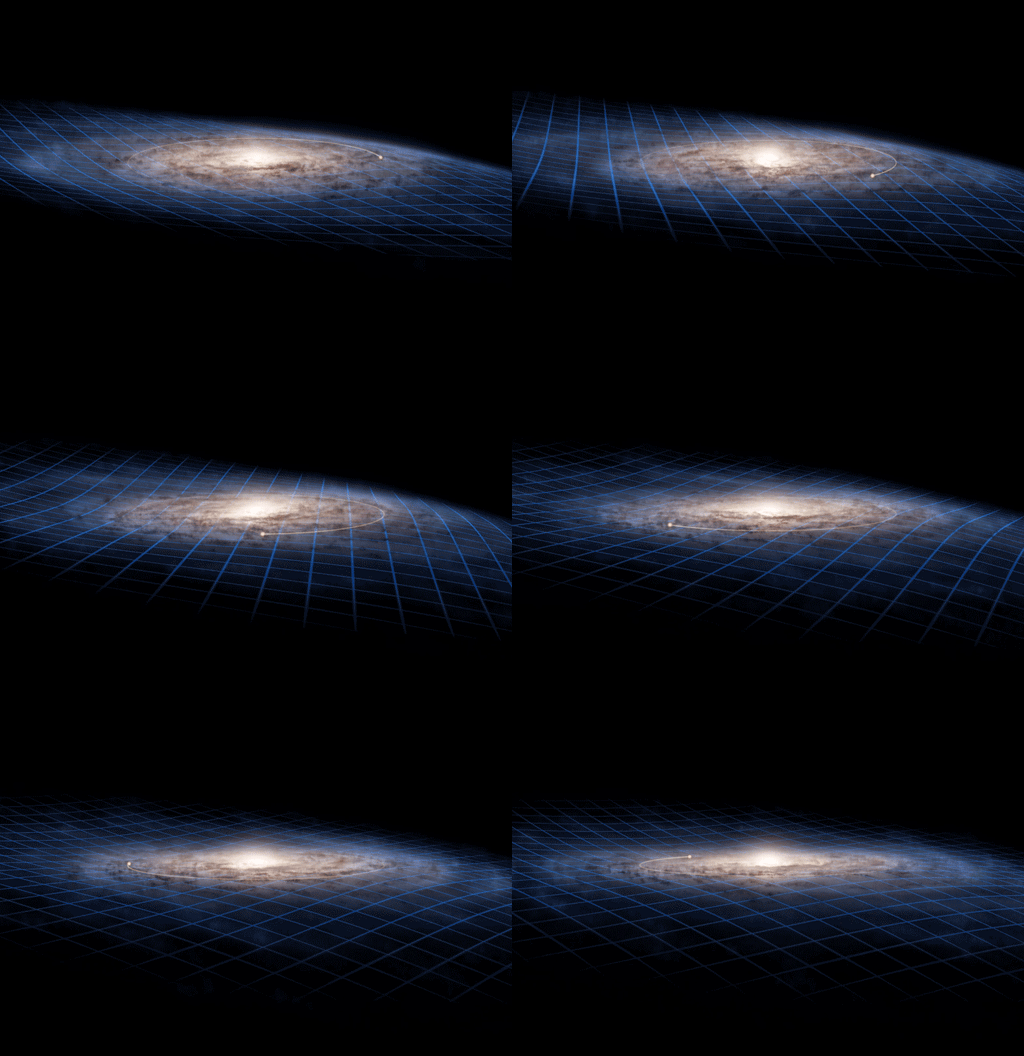
The Universe begins with negligible amounts of angular momentum, which is always conserved. So why do planets, stars, and galaxies all spin?