




















Search
Ethan Siegel
Theoretical astrophysicist and science writer

Ethan Siegel is a Ph.D. astrophysicist and author of "Starts with a Bang!" He is a science communicator, who professes physics and astronomy at various colleges. He has won numerous awards for science writing since 2008 for his blog, including the award for best science blog by the Institute of Physics. His two books "Treknology: The Science of Star Trek from Tricorders to Warp Drive" and "Beyond the Galaxy: How humanity looked beyond our Milky Way and discovered the entire Universe" are available for purchase at Amazon. Follow him on Twitter @startswithabang.
Read Less

It’s perhaps the most famous thought experiment in all of physics, but is full of popular myths and misconceptions. One of the most bizarre ideas about the quantum Universe is […]
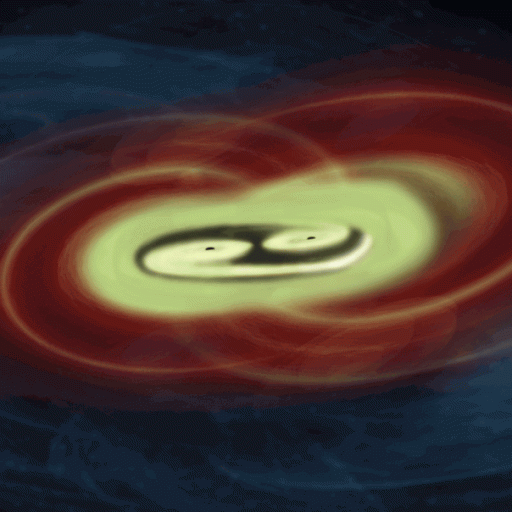
Light cannot escape from a black hole, no matter what. But when two black holes merge? They just might. On September 14, 2015, history was made as the NSF’s twin LIGO […]

It contains more water than all the Great Lakes combined, and the science of our planet explains why. Although practically all of Earth’s human population lives on dry land, our surface […]

CERN’s bold new proposal has physicists confronting the biggest question of all: is building a new collider worth it? If you want to discover anything novel about the natural, physical […]

Without a little help from Einstein, we couldn’t have made this discovery. NASA’s Hubble Space Telescope, currently celebrating its 30th anniversary, still churns out novel discoveries. The Hubble eXtreme Deep […]

This mystery comes in two varieties: repeating and non-repeating. Here’s what we know so far. Imagine that you were looking out at the distant Universe, watching the stars, galaxies, and the […]

This year’s June solstice coincides with a new Moon and an annular solar eclipse. Here’s how rare it truly is. As the Earth orbits the Sun, it rotates on its axis. […]

You never know what you’re going to find when you look somewhere new for the first time. Approximately 4600 feet (1400 meters) underground, beneath the Italian mountain known as Gran Sasso, […]

One look at the uncertainties and the assumptions changes the story tremendously. Is there intelligent life out there in the Milky Way beyond our own Solar System? If so, how […]

The view from beyond Pluto is far enough from Earth that we can see the stars shift. NASA’s New Horizons, humanity’s first spacecraft to encounter Pluto, is more than 4.3 billion […]

Nothing in the Universe can travel faster than the speed of light. So how does space itself do it? One of the fundamental rules we all learn in physics — set forth by […]

Even physicists sometimes fall for these. For centuries, the laws of physics seemed completely deterministic. If you knew where every particle was, how fast it was moving, and what the forces […]

Too little breathing room, tear gas, and insufficient masks are a recipe for disaster. Police are worsening all three. Across the nation and the world, people of all skin colors are […]

Solid, liquid, and gas are the three everyone learns. Plasma is the fourth. But there are two more, and they’re fascinating. How many states of matter are there? When you […]

In 2011, a bizarre, green object was discovered. At long last, we finally understand why. One of astronomy’s biggest surprises came in 2007, when a mysterious green object was found. […]

We’re looking back farther in time than ever before. Here’s what we’re finding. Even today, the Universe is forming enormous numbers of new stars: from various nebulae throughout our galaxy to […]

It happened 13.8 billion years ago, so why hasn’t the radiation all passed over us by now? For the past 13.8 billion years, our Universe has been expanding, cooling, and gravitating. […]

They said the “missing half” of the Universe’s matter was just found. But what they found barely makes a dent to the big picture. When we look up into the great […]

The origin of the 3rd element on the periodic table was one of the great cosmic mysteries. We just solved it. How did we form the elements that pervade the Universe […]

It’s not only about what’s happening right now. Things need to change for good. It could be your colleague, your coworker, your staff member, or your student. As the world mourns […]