










Francis Collins

Francis Collins

Director, NIH
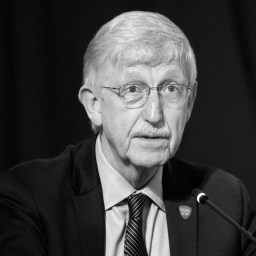
Dr. Francis Collins has served as the director of the National Institutes of Health since August, 2009. He is the former director of the National Human Genome Research Institute, where he led the successful effort to complete the Human Genome Project—which mapped and sequenced all of the human DNA and determined aspects of its function. The project built the foundation upon which subsequent genetic research is being performed. He is a member of the Institute of Medicine and the National Academy of Sciences.  In 2007 Collins received the Presidential Medal of Freedom, the nation's highest civilian honor, and in 2009 Pope Benedict XVI appointed him to the Pontifical Academy of Sciences.

Collins has also published several books about the intersection of science and faith, including the New York Times bestseller "The Language of God: A Scientist Presents Evidence for Belief."


A softly colored illustration of a double rainbow arches over a calm blue sea under a pastel sky, evoking harmony between religion and science.
4mins
Some scientists see religion as a threat to the scientific method that should be resisted. But faith "is really asking a different set of questions," says Collins.
John Templeton Foundation
I would not want to look forward to a culture where science lost and religious faith became the dominating force for truth.  I would not want to live in a culture where faith lost and science, with all of its reductionism and its materialism became the sole source of truth. 
What’s the evidence for the idea that God exists or doesn’t exist?
The so-called ‘Valley of Death’ is where a lot of research projects die. 
Francis Collins: we need to be prepared at any moment to defend the choices we’ve made as having had the best chance of benefiting real people out there who are counting on the NIH to use their money wisely.  
Conventional chemotherapy is like trying to turn off the lights in your kitchen by nuking your house. Personalized medicine will try to turn off the lights by flipping a switch.
3mins
NIH has to play a larger role in working with the private sector to get more effective treatments through the development pipeline, approved by the FDA, and into the hands […]
4mins
“Whether or not scientists are believers should not have a whole lot to do with how they conduct science,” says Collins. He wishes more scientists were willing “to stand up […]
4mins
Some scientists see religion as a threat to the scientific method that should be resisted. But faith “is really asking a different set of questions,” says Collins.
4mins
The NIH chief talks about attempts to factor an individual’s genetic profile into the way the person is diagnosed and treated.
4mins
The former director of the National Human Genome Research Institute describes how researchers compare DNA sequences to pinpoint which genes cause which diseases.
5mins
Recent uncertainty about whether federal funds can be used for for human embryonic stem cell research has “cast a cold chill” through the field, says Collins.
3mins
We must confront our national obesity crisis, warns NIH director Francis Collins, or face a decrease in life expectancy.
3mins
Having a smaller budget is forcing the NIH to be even more specific about how it sets priorities, and, in some instances, to close down productive programs.
3mins
The real “return” on research investments is in clinical benefits, diagnostics, therapeutics, and preventive measures. The lead time on those is often measured in years, so they can be hard […]
2mins
“Scientific opportunity has to be a big part of it,” says Francis Collins. Sometimes when a rare disease hits that moment of scientific opportunity it can reveal things about common […]
40mins
A conversation with the director of the National Institutes of Health.