











Lee Cronin

Lee Cronin

lee cronin

Dr. Lee Cronin was born in the UK and was fascinated with science and technology from an early age getting his first computer and chemistry set when he was eight years old. This is when he first started thinking about programming chemistry and looking for inorganic aliens. He went to the University of York where he completed both a degree and PhD in chemistry and then went on to do post-docs in Edinburgh and Germany before becoming a lecturer at the Universities of Birmingham, and then Glasgow where he has been since 2002, working up the ranks to become the Regius Professor of Chemistry in 2013 at age 39. He has one of the largest multidisciplinary, chemistry-based research teams in the world. He has given over 300 international talks and has authored over 350 peer-reviewed papers with recent work published in Nature, Science, and PNAS. He and his team are trying to make artificial life forms, find alien life, explore the digitization of chemistry, understand how information can be encoded into chemicals, and construct chemical computers.

Stylized illustration of Frankenstein's monster with outstretched arms against a red and orange background.
4 min
How do scientists measure and define life in the natural world? Dr. Lee Cronin gives us a definition, in 4 minutes:
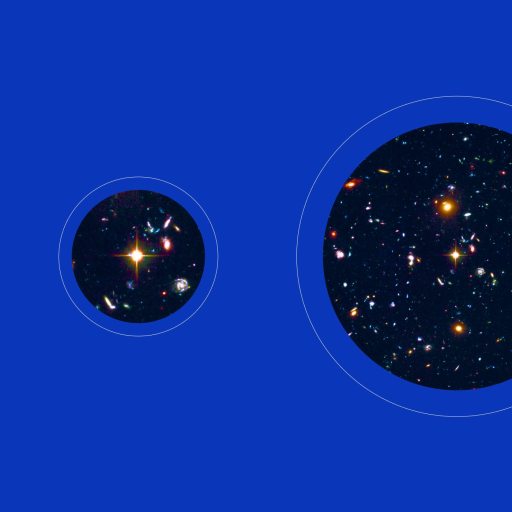
Three circles of increasing size, each containing images of distant stars and galaxies, set against a solid blue background.
3 min
What drives the universe's expansion? Chemist Lee Cronin explains the theories linking time, space, and selection, providing a fresh perspective on this cosmic mystery.
A hand is tossing two white dice with black dots against a dark background.
3 min
Don’t fall into the determinism trap. Everything is, in fact, random, says chemist Lee Cronin:
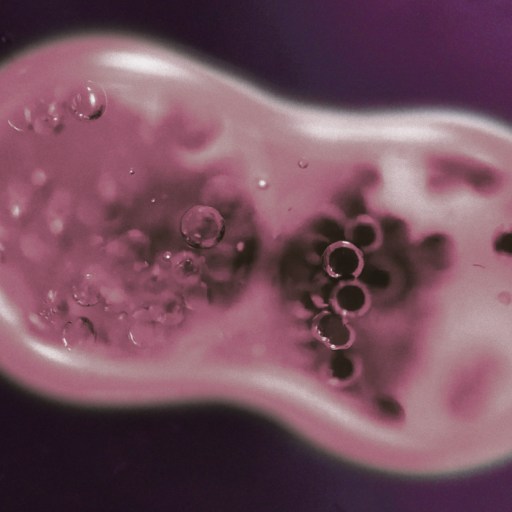
Microscopic close-up of a cell undergoing division, showing two forming daughter cells with visible internal structures against a purple background.
7 min
“The physics of the universe doesn't predict the emergence of biology.” Glasgow chemist Lee Cronin explains how inanimate matter becomes evolutionary:
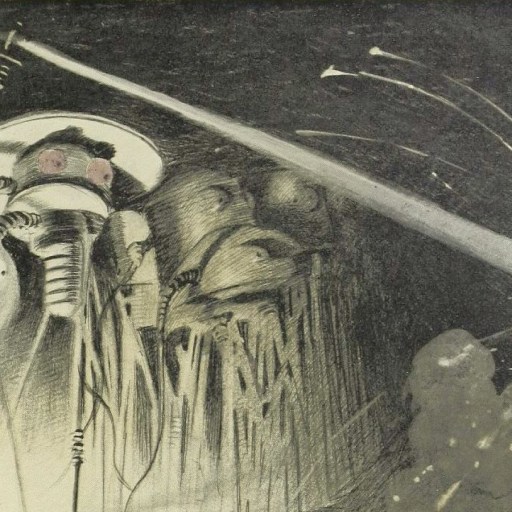
Illustration of large, mechanical tripod machines with glowing eyes detecting life as they shoot a beam of light at a smoking building, causing sparks and destruction.
The emergence of life in the universe is as certain as the emergence of matter, gravity, and the stars. Life is the universe developing a memory, and our chemical detection system could find it.
John Templeton Foundation