







Maria Konnikova

Maria Konnikova

New York Times Best-Selling Author, Journalist and Professional Poker Player

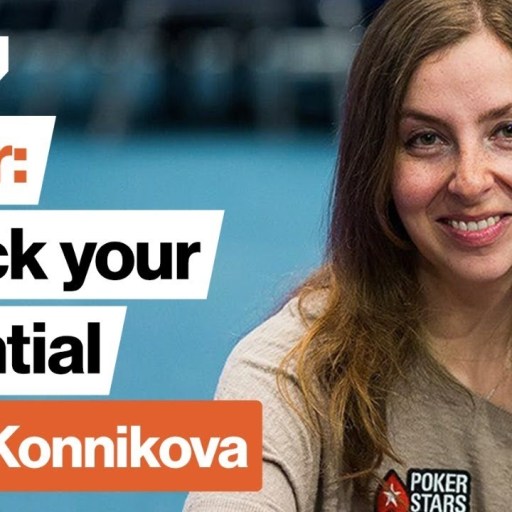
A woman with long brown hair, wearing a black top and a necklace, looks at the camera and smiles against a plain light background.

Maria Konnikova is the author of The Biggest Bluff, a New York Times bestseller, one of the Times’ “100 Notable Books of 2020,” and a finalist for the Telegraph Best Sports Writing Awards for 2021. Her previous books are the bestsellers: The Confidence Game, winner of the 2016 Robert P. Balles Prize in Critical Thinking, and Mastermind: How to Think Like Sherlock Holmes, an Anthony and Agatha Award finalist.

Konnikova is a regularly contributing writer for The New Yorker whose writing has won numerous awards, including the 2019 Excellence in Science Journalism Award from the Society of Personality and Social Psychology. While researching for The Biggest Bluff, Konnikova became an international poker champion and the winner of over $300,000 in tournament earnings — and inadvertently turned into a professional poker player. Konnikova’s writing has been featured in Best American Science and Nature Writing and has been translated into over twenty languages.

Konnikova also hosts the podcast The Grift from Panoply Media, a show that explores con artists and the lives they ruin. Her podcasting work earned her a National Magazine Award nomination in 2019.

She graduated from Harvard University and received her Ph.D. in psychology from Columbia University.

A yellow and black snake with a black background.
10mins
“Only a narcissist would want to become president.” This is the psychology of an authoritarian unpacked.
Illustration of a man smoking a pipe, with red handprint-shaped smoke rising from the pipe against a yellow background.
5mins
Poker pro Maria Konnikova on how to recognize which details matter and master the science of deduction.
Join Maria Konnikova live at 11am EDT tomorrow on Big Think!
3mins
Success isn't about finding one great way to achieve something and sticking with it. It's about looking at all the possible options and computing success through analysis.
7mins
Psychologist and writer Maria Konnikova on how to out-smart a con artist.
4mins
Psychologist and writer Maria Konnikova looks at the mechanisms of human nature that have allowed con artists, religious authorities, and cult leaders to prevail for thousands of years.
4mins
We tend to think con artists are smooth talkers and persuasive sellers, but listening is their most important quality, says Maria Konnikova, who has written a new book on con artistry.
3mins
The con artist is more of a psychologist than a thief, explains Maria Konnikova. If fact, con artists will never actually steal anything from you; they'll convince you to hand it over freely.
We all need to give ourselves mental breaks, but we also need to focus and not let email notifications, Twitter notifications, suck our attention.
We need to learn to train our attention because, as with anything, attention is like a muscle. 
Your brain learns to block out the noises that it hears all the time.
Maria Konnikova: the good news is that you can become more creative and I think that everyone has a certain degree of creativity in them.
Heavy multitaskers become worse at the very thing that they should be very good at. 
You can learn to argue with yourself. That’s actually how I get a lot of my thinking done. 
For whatever reason being in nature helps people become better at problem solving.
Experts should trust all of their instincts and their common sense in their areas of expertise. The problem comes when non-experts have "common sense opinion" that really is just coming out of nowhere. 
2mins
What are the things that I want to remember and that I want to be able to access later on and focus on remembering how to access them? And then […]
4mins
How can we train our brains to think like Sherlock Holmes? This question occupies Konnikova’s book, and her answer can be summed up in one word: mindfulness. Mindfulness is “staying […]
Today marks my last blog for Artful Choice. It has been an exciting year of writing about decisions small and big and the forces that help shape them and make […]