




















Search
Paul Ratner
Contributing Writer
Paul is a writer, filmmaker, and educator. He has written for years for Big Think and other outlets on transformative scientific research, history, and current events. His award-winning films like the true-life adventure "Moses on the Mesa" and the science documentary "The Caveman of Atomic City" have played at film festivals around the world. Paul also organizes numerous unique educational events, renowned film festivals, and competitions for thousands of people. He has degrees from Cornell University (BA) and Chapman University (MFA). You can follow Paul's work at paulratnerimagines.com, on Instagram, and Facebook.
Read Less

Japanese doctors reveal how AI software helped save the life of a cancer patient.

A first-ever full-body transplant will be performed by controversial Italian neurosurgeon Sergio Canavero who became famous when he enlarged on plans to remove the heads of two people.

A noted economist and futurist Robin Hanson sees a civilization of brain simulations or "ems" rising within the next 100 years.

The famous inventor Nikola Tesla shared his views on dieting and exercising that helped him think better and live longer.

Researchers create tiny implants that promise new medical treatments via breakthrough brain-machine interaction.

Ukraine's government is planning to turn the contaminated area around Chernobyl into a producer of renewable energy.

Nikola Tesla, one of history's most celebrated inventors, has an unexpected connection to the current U.S. Elections.

Many predictions by Nikola Tesla, one of the world's most celebrated inventors, have already come true and some might in the near future.

German researchers find an unexpected source for new antibiotics as growing drug resistance threatens to cause worldwide epidemics.

Researchers possibly identify LUCA, the common ancestor to all life on Earth, and figure out where it lived.

Researchers find an unlikely source for the next superfood.

A number of prominent world leaders are avowed atheists and there's no reason the American President has to be religious.

Several studies confirm that 2016 is shaping up to be the hottest year ever.

Modern terrorism has roots in a mythical sect of assassins from the time of the Crusades.

Studies confirm that having experiences makes us happier than material possessions.

The last Japanese manufacturer of VCRs stop production, marking the end of a technological era.

Neuroscientists create the ultimate map of the brain, greatly advancing our understanding and leading to potential new cures.

Saudi clerics see Pokemon Go as anti-Islamic and full of forbidden symbols and ideas (like evolution!), so have renewed their 2001 fatwa on it.
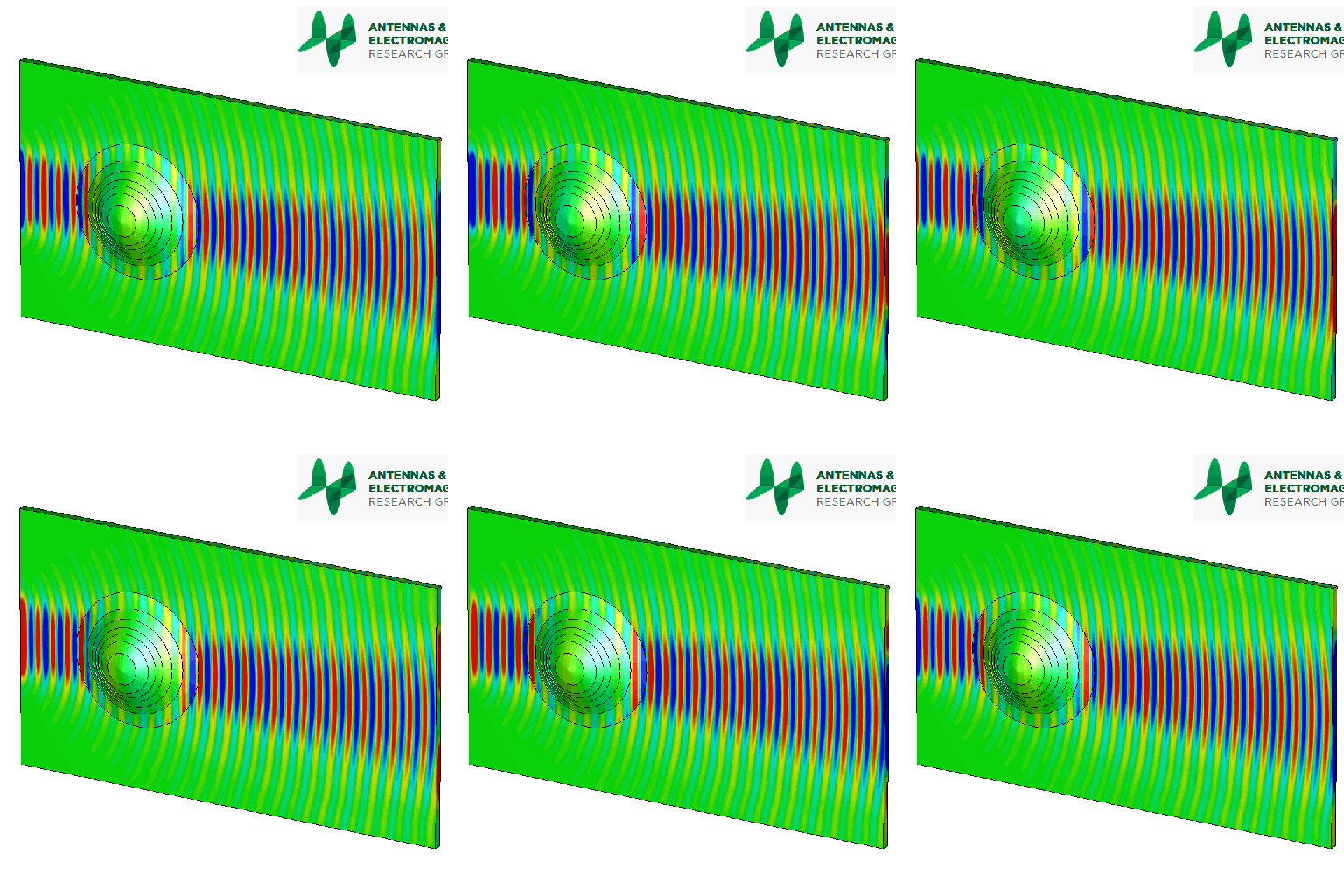
Scientists get one step closer to Harry Potter's invisibility cloak by creating a material that can conceal objects, with far-reaching commercial applications.

The man who lives a functional life with most of his brain filled with water challenges what we know about the brain.