




















Search
Simon Oxenham
The best and the worst of psychology and neuroscience
Simon Oxenham covers the best and the worst from the world of psychology and neuroscience. Formerly writing with the pseudonym "Neurobonkers", Simon has a history of debunking dodgy scientific research and tearing apart questionable science journalism in an irreverent style. Simon has written and blogged for publishers including: The Psychologist, Nature, Scientific American and The Guardian. His work has been praised in the New York Times and The Guardian and described in Pearson's Textbook of Psychology as "excoriating reviews of bad science/studies”.
Follow Simon on Twitter
Like Simon on Facebook
Follow Simon on Google+
Subscribe via Email
Subscribe via RSS
Contact Simon directly by Email
Read Less

Professor Richard Dawkins was once again recently the centre of controversy after the media suggested that he had claimed children should not be read fairy tales: “I think it’s rather […]

Solstice might just be my new favourite (non-)holiday. As the sun peaks its highest excursion relative to the celestial equator, we experience the longest day and the shortest night. This […]

I’ve just discovered what might just be my new favorite lecture on Youtube. Pseudonymous philosopher Sisyphus Redeemed describes a sample of the many ways we have been wrong throughout history […]
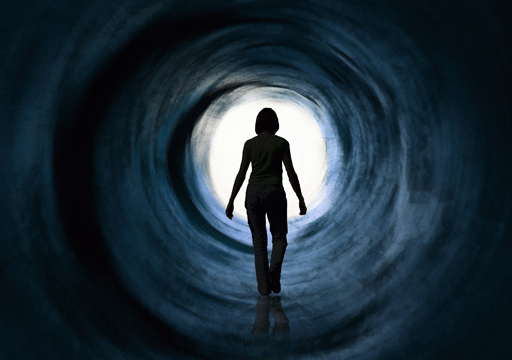
Have you ever found yourself taking an exam, working on a tight deadline, or solving an important time critical problem and becoming stuck; unable to progress because your brain won’t […]

I recently stumbled upon an excellent essay by Steven Poole in Aeon Magazine on teleology (the widely abandoned philosophical idea used to support arguments for intelligent design, that in nature, […]

Eight years ago professor of global health Hans Rosling delivered a TED talk that remains one of the most viewed TED talks of all time. This month at the Nordic […]

Recently a good friend told me over a pint in our local pub that he hadn’t been able to sleep a wink for two nights. He’d been left traumatised by […]

I was very surprised to see the following headline earlier today on a parenting website of all places: Just keep your promises: Going above and beyond does not pay off. […]

If you’re a regular at this blog, you’ll have picked up on my favourite theme – bad science (and bad science journalism) in the world of psychology and neuroscience. The […]

Walk into any modern university lecture theatre and you can expect to see a wall of laptop lids, with students’ eyes peering over them. Past research has demonstrated that laptops […]

Don’t read this blog post. Definitely don’t read it to the end. Didn’t I tell you not to read this blog post? You’re still doing it… We can laugh at […]

Imagine if I were to ask you to donate blood tomorrow. Now imagine that I were to offer you $7 to do the very same thing. Would this incentive make […]

A while back I wrote a post about the problem of pseudoscience in TED talks and how this problem was made so much worse by the failure across the board […]

According to an article published yesterday in Popular Mechanics based on an article published this week in Current Biology, a new application named “Ultimeyes” has been created that can train […]

Update March 25th 2014:The Psychiatric Timeshave republished the article along with responses from those involved. On 6th December 2013 the journal Psychiatric Times published an article online by Richard Noll, a […]

A spellbinding case of justified paranoia is documented this week in the New Yorker. Researcher Tyrone Hayes upset the manufacturer of the second most popular herbicide in the US (since […]

Coursera is a service that allows top universities around the world to share their material online. Without spending a penny I’ve completed courses on Coursera from universities including Stanford and […]

I’ve written a guest post over at Dean Burnett’s Guardian Science blog about an important piece of information that is not getting through to people who have had brain injuries. See […]

Over recent years a new industry has exploded that sells educational interventions purportedly based on neuroscience to schools. In 2006 a paper published in Nature Reviews Neuroscience reported that teachers […]

In a fascinating interview Stanford University psychological anthropologist Tanya Luhrmann describes meeting modern day “witches”, taking a “magic” course, experiencing bizarre (non-drug-induced) hallucinations and generally “hanging out in the magical […]