




















Search


Our mission is to answer the biggest questions of all, scientifically.
What is the Universe made of? How did it become the way it is today? Where did everything come from? What is the ultimate fate of the cosmos?
For most of human history, these questions had no clear answers. Today, they do. Starts With a Bang, written by Dr. Ethan Siegel, explores what we know about the universe and how we came to know it, bringing the latest discoveries in cosmology and astrophysics directly to you.
Read Less
with
Full Profile
Ethan Siegel is an award-winning PhD astrophysicist and the author of four books, including The Grand Cosmic Story, published by National Geographic.

Ask Ethan: What’s the biggest misconception in astronomy?
Many facts are well-known to professionals, but are unappreciated or even rejected outright by the public. "How stars work" takes the cake.


Most massive galaxies are spiral or elliptical shaped. But peculiar galaxies showcase the beautiful violence that helps explain our cosmos.

Early on, the Universe needed near-perfect flatness, or atoms, stars, and galaxies couldn't form. What happens once dark energy takes over?
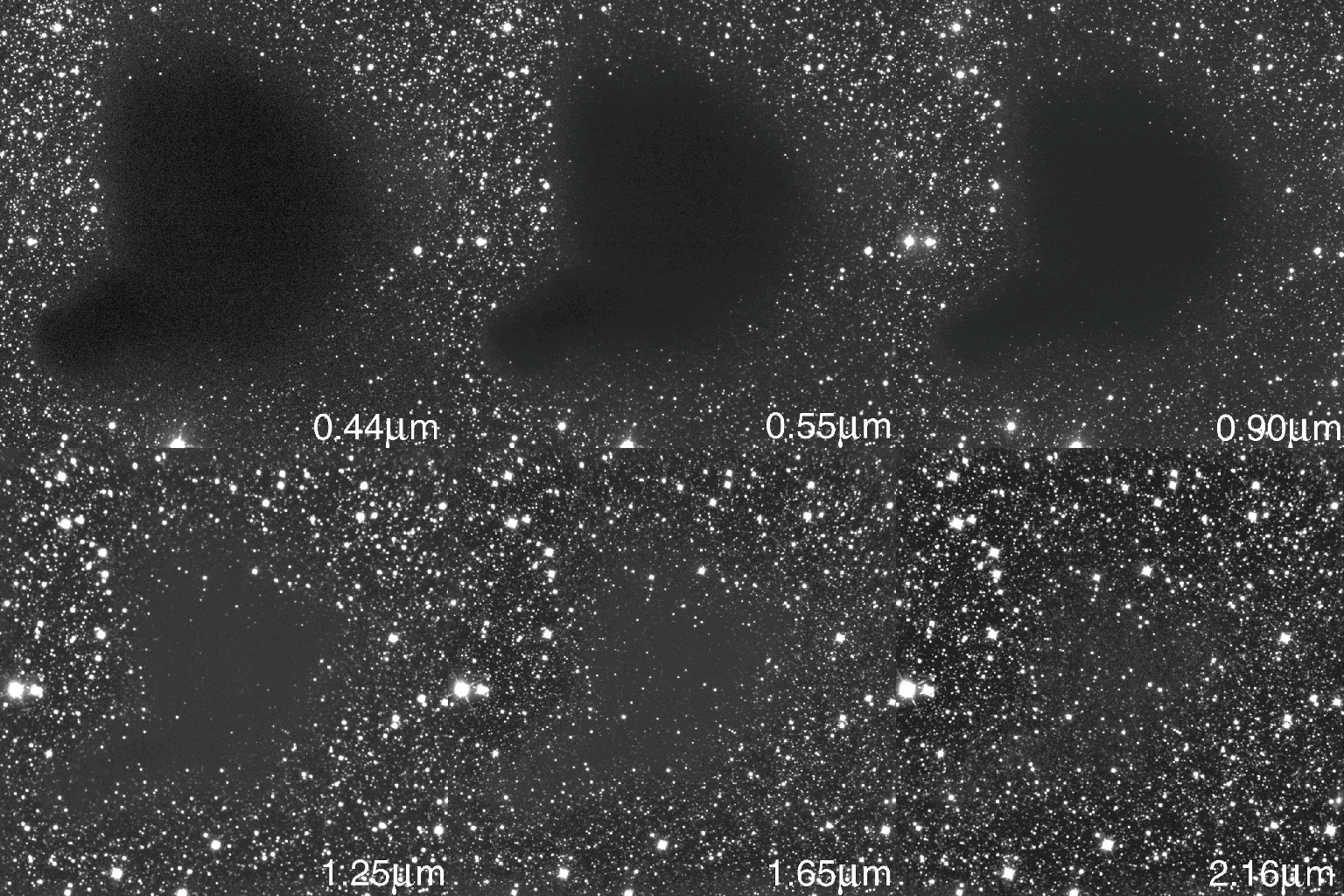
The image you're seeing isn't a hole in the Universe, and the cosmic voids that do exist aren't hole-like at all.

While LooksMaxxing often headlines the news, the idea of BrainMaxxing deserves real attention. Growing your mind never goes out of style.

We have two descriptions of the Universe that work perfectly well: general relativity and quantum physics. Too bad they don't work together.

Looking up at the night sky gives us a glimpse of the Universe beyond our terrestrial concerns. Here's the science of what's out there.

No matter what physical system we consider, nature always obeys the same fundamental laws. Must it be this way, and if so, why?

When what we predict and what we measure don't add up, that's a sign there's something new to learn. Could it be a new fundamental force?

The combination of charge conjugation, parity, and time-reversal symmetry is known as CPT. And it must never be broken. Ever.

In theory, the fabric of space could have been curved in any way imaginable. So why is the Universe flat when we measure it?

Binary black holes eventually inspiral and merge. That's why the OJ 287 system is destined for the most energetic event in history.

Over billions of years, fewer stars form, galaxies mutually recede, and the Universe becomes ever darker. Here's how fast it all happens.

Nothing lives forever, at least, not in the known Universe. But relativity allows us to get closer than ever: from a physics perspective.

The path to exploring the high-energy Universe was clear and compelling. Here's how 2025's cuts are still causing NASA casualties in 2026.

Not everyone accepts the scientific consensus; some even make careers out of challenging it. But only a select few do it the right way.

Resembling a cosmic brain, the Exposed Cranium Nebula instead shows a dying, massive star, as JWST reveals. Its fate remains uncertain.

What goes up into low-Earth orbit will eventually come down, bringing huge consequences with it. Be informed, not surprised!

In traveling through the expanding Universe, particles slow down while light and gravitational waves redshift. What degrades and what won't?

Smashing things together at unprecedented energies sounds dangerous. But it's nothing the Universe hasn't already seen, and survived.

No civilization, no matter how successful, can last forever. What does the non-detection of intelligent aliens mean for our own longevity?