




















Search


Our mission is to answer the biggest questions of all, scientifically.
What is the Universe made of? How did it become the way it is today? Where did everything come from? What is the ultimate fate of the cosmos?
For most of human history, these questions had no clear answers. Today, they do. Starts With a Bang, written by Dr. Ethan Siegel, explores what we know about the universe and how we came to know it, bringing the latest discoveries in cosmology and astrophysics directly to you.
Read Less
with
Full Profile
Ethan Siegel is an award-winning PhD astrophysicist and the author of four books, including The Grand Cosmic Story, published by National Geographic.

Ask Ethan: What’s the biggest misconception in astronomy?
Many facts are well-known to professionals, but are unappreciated or even rejected outright by the public. "How stars work" takes the cake.


The original principle of relativity, proposed by Galileo way back in the early 1600s, remains true in its unchanged form even today.

Most stars in the Universe are located in big, massive, Milky Way-like galaxies. But most galaxies aren't like ours at all.

The largest particle accelerator and collider ever built is the Large Hadron Collider at CERN. Why not go much, much bigger?

More than any other equation in physics, E = mc² is recognizable and profound. But what do we actually learn about reality from it?

The Michelson-Morley experiment of 1887, despite expectations, revealed a null result: no effect. The implications were revolutionary.

For centuries, Newton's inverse square law of gravity worked beautifully, but no one knew why. Here's how Einstein finally explained it.

From size to mass to density and more, each world in our Solar System is unique. When we compare them, the results are truly shocking.

Today, the Large Hadron Collider is the most powerful particle physics experiment in history. What would a new, successor collider teach us?

Dark matter's hallmark is that it gravitates, but shows no sign of interacting under any other force. Does that mean we'll never detect it?

Peaking on the night of August 11/12, up to 100 bright meteors per hour will be visible. Here's how to make the most of it.

Earth, the only rocky planet with a large, massive satellite, is greatly affected by the Moon. Destroying it would cause 7 major changes.

Straddling the bounds of science and religion, Newton wondered who set the planets in motion. Astrophysics reveals the answer.

How do normal matter and dark matter separate by so much when galaxy clusters collide? Astronomers find the surprising, unexpected answer.

Even in the very early Universe, there were heavy, supermassive black holes at the centers of galaxies. How did they get so big so fast?

Often viewed as a purely theoretical, calculational tool only, direct observation of the Lamb Shift proved their very real existence.
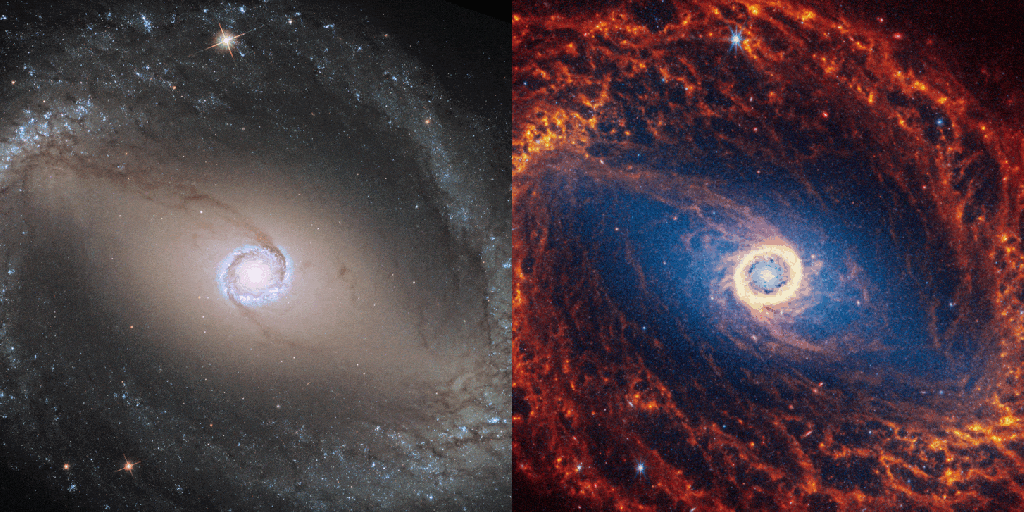
In July of 2022, the first science images from JWST were unveiled. Two years later, it's changed our view of the Universe.

A longstanding mismatch between theory and experiment motivated an exquisite muon measurement. At last, a theoretical solution has arrived.

The all-time record is Usain Bolt's 9.58 seconds, set in 2009. What is the fastest time, ultimately, for an ideal human body?

The passage of time is something we all experience, as it takes us from one moment to the next. But could it all just be an illusion?
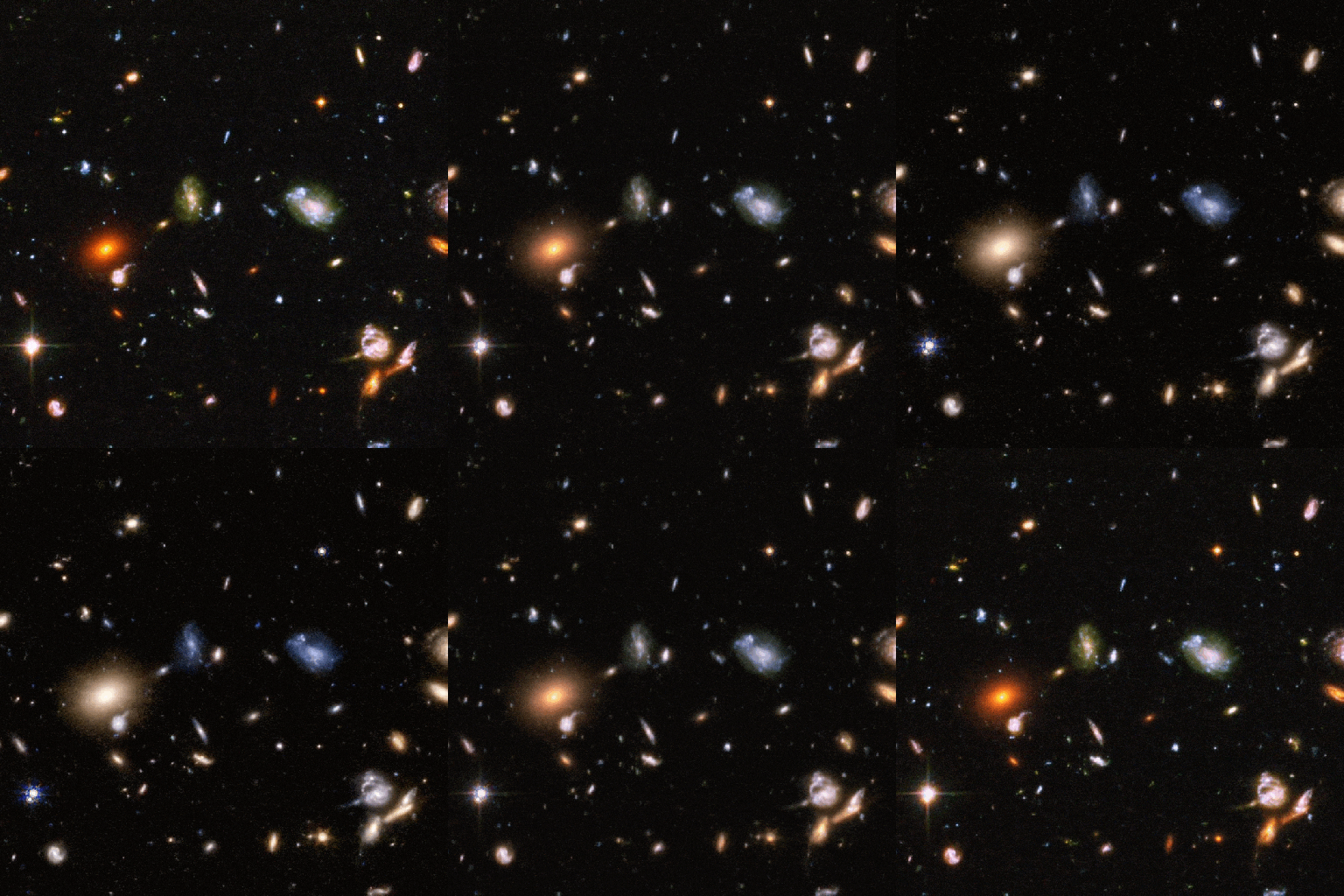
From inside our Solar System, zodiacal light prevents us from seeing true darkness. From billions of miles away, New Horizons finally can.