








Why Einstein called awe the fundamental emotionIf you’ve gotten goosebumps when hearing a story about a stranger’s selfless heroism, or you’ve felt your chest swell at...
How facing adversity can help you live a deeper, more meaningful life“There would be something very, very empty and meaningless about [a] sort of life with no problems.”
Can you measure love? 3 experts discussFrom neuroscience to philosophy, experts reveal why compassion may be the most important human skill we have.
How accepting impermanence can end the struggle to “fix” your life“The idea is that we move from a place of wanting the world to conform to what we like [towards]...
How your cognitive biases lead to terrible investing behaviors“Let me walk you through the biggest traps that you should be aware of that are a danger to your...
Is free will a fallacy? Science and philosophy explain.Philosophy asks if free will is real. Neuroscience reveals why the answer is more complicated than we expected.
Why 2025 is the single most pivotal year in our lifetime"We're living in an extraordinary moment in history. We are at a moment here in 2025 where we have world...
Even AI is self-censoring. Here’s why that matters.If the people controlling AI are biased, the output will also be. Free speech scholar Jacob Mchangama makes the case...
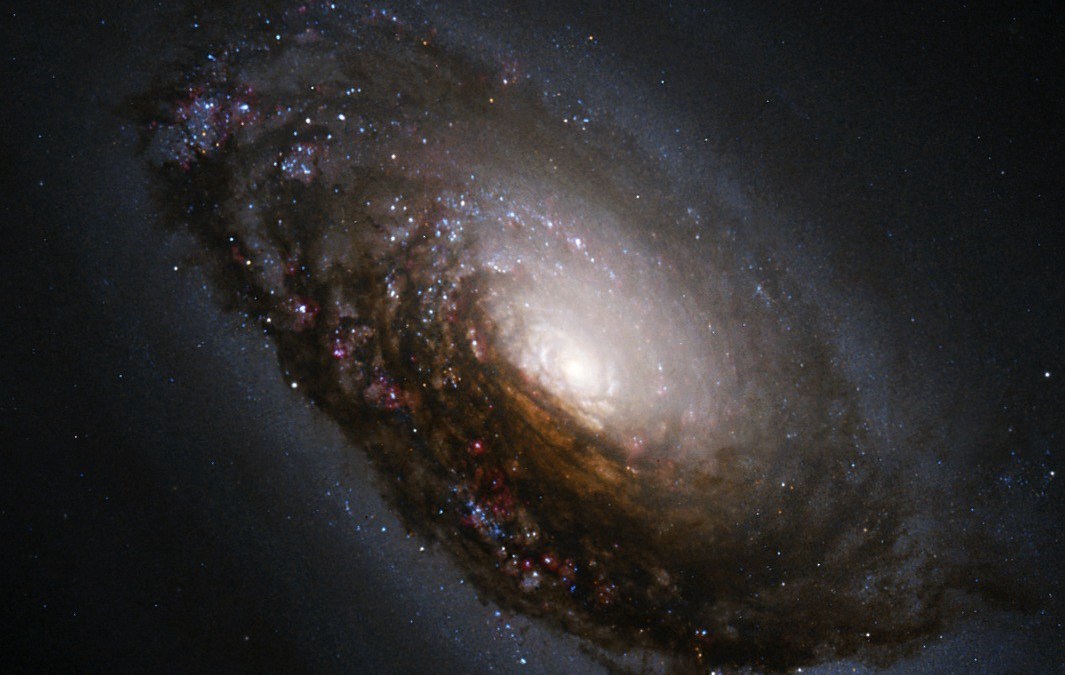
Mystery Solved: Why some galaxies appear darker on one half
Does your galaxy have a black eye? It’s not because of violence, I promise!“He ate and drank the precious Words,his Spirit grew robust;He knew no more that he was poor,nor that […]
When viewed face-on, galaxies appear to be relatively uniform, with new stars forming in the arms and dust lanes located all along them.
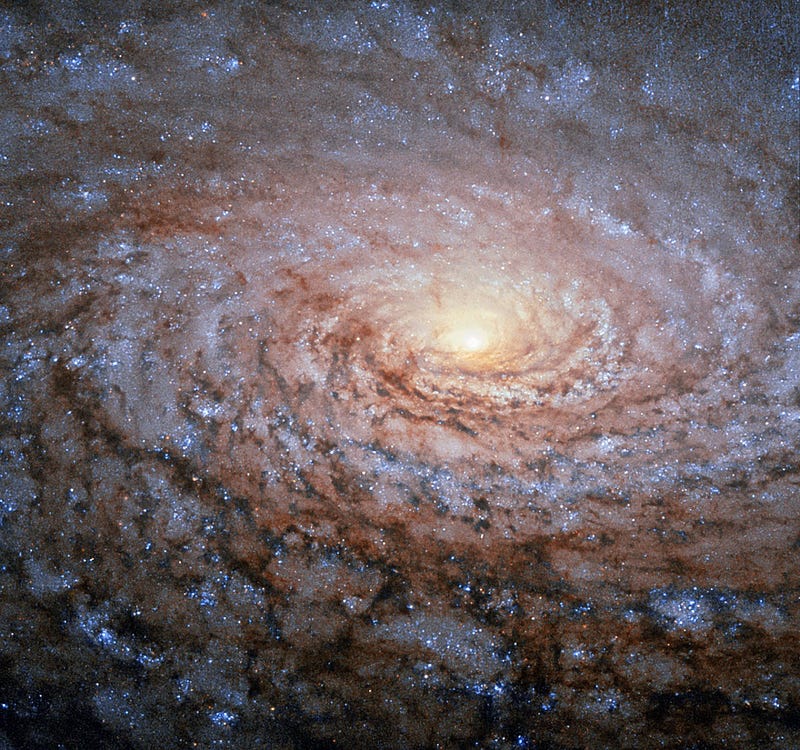
The Sunflower Galaxy, Messier 63, tilted relative to our line-of-sight, with one half clearly appearing dustier than the other. Image credit: ESA/Hubble & NASA.
But if a galaxy is tilted relative to us, one half inevitably appears darker and dustier than the other.
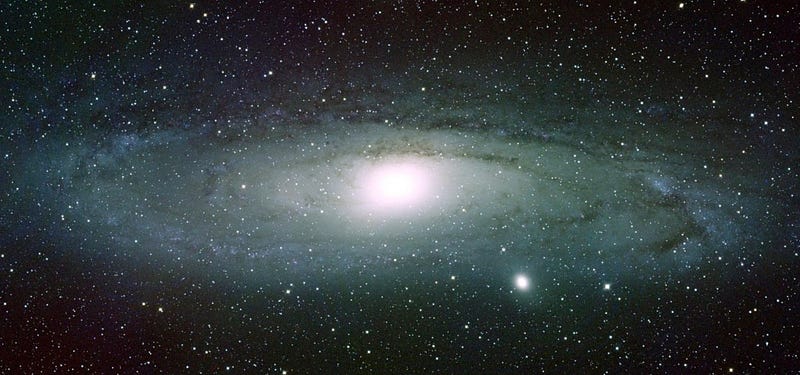
The Andromeda Galaxy, Messier 31, is significantly tilted with respect to us, and appears much dustier on one side than the other. Image credit: Bill Schoening, Vanessa Harvey/REU program/NOAO/AURA/NSF.
For many years, scientists wondered if this were actually the case, or if there were some trick occurring.
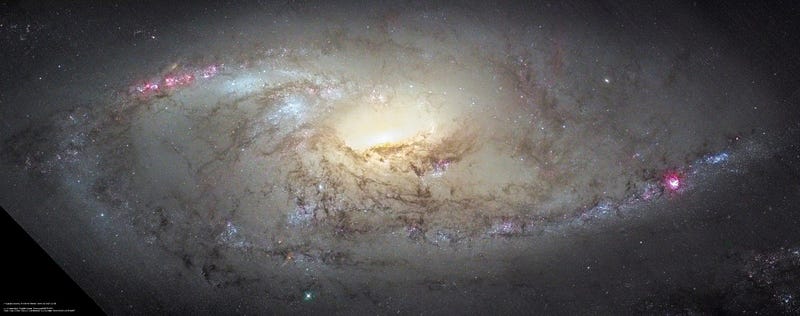
Messier 106, with the “bottom” side clearly dustier than the “top” side. Image credit: Hubble Legacy Archive; Adrian Zsilavec, Michelle Qualls, Adam Block / NOAO / AURA / NSF; Processing — André van der Hoeven.
The key is revealed by looking at an edge-on galaxy.
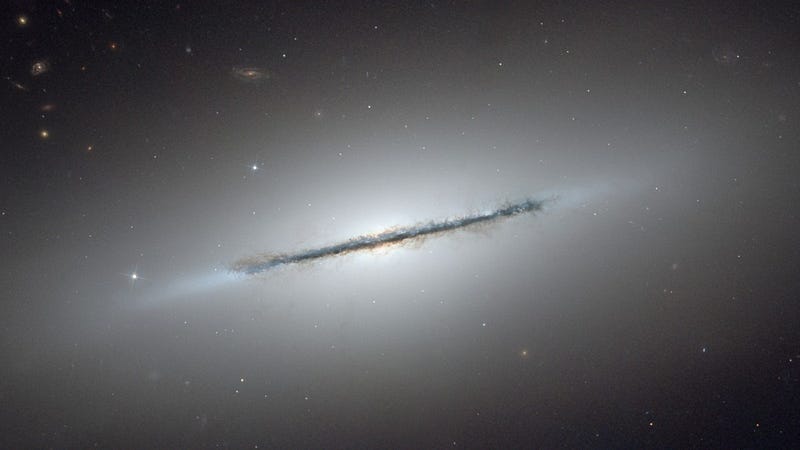
The Spindle Galaxy, NGC 5866, one of the finest edge-on galaxies visible from Earth. Image credit: NASA, ESA, and The Hubble Heritage Team (STScI/AURA).
Relative to where the stars are, the dust lane is narrow, and bisects the galactic plane.
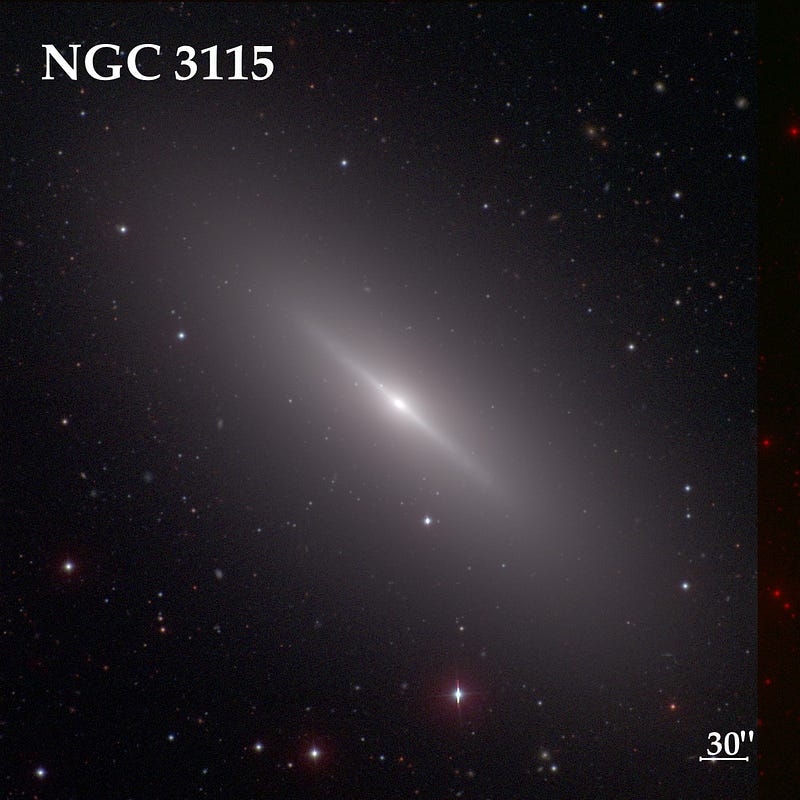
The starlight from the edge-on galaxy NGC 3115. Image credit: The Carnegie-Irvine Galaxy Survey (CGS).
In addition, the stars are more densely packed towards the galactic center, rather than the outskirts.
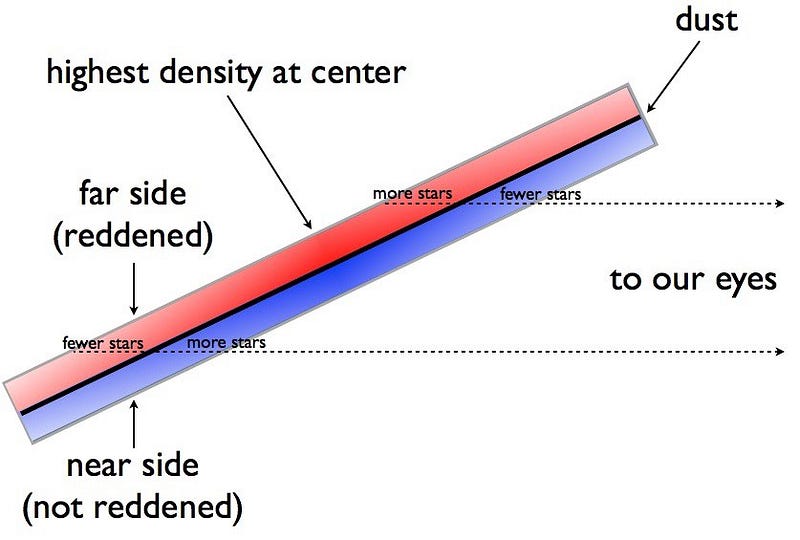
A simple model of a tilted galaxy with a dusty central region, demonstrating why the side tilted towards you appears dustier and the side tilted away from you appears more dust-free. Image credit: E. Siegel.
From our point-of-view, this means more stars are visible in front of the duston one half, while more stars are visible behind the dust on the other half.
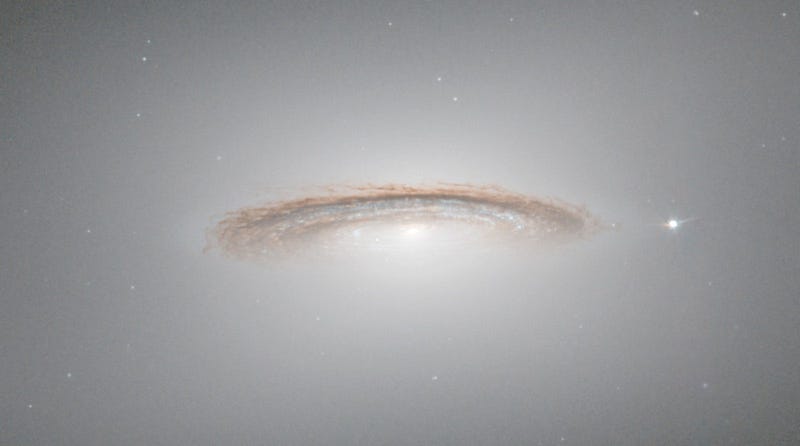
The dust-rich spiral galaxy NGC 4526, located in the Virgo Cluster of Galaxies. Image credit: ESA/Hubble & NASA; Acknowledgement: Judy Schmidt.
This results in one side appearing dustier, as the light from the stars behind the dust are obscured.
The stars visible in the Andromeda galaxy, in a dust-rich region and a dust-poor region. Images credit: Illustration Credit: NASA, ESA, and Z. Levay (STScI/AURA); Science Credit: NASA, ESA, J. Dalcanton, B.F. Williams, and L.C. Johnson (University of Washington), and the PHAT team, of a dusty region (top) and a relatively dust-free region (bottom).
This can render the dusty side redder, as blue wavelength light shining through the dust is scattered away almost completely.
Mostly Mute Monday tells the story of a single astronomical phenomenon or object primarily in visuals, with no more than 200 words of text.
George Raveling — the iconic leader who brought Michael Jordan to Nike — shares with Big Think a lifetime of priceless wisdom learned at the crossroads of sports and business.