

















This story appears in Starts with a Bang, our special column on astrophysics.
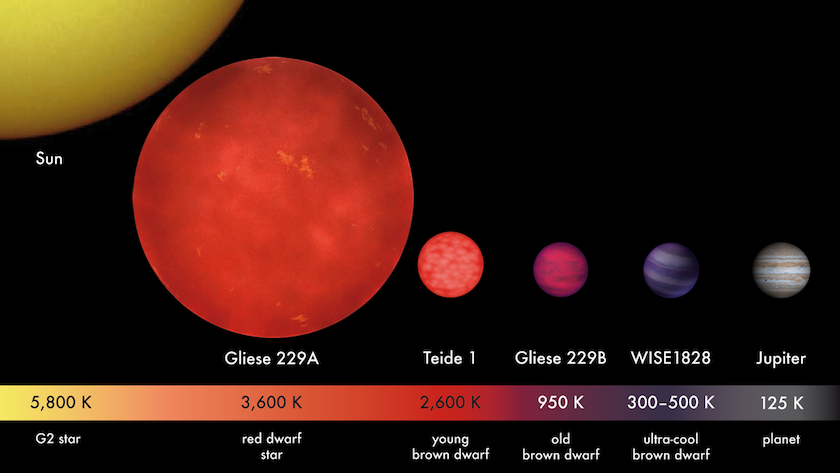
Out there in the Universe, there’s a whole lot more than simply what we find in our own Solar System. Here at home, the largest, most massive object is the Sun: a bright, hot, luminous star, while the second most massive object is Jupiter: a mere gas giant planet, exhibiting a small amount of self-compression due to the force of gravity.
But elsewhere in the Milky Way and beyond, numerous classes of objects exist in that murky “in-between” space. There are stars less luminous and lower in mass: the K-type stars as well as the most numerous star of all: the red dwarf. At even lower masses, there are brown dwarf stars, possessing various temperatures ranging from a little over ~1000 K all the way down to just ~250 K at the ultra-cool end.
These “in-between” objects, not massive enough to be a star but too massive to be a planet, have their own atmospheres, weather, and a variety of other properties. The thing that limits our knowledge of them, at present, is merely our own instruments. That’s why, on this edition of the Starts With A Bang podcast, I’m so pleased to welcome Dr. Brittany Miles, an expert on ultra-cool brown dwarfs and a specialist in instrumentation technology. If you were ever curious about these “in between” objects, you won’t want to miss this journey to the frontiers of modern astronomical science!
A theoretical astrophysicist and science writer, host of popular podcast “Starts with a Bang!”