




















Search
Cosmic Inflation

Known as the "past hypothesis" problem, the Universe's initially low entropy has long puzzled scientists. Now, cosmic inflation solves it.

Most massive galaxies are spiral or elliptical shaped. But peculiar galaxies showcase the beautiful violence that helps explain our cosmos.

Looking up at the night sky gives us a glimpse of the Universe beyond our terrestrial concerns. Here's the science of what's out there.

In theory, the fabric of space could have been curved in any way imaginable. So why is the Universe flat when we measure it?

In traveling through the expanding Universe, particles slow down while light and gravitational waves redshift. What degrades and what won't?

Smashing things together at unprecedented energies sounds dangerous. But it's nothing the Universe hasn't already seen, and survived.

Before we formed stars, atoms, elements, or even got rid of our antimatter, the Big Bang made neutrinos. And we finally found them.

Here in our modern Universe, it's cosmic dust that forms planets, complex molecules, and enables life. But how did the Universe create it?

When objects are gravitationally bound, they cannot escape from one another's influence. How does that work within the expanding Universe?

In a galaxy less than 300 million years after the Big Bang, oxygen's presence abounds. That's expected; its absence would truly be profound.

There will always be "wolf-criers" whose claims wither under scrutiny. But aliens are certainly out there, if science dares to find them.

Particles are everywhere, including particles from space that stream through the human body. Here's how they prove Einstein's relativity.

The highest-energy particles could be a sign of new, unexpected physics. But the simplest, most mundane explanation is particularly iron-ic.

While humanity has been skywatching since ancient times, much of our cosmic understanding has come about only recently. Very recently.

Our Universe doesn't just expand and cool, but the expansion itself is accelerating. Can stars form under such structure-erasing conditions?

Our Standard Model of the Universe, for both particle physics and cosmology, remains intact for now. When will its foundations crack?

Science has assembled an incredible story outlining our Universe's whole history. Despite its unrivaled success, 9 profound gaps remain.

Although American Thanksgiving only comes once a year, the scientific rules that make our Universe possible are always worth appreciating.

For over 10 billion years, the cosmic star-formation rate has been dropping and dropping. Someday, the final star in the Universe will die.
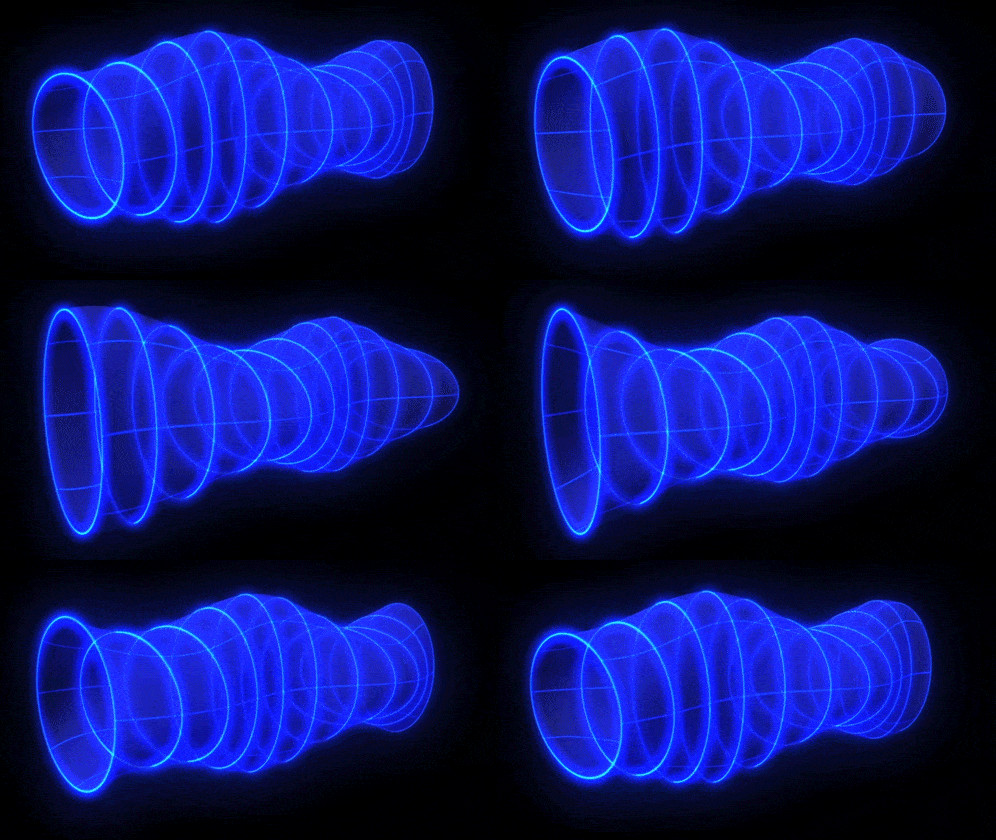
We've now detected hundreds of gravitational waves with LIGO, Virgo, and KAGRA. What if we tried Weber's original method in the modern day?

For 13.8 billion years, the Universe has been expanding. But that couldn't have been the case for an eternity, and science has proven it.

We've long known we can't go back to infinite temperatures and densities. But the hottest part of the hot Big Bang remains a cosmic mystery.

Inflation's two main criticisms, that it can predict anything and that the "measure problem" remains unsolved, can't erase its successes.
From the Big Bang to a prior period of cosmic inflation, our cosmic origins are clearer than ever. Yet these 5 big mysteries still remain.

The hot Big Bang is often touted as the beginning of the Universe. But there's one piece of evidence we can't ignore that shows otherwise.
As we gain new knowledge, our scientific picture of how the Universe works must evolve. This is a feature of the Big Bang, not a bug.

Questions about our origins, biologically, chemically, and cosmically, are the most profound ones we can ask. Here are today's best answers.

Dust is ubiquitous in the modern Universe, appearing in nearly all galaxies. But our cosmos was born dust-free. So where does it originate?

It's the origin of our entire observable Universe, but it's still not the very beginning of everything.

As we look to larger cosmic scales, we get a broader view of the expansive cosmic forest, eventually revealing the grandest views of all.