- Latest
-
Topics
Philosophy
Mind & Behavior
Business
-
Videos
Latest Videos
 Why Einstein called awe the fundamental emotion If you’ve gotten goosebumps when hearing a story about a stranger’s selfless heroism, or you’ve felt your chest swell at...
 How facing adversity can help you live a deeper, more meaningful life “There would be something very, very empty and meaningless about [a] sort of life with no problems.”
 Can you measure love? 3 experts discuss From neuroscience to philosophy, experts reveal why compassion may be the most important human skill we have.
 How accepting impermanence can end the struggle to “fix” your life “The idea is that we move from a place of wanting the world to conform to what we like [towards]...
 How your cognitive biases lead to terrible investing behaviors “Let me walk you through the biggest traps that you should be aware of that are a danger to your...
 Is free will a fallacy? Science and philosophy explain. Philosophy asks if free will is real. Neuroscience reveals why the answer is more complicated than we expected.
 Why 2025 is the single most pivotal year in our lifetime "We're living in an extraordinary moment in history. We are at a moment here in 2025 where we have world...
 Even AI is self-censoring. Here’s why that matters. If the people controlling AI are biased, the output will also be. Free speech scholar Jacob Mchangama makes the case...
 -
Columns
Columns
 Mini Philosophy Mini Philosophy is a space to explore ideas. It’s where we pause the busyness of life to reflect on ourselves,...
 Starts With A Bang Understand how the universe works with Ethan Siegel.
 Books Big Ideas. Thoughtful Conversations. One Book at a Time.
 The Long Game A Big Think Business column written by investor Eric Markowitz, focused on the philosophy and practice of long-term thinking.
 The Well Exploring life's biggest questions, publication by the John Templeton Foundation and Big Think.
 13.8 A series exploring the beauty and power of science in culture by Adam Frank and Marcelo Gleiser.
 -
Classes
Featured Classes
- My Account
- Sign In
- Membership
- More


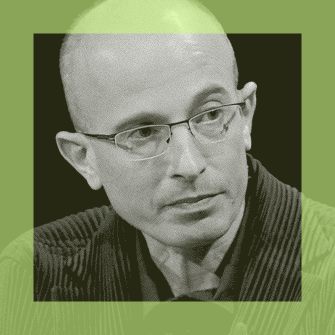

In 1996, William Gibson published the second book of his Bridge trilogy. Idoru tells the story of Colin Laney, who has the uncanny ability of quickly sorting through massive amounts of data in order to recognize "nodal points"—a skill Gibson claims requires a "non-rational process" of identifying "bits of the literal future right here." Here, biography and fiction clash, as the author wrote a bit of himself into the character.
When Gibson was interviewed for the BBC program, The Net—the network's five-year exploration of emerging technologies—host Benjamin Woolley claims most futurists get numerous details wrong, citing 1984, 2001, and Brave New World as examples.
Woolley's claim could have just been premature. The late media theorist, Neil Postman, wrote the prophetic Amusing Ourselves to Death in 1985. In it he claims that everyone thought we were going to see an Orewellian future, but it turned out to be much more Huxleyan. The basis of his work is that we have not been imprisoned by the state so much as our own ceaseless drive for constant distraction and pleasure. As his son, Andrew, writes about his father's work:
"An Orwellian world is much easier to recognize, and to oppose, than a Huxleyan," my father wrote. "Everything in our background has prepared us to know and resist a prison when the gates begin to close around us … [but] who is prepared to take arms against a sea of amusements?"
Maybe Woolley couldn't have foreseen the widespread dispersal of smart phones and the pleasure addicts they would create. He qualifies his above statement, however, claiming that these authors weren't writing about the future, but the present—a sentiment that segues to Gibson.
William Gibson.
Credit: Fred Armitage, 2007.
During the interview, Gibson comments on celebrity culture, an essential aspect of Idoru. In the book, SlitScan is the infotainment organization that exists to destroy media personalities; Colin Laney is a former employee. Who could possibly imagine a society in which massive amounts of data are mined to discover pain points to expose celebrities, politicians, and other public figures?
Gibson was informed by his own minor celebrity when penning Idoru, which he called "homeopathic doses" when compared to "rock stars." Still, he observed a massive shift in what we term "celebrity" on the horizon.
The digitalization of media will change the nature of celebrity in the future. I wouldn't hazard a guess as to how exactly that would happen. I think the most important difference with the internet and world wide web is that they're not top-down hierarchical structures on the order of broadcast television.
Even then Gibson recognized a power shift occurring in who would thrive in the emerging digital landscape.
A really talented and determined fifteen-year-old can create a website in his bedroom that's a more entertaining environment than something a multinational entertainment conglomerate might come up with, and in fact that happens rather consistently. The good ones tend to be put together by kids and the ones put together by major corporations are rather dull and behind the curve.
The heart of this interview revolves around Gibson's coining of the term "cyberspace," from his breakaway 1984 debut, Neuromancer. Turns out he wrote that book on a typewriter, envisioning what the awesome power of computers would become. It just so happens that his book was published the same year the first Macintosh personal computer was made available to the public.
Gibson claims that he got it wrong in that Orwellian year. He had envisioned the world wide web as a corporatized prison, not a vehicle for exchanging recipes with relatives in West Germany or other seemingly benign personal uses. In 1996, true decentralization of information seemed right around the corner.
When I wrote Neuromancer, there was effectively no internet to extrapolate from. The cyberspace I made up isn't being used in Neuromancer the way we're using the internet today. In Neuromancer, it's all corporate, effuse cybernetic car thieves skulking through it attempting to steal tidbits of information. In my later work, I've had to deal with what the internet has become.
William Gibson: Technology, Science Fiction & the Apocalypse
Yet again: too soon. Tear down one corporate structure another comes rushing in. Net neutrality remains a serious threat to the democratization of information and power online. Our data is being shared and sold in increasingly troublesome ways. We can still share recipes with German relatives, yet those ingredient lists are its own cottage industry. Mention spätzle within earshot of Alexa and expect an assault of pasta ads to dominate your browser.
Hoarding information in hopes of discovering "nodal points" has become a lucrative occupation for corporations. Gibson was certainly not wrong in his assessment, it just took a little longer than he expected. As he notes in 1997:
We're still in the phase where computation is still a sort of middle class pastime. Given the market forces driving the computer industry, we'll see it spread through the whole society. It should fairly soon, I think it would evolve into something like television to the extent that it penetrates every level of society.
Gibson claims all of his work centers on uncovering the "unintended consequences of new technologies." He does not believe fear to be the appropriate course of action, however, an interesting observation given how information is used to drive political fearmongering today. His suggestion is more nuanced, requiring foresight that many don't seem equipped to offer given where we've ended up.
Technophobia or technophilia are not appropriate responses to new technology. The only appropriate response is the most profound ambivalence. That's what we owe new technologies—we have to teach ourselves to be absolutely ambivalent about them and imagine their most inadvertent side effects. The most inadvertent side effects are the side effects that tend to get us.
--
Stay in touch with Derek on Twitter and Facebook.
How social networks shaped 500 years of revolutionary progress
No transcript available for this video.