














Steven Pinker

Steven Pinker

Johnstone Family Professor in the Department of Psychology at Harvard University

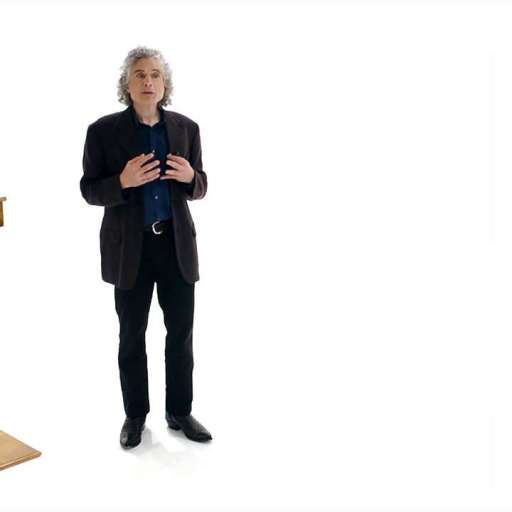
A man with curly gray hair wearing a blue suit, white shirt, and dark tie poses against a plain light background.

Steven Pinker is an experimental psychologist who conducts research in visual cognition, psycholinguistics, and social relations. He grew up in Montreal and earned his BA from McGill and his Ph.D. from Harvard. Currently Johnstone Professor of Psychology at Harvard, he has also taught at Stanford and MIT. He has won numerous prizes for his research, his teaching, and his books, including The Language Instinct, How the Mind Works, The Blank Slate, The Better Angels of Our Nature, The Sense of Style, and Enlightenment Now. He is an elected member of the National Academy of Sciences, a two-time Pulitzer Prize finalist, a Humanist of the Year, a recipient of nine honorary doctorates, and one of Foreign Policy’s “World’s Top 100 Public Intellectuals” and TIME’s “100 Most Influential People in the World Today.” He was chair of the Usage Panel of the American Heritage Dictionary and writes frequently for The New York Times, The Guardian, and other publications. His twelfth book is called Rationality: What It Is, Why It Seems Scarce, Why It Matters.
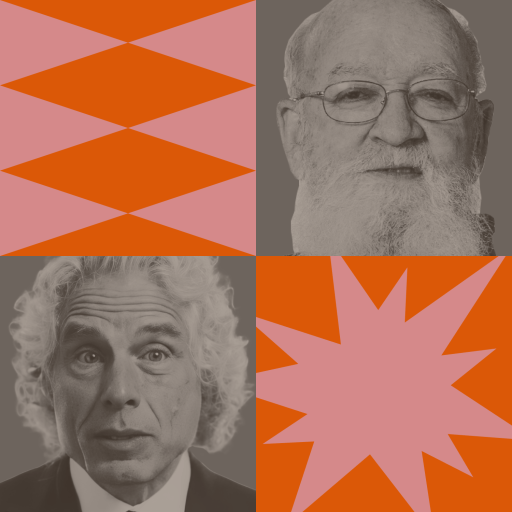
A grid with two grayscale portraits of older men with glasses and curly hair, separated by pink and orange geometric shapes.
Members
This class, featuring insights from experts like Steven Pinker and Gary Marcus, equips learners with critical thinking tools to navigate biases, understand scientific research, and make informed decisions in a media-saturated world, emphasizing the importance of questioning assumptions and grounding perceptions in data.
A geometric composition with green, pink, and blue overlapping shapes, each containing intricate, vintage anatomical line drawings on a textured background.
Members
This class explores human decision-making, emphasizing humility and data-driven analysis while addressing cognitive biases like availability bias and confirmation bias, ultimately equipping participants with strategies to improve judgment and navigate complex choices through a blend of psychological insights and practical applications.
A young girl with light brown hair sits with her knees drawn up, looking down, illustrated blue teardrops on her face—capturing a quiet moment that reflects why humans cry.
In this excerpt from "When Everyone Knows That Everyone Knows...," Steven Pinker examines how crying may have evolved as part of a suite of emotional expressions aimed at strengthening social bonds.
a collage of a woman's face with a colorful background.
1hr 19mins
Steven Pinker explains how to cultivate greater rationality in today's complex world.
5mins
The formula for rational thinking explained by Steven Pinker.
7mins
Is it better to be rational or optimistic? Steven Pinker explains.
3mins
We need to enact policies founded on solid research — more importantly, though, we have to stop suppressing research into hot topics.
3mins
The processes behind our ability to make decisions are complex, but they're not miracles.
5mins
Without expressing and evaluating ideas, we would never be able to determine what's right or wrong.
In practice, no one has ever developed a democracy that works particularly well if judged in absolute terms. But all the alternatives so far have been worse.
4mins
When we see problems in the world, we're quick to blame someone—anyone—who should be providing peace, love, and harmony. But the universe actually bends toward chaos and decay.
4mins
It might seem like humanity disagrees over basic values, but the data is in: we actually don't.
"The starting point for understanding inequality in the context of human progress is to recognize that income inequality is not a fundamental component of well-being."
2mins
Steven Pinker believes there's some interesting gender psychology at play when it comes to the robopocalypse. Could artificial intelligence become evil or are alpha male scientists just projecting?
3mins
If you want to understand trends in the history of global violence, look to data, not headlines, says Harvard psychology professor and linguist Steven Pinker.
6mins
Today's video is part of a series on genius, in proud collaboration with 92Y's 7 Days of Genius Festival.
50mins
Professor Steven Pinker illustrates how the study of linguistics can give us a rare window into the conscious mind.
3mins
In this selection from his Floating University lecture, Professor Steven Pinker deduces the nature of language acquisition by examining the generative use of grammar in children.