- Latest
-
Topics
Philosophy
Mind & Behavior
Business
-
Videos
Latest Videos
 Why Einstein called awe the fundamental emotion If you’ve gotten goosebumps when hearing a story about a stranger’s selfless heroism, or you’ve felt your chest swell at...
 How facing adversity can help you live a deeper, more meaningful life “There would be something very, very empty and meaningless about [a] sort of life with no problems.”
 Can you measure love? 3 experts discuss From neuroscience to philosophy, experts reveal why compassion may be the most important human skill we have.
 How accepting impermanence can end the struggle to “fix” your life “The idea is that we move from a place of wanting the world to conform to what we like [towards]...
 How your cognitive biases lead to terrible investing behaviors “Let me walk you through the biggest traps that you should be aware of that are a danger to your...
 Is free will a fallacy? Science and philosophy explain. Philosophy asks if free will is real. Neuroscience reveals why the answer is more complicated than we expected.
 Why 2025 is the single most pivotal year in our lifetime "We're living in an extraordinary moment in history. We are at a moment here in 2025 where we have world...
 Even AI is self-censoring. Here’s why that matters. If the people controlling AI are biased, the output will also be. Free speech scholar Jacob Mchangama makes the case...
 -
Columns
Columns
 Mini Philosophy Mini Philosophy is a space to explore ideas. It’s where we pause the busyness of life to reflect on ourselves,...
 Starts With A Bang Understand how the universe works with Ethan Siegel.
 Books Big Ideas. Thoughtful Conversations. One Book at a Time.
 The Long Game A Big Think Business column written by investor Eric Markowitz, focused on the philosophy and practice of long-term thinking.
 The Well Exploring life's biggest questions, publication by the John Templeton Foundation and Big Think.
 13.8 A series exploring the beauty and power of science in culture by Adam Frank and Marcelo Gleiser.
 -
Classes
Featured Classes
- My Account
- Sign In
- Membership
- More


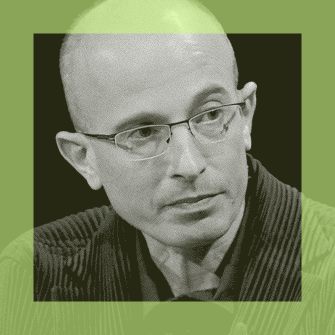




Peter Singer on the ethics of how drones are like viruses and vice-versa.
The push of a button was never considered a violent act until the 20th century. Cold War films like Dr. Strangelove turned the "Doomsday" button--the launch of nuclear missiles which assured mutual self-destruction between East and West--into a cultural icon.
In recent years, with the boom of video games, war is no longer about the push of a single button, but rather now conjures up images of playing a computer game. In the resurrected series Arrested Development, the smothered son Buster enlists in the military to escape his overbearing mother; someone as helpless as him finds success playing what he believes to be is a video game. To his horror, he eventually learns that he's actually commanding drones.
As this satire illustrates, our drones--all technology--are only as smart and as ethical as those controlling it.
Peter Singer, the director of the Center for 21st Century Security and Intelligence and a senior fellow in the Foreign Policy program, spoke to Big Think about shifting war technologies and ethical issues.
As Singer explains, how we wage war continues to advance in ways that may one day bring to life science fiction:
There’s been an enormous amount of changing forces on warfare in the twenty-first century. And they range from new actors in war like private contractors, the black waters of the world to the growth of warlord and child soldier groups to technological shifts. The introduction of robotics to cyber. And one of the interesting things that ties these together is how not only the who of war is being expanded but also the where and the when. So one of the things that links, for example, drones and robotics with cyber weapons is that you’re seeing a shift in both the geographic location of the human role. Humans are still involved. We’re not in the world of the Terminator. Humans are still involved but there’s been a geographic shift where the operation can be happening in Pakistan but the person flying the plane might be back in Nevada 7,000 miles away.
But new tricks bring up age-old debates. Singer touches on Stuxnet, a computer virus that attacked Iran's nuclear centrifuge seemingly undetected. A cyberweapon seems less violent, of course, than traditional forms of warfare. But even cyberwarfare is not free from ethical scrutiny, as Singer points:
One of the next steps in this both with the physical side of robotics and the software side of cyber is a shift in that human role – not just geographically but chronologically where the humans are still making decisions but they’re sending the weapon out in the world to then make its own decisions as it plays out there. In robotics we think about this as autonomy. With Stuxnet it was a weapon. It was a weapon like anything else in history, you know, a stone, a drone – it caused physical damage...
On one hand we can say this may have been the first ethical weapons ever developed. Again whether we’re talking about the robots or Stuxnet, they can be programmed to do things that we would describe as potentially ethical. So Stuxnet could only cause harm to its intended target. Yet popped up in 25,000 computers around the world but it could only harm the ones with this particular setup, this particular geographic location of doing nuclear research. In fact, even if you had nuclear centrifuges in your basement, it still wouldn’t harm them. It could only hit those Iranian ones. Wow, that’s great but as the person who discovered it so to speak put it, “It’s like opening Pandora’s box.” And not everyone is going to program it that way with ethics in mind.
For Singer's complete interview, watch the video.