













Test Special Issue

Game Change

Do elite athletes really make elite employees?

Sports, we tend to assume, offer a sharp-edged reflection of business life in microcosm — leadership under pressure, the winning mentality, valuable lessons drawn from loss. It’s all there. Just kick back with a beer and a pizza and watch your pathway to workplace success unfold on game day. Well, it turns out that the connections are often far more nuanced than we might have presumed. Do elite athletes really make elite employees? What’s the connection between Swedish pragmatics in soccer and a thriving startup culture? Have you factored in the difference between “wicked” and “kind” environments (and what does that even mean)? We investigate all of these pivotal tangents, and much more, in this Big Think special collection of essays, interviews, and curated book excerpts. Forget everything you’ve been told about the synergies between sports and business. It’s time to rewrite the rules.

Blue background with the words "Game Change" in white, surrounded by strategic game symbols and graphs in the background.
Presented by
John Templeton Foundation
Why do we fall in love with one person over another? The late biological anthropologist Dr. Helen Fisher unpacks the evolutionary roots of romantic love, sex, and attachment.  Using research […]
A digital illustration showing a glowing blue particle on the left, evoking cosmic inflation, transitioning into a geometric, grid-like structure on a purple background on the right.
A few physical quantities, in all laboratory experiments, are always conserved: including energy. But for the entire Universe? Not so much.
A woman, resembling a paranormal investigator, holds a rectangular glass dish above her eyes, which are illuminated by light shining through the dish in a dark setting.
For his new book, “The Ghost Lab,” Matt Hongoltz-Hetling spent time with paranormal investigators to understand their relationship with science and society.
Two men in suits stand in front of a graphic collage featuring technical drawings and a building with solar panels, overlaid with the text "The Nightcrawler," evoking innovation that stands the test of stellar age.
Welcome to The Nightcrawler — a weekly newsletter from Eric Markowitz covering tech, innovation, and long-term thinking.
A heart shape is cut out of paper, revealing a circuit board with computer chips and code underneath.
4mins
"If we did create beings that were more like non-human animals, we ought to treat them much better than we now treat non-human animals."
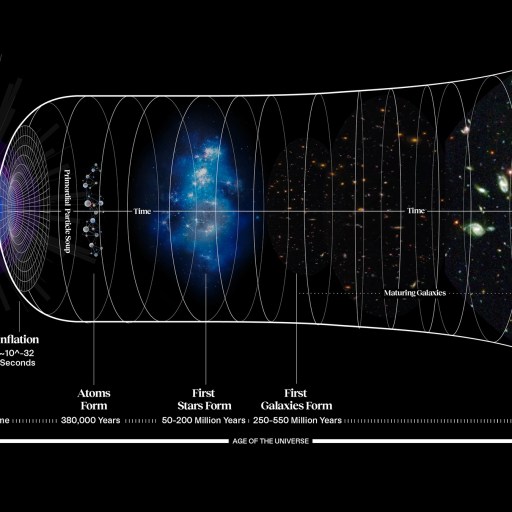
Timeline of the universe from the Big Bang, as described in cosmology, showing inflation, formation of atoms, stars, galaxies, and expansion to the present day over 13.8 billion years.
If you want to understand the Universe, cosmologically, you just can't do it without the Friedmann equation. With it, the cosmos is yours.
A large yellow hot air balloon with a smiley face is shown on the left; on the right, a bunch of parfit smiley face balloons float against a cloudy sky.
If happiness is an absolute good, would 1 billion slightly happy people be better than 1 million incredibly happy people?
A man wearing a black blazer, graphic T-shirt, and backwards cap stands against a plain background with his hands raised in a questioning gesture.
6mins
“You might as well go for it. You might as well do the thing that you dream about doing for heaven's sake.”
A blue planet with visible rings and several small, bright Uranus moons is set against a darkened black background.
Viewing Uranus's largest moons with Hubble, astronomers hoped to find darkening on the trailing side. They found the exact opposite instead.
A worker in protective gear operates machinery in an industrial facility, with a partial overlay of solar panels and geometric patterns above—hinting at the innovative spirit found in stellar societies.
The cofounders of think tank RethinkX are convinced that humanity is undergoing civilizational phase change.
A white dinosaur skull silhouette on a black background with red, rough, scribbled lines evokes the intrigue of the dinosaur myth.
In "The Shortest History of the Dinosaurs," Riley Black reveals the bold mammals that thrived in the Age of Reptiles.
Book cover for "Speak, Memorably: The Art of Captivating an Audience" by Bill McGowan and Juliana Silva, featuring "an excerpt from" on a split orange and light background, inspired by Francis Coppola’s distinctive visual storytelling.
The “primacy/recency effect” is used by celebrated movie-makers, Broadway composers, and restaurateurs — it can work for you too.
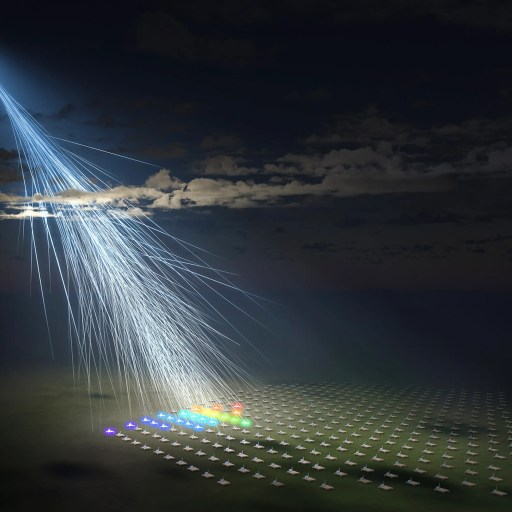
An illustration shows a cosmic ray entering Earth’s atmosphere, creating a cascade of secondary particles—some of the highest energy particles astronomers study—detected by an array of sensors on the ground.
On Earth, our particle accelerators can reach tera-electron-volt (TeV) energies. Particles from space are thousands of times as energetic.
A silhouette of a person stands facing a wireframe digital figure on a purple patterned background.
"We are racing towards a new era in which we outsource cognitive abilities that are central to our identity as thinking beings," writes computer scientist Louis Rosenberg.
Black-and-white portrait of Steve Hanke, an older man in a suit and glasses, centered on a background with graph lines and dotted patterns.
The veteran economist joins Big Think to unpack the new rules of social media, explain tariffs, and recount his adventures in Albania.
A person sits alone on a bench against a yellow background, looking down at a smartphone.
12mins
“You can debate all sorts of things about how the texture of American life has changed. What you can't debate is the sheer, objective, existential fact that Americans are more alone than ever.”
A petri dish containing various colorful bacterial colonies growing on agar, viewed from above against a dark background.
6mins
These microbes endured the unlivable. The NASA astrobiologist who studies them reveals what that means for us today
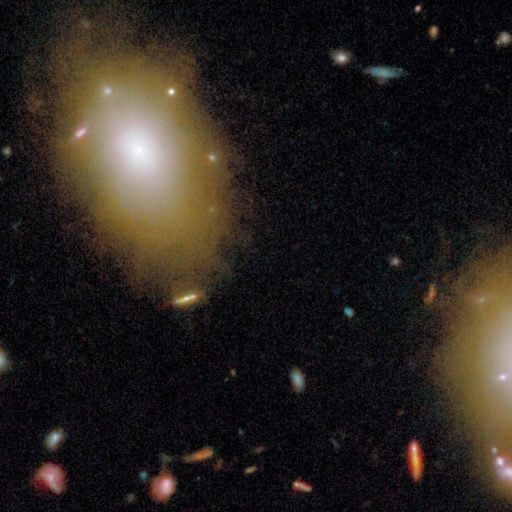
Image of two large elliptical galaxies surrounded by several smaller, colorful galaxies and stars against a dark background in space.
The first galaxies were irregular blobs of gas and stars. But modern features, like spiral arms and bars, appeared earlier than expected.
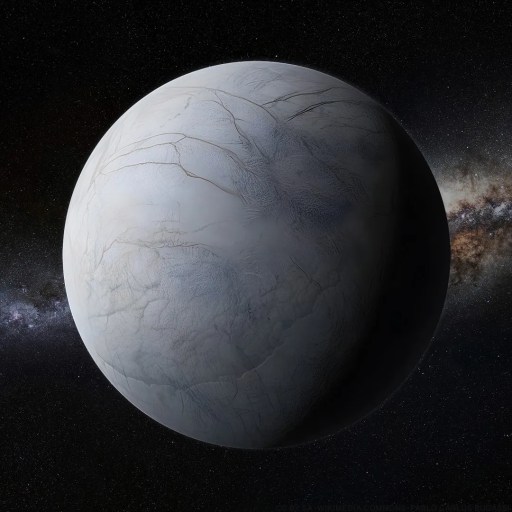
A grey, icy planet or moon with surface cracks is shown against a backdrop of stars and the Milky Way galaxy.
The hunt for extraterrestrial life begins with planets like Earth. But our inhabited Earth once looked very different than Earth does today.