




















Search


OpenAI has become a household name in artificial intelligence — but back in 2018 things looked very rocky. Here’s what happened.

Even from a single pixel, multiwavelength data taken over time can reveal clouds, icecaps, oceans, continents, and even signs of life.

A powerful psychedelic long used in African rituals shows surprising promise for treating traumatic brain injury and PTSD.

Professor of leadership Michael D. Watkins identifies ways high-performing teams can be sabotaged — and offers simple fixes for each.

Someday, we'll look back and see a young galaxy forming stars for the first time. JADES-GS-z14-0, the farthest ever, isn't early enough.

Your BS detector might not be as accurate as you think.

Einstein's general relativity has reigned supreme as our theory of gravity for over a century. Could we reduce it back down to Newton's law?

A fresh view of intelligence — spanning living systems from bacteria to human civilization — challenges the idea that it’s merely problem-solving.

In his new book, the popular science writer tells the story of how scientists discovered the “gaseous ocean” we all swim in — and the trillions of invisible life forms we share it with.

Welcome to The Nightcrawler — a weekly newsletter from Eric Markowitz covering tech, innovation, and long-term thinking.

Our scientific instruments are constantly improving, revealing nature's workings as never before. Without them, we'll remain in the dark.
Tech expert Peter Leyden argues that we have a historic opportunity to harness AI and other transformative technologies in order to make a much better world over the next 25 years.

When you enter someone's home, you learn how life is lived elsewhere.
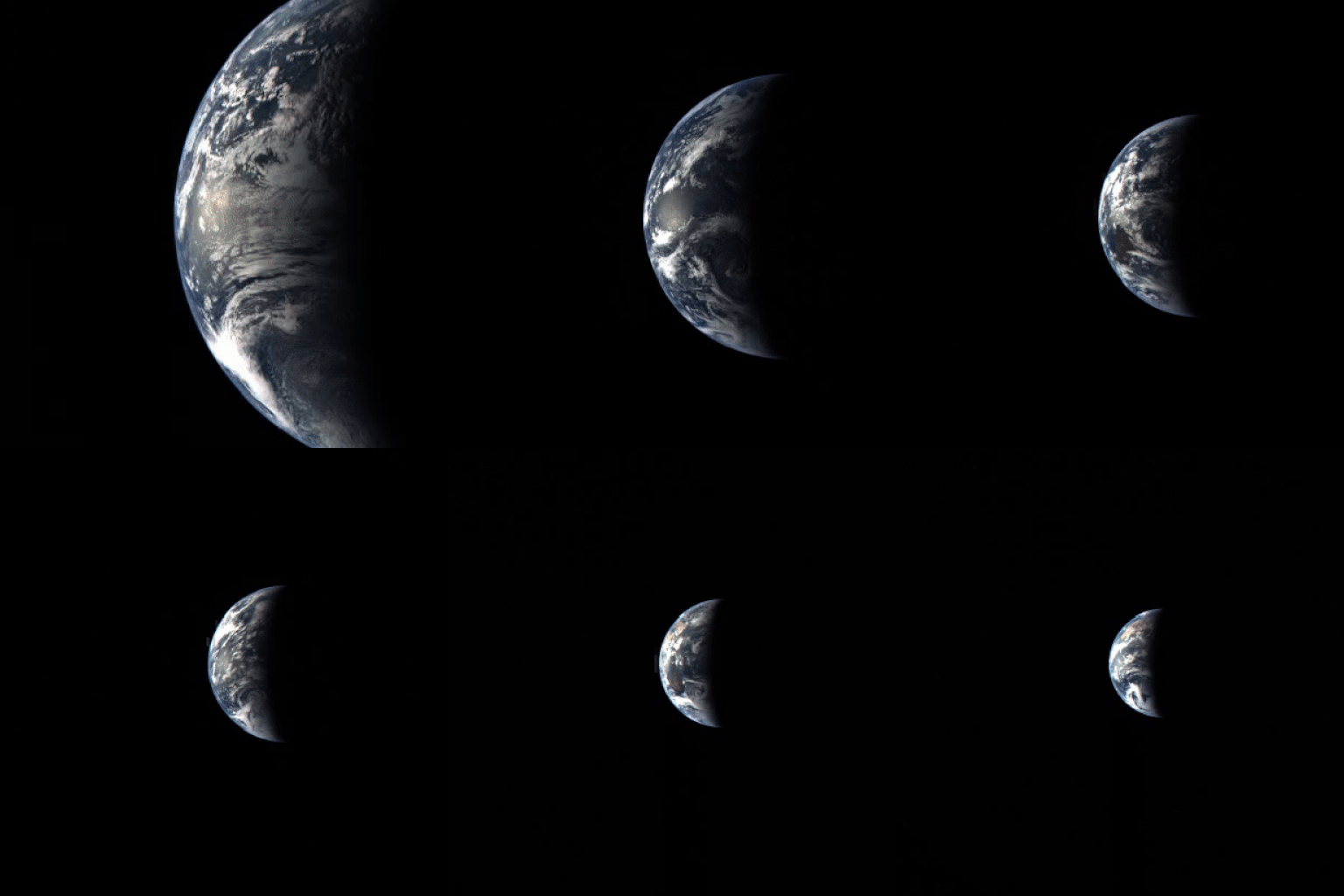
All scientific theories are limited in scope, power, and application, being mere approximations of reality. That's why consensus is vital.

The history of catastrophe shows that true resilience comes not from restoration, but from reinvention.

These books helped build the empirical case that life's origins differ from those described in myths and legends.

The nature of “the mind” is always vast and clear no matter how swamped by information we feel — and leaders can learn to embrace this space.

Some nebulae emit their own light, some reflect the light from stars around them, and some only absorb light. But that's just the beginning.

Investor Guy Spier joins Big Think for a chat about the “Oracle of Omaha,” generative AI, what confuses him, and more.

When we see spiral galaxies, some are face-on, others are edge-on, but most are tipped at an angle. But which side is closest to us?