




















Search
Ethan Siegel
Theoretical astrophysicist and science writer

Ethan Siegel is a Ph.D. astrophysicist and author of "Starts with a Bang!" He is a science communicator, who professes physics and astronomy at various colleges. He has won numerous awards for science writing since 2008 for his blog, including the award for best science blog by the Institute of Physics. His two books "Treknology: The Science of Star Trek from Tricorders to Warp Drive" and "Beyond the Galaxy: How humanity looked beyond our Milky Way and discovered the entire Universe" are available for purchase at Amazon. Follow him on Twitter @startswithabang.
Read Less

What are supermassive black holes, how common are they, and how do they grow up throughout cosmic history? Listen and find out!

A Harvard astronomer went to the bottom of the ocean, claiming he recovered alien technology. But what does the science actually indicate?

Some processes, like quantum tunneling, have been shown to occur instantaneously. But the ultimate cosmic speed limit remains unavoidable.

From the present day all the way to less than 400 million years after the Big Bang, we're seeing how the Universe grew up like never before.

All biological systems are wildly disordered. Yet somehow, that disorder enables plant photosynthesis to be nearly 100% efficient.

Some 55 million light-years away lies the giant galaxy Messier 87. Its supermassive black hole, inside and out, looks better than ever.

Headlines have blared that quasar ticking confirms that time passed more slowly in the early Universe. That's not how any of this works.

Math can explain why your laces spontaneously come untied — and how to stop it.

For thousands of years, we puzzled at how far away the Moon was. Today we know its distance, at any time, to within millimeters.

While Saturn and its moons all appear faint and cloudy to JWST, Saturn's rings are the star of the show. Here's the big scientific reason.

There's an entire Universe out there. So, with all that space, all those planets, and all those chances at life, why do we all live here?

After 15 years of monitoring 68 objects known as millisecond pulsars, we've found the Universe's background gravitational wave signal!

Michael Faraday's 1834 law of induction was the key experiment behind the eventual discovery of relativity. Einstein admitted it himself.

A cute mathematical trick can "rescale" the Universe so that it isn't actually expanding. But can that "trick" survive all our cosmic tests?

As the Earth spins and wobbles on its axis and revolves elliptically around the Sun, each day changes from the last. "24 hours" isn't right.
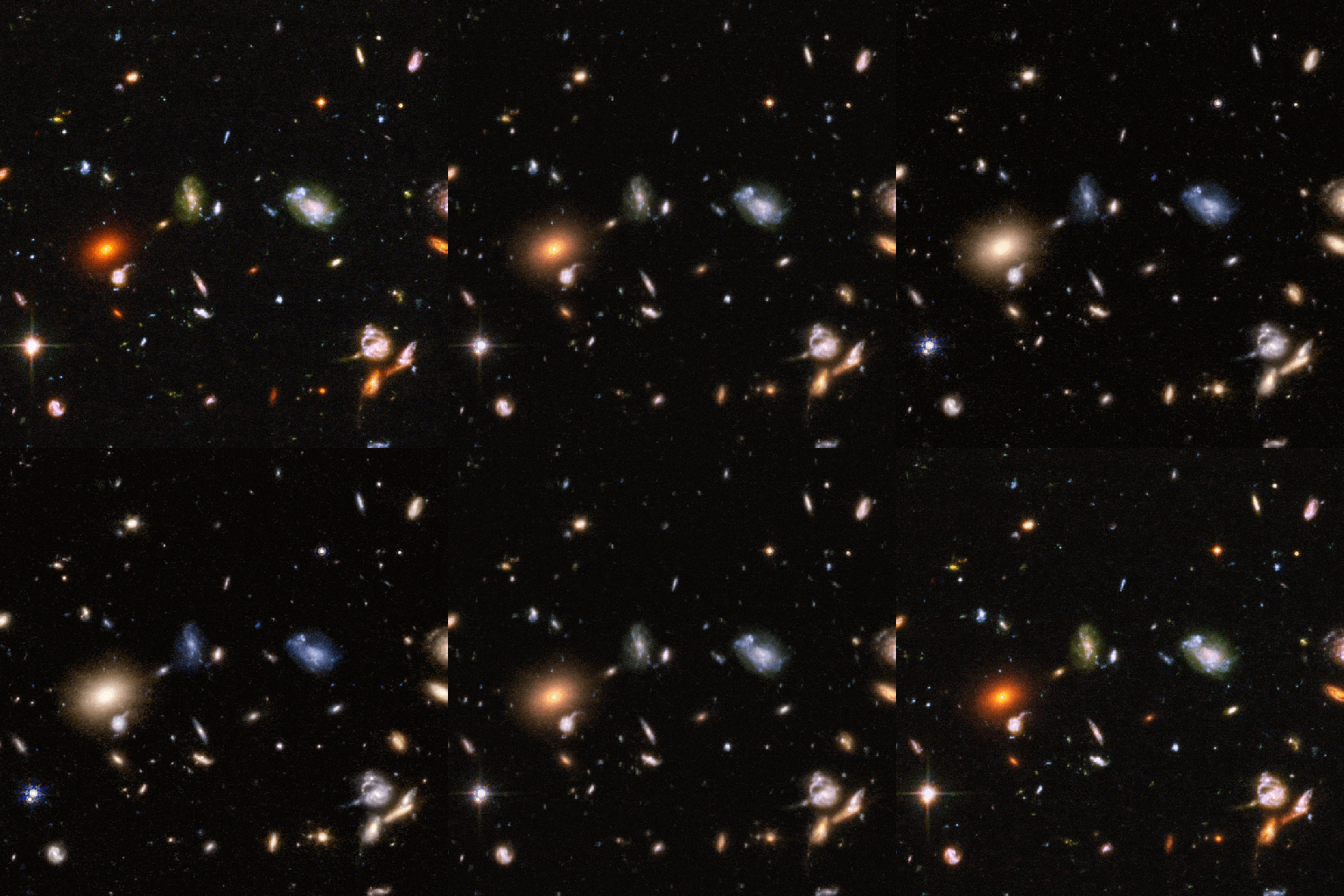
The farther away they get, the smaller distant galaxies look. But only up to a point, and beyond that, they appear larger again. Here’s how.

Despite the enormous mass of the Earth, simply depleting our groundwater is changing our axial tilt. Simple Newtonian physics explains why.

In physics, we reduce things to their elementary, fundamental components, and build emergent things out of them. That's not the full story.

In a far-reaching discovery with astrophysicist Karolina Garcia, we discuss what's in the Universe and how it grew up.

If we waited long enough, would even protons themselves decay? The far future stability of the Universe depends on it.