




















Search
Ethan Siegel
Theoretical astrophysicist and science writer

Ethan Siegel is a Ph.D. astrophysicist and author of "Starts with a Bang!" He is a science communicator, who professes physics and astronomy at various colleges. He has won numerous awards for science writing since 2008 for his blog, including the award for best science blog by the Institute of Physics. His two books "Treknology: The Science of Star Trek from Tricorders to Warp Drive" and "Beyond the Galaxy: How humanity looked beyond our Milky Way and discovered the entire Universe" are available for purchase at Amazon. Follow him on Twitter @startswithabang.
Read Less

With infrared capabilities and image sharpness far beyond Hubble's limits, JWST looked at Hubble's deepest field, revealing so much more.

The Universe is grand, awe-inspiring, and greater than we likely imagine. Even astrophysicists get anxious thinking about it, but we cope.

The double-slit experiment, hundreds of years after it was first performed, still holds the key mystery at the heart of quantum physics.

With a massive, charged nucleus orbited by tiny electrons, atoms are such simple objects. Miraculously, they make up everything we know.

"Imagination is more important than knowledge" is often taken to mean that your conceptions outweigh what's real. That's not what he said.

Voyager 2 flew past Uranus in 1986, finding a bland, featureless world. Now, in 2023, JWST's sights are similar. There's a reason for that.

When white dwarfs explode, they create a type Ia supernovae. After decades of following the leading theory, here's the complete overhaul!

From up close, the cracking sound of a thunderclap dominates. From far away, it's more like a drawn-out rumble. Can science explain why?

When someone attempts to make you afraid of something that hasn't happened instead of a true, present danger, suspect this nefarious ploy.

Leading a scientific revolution is easy: you just have to succeed where the current theory fails while equaling its successes. Good luck!

Most of us only ever see a fraction of a full rainbow: an arc. But optically, a full rainbow makes a complete circle. Physics explains why.

The next solar eclipse to occur over heavily populated areas is on April 8, 2024. For a spectacular show; here's where the best views are!

Our huge, expanding Universe may truly be infinite. But if the set of possible quantum outcomes is also infinite, which "infinity" wins?

With a finite 13.8 billion years having passed since the Big Bang, there's an edge to what we can see: the cosmic horizon. What's it like?

Gamma-ray bursts are among the most energetic cosmic events of all. On October 9, 2022, a remarkable one occurred: the brightest ever seen.

Many galaxies really are ultra-distant, but some are just intrinsically red or dusty. Only with spectroscopy can JWST tell which is which.

Mercury, Venus, and Mars are all uni-plate planets, and may always have been. Here's what's known about why Earth, uniquely, has plate tectonics.
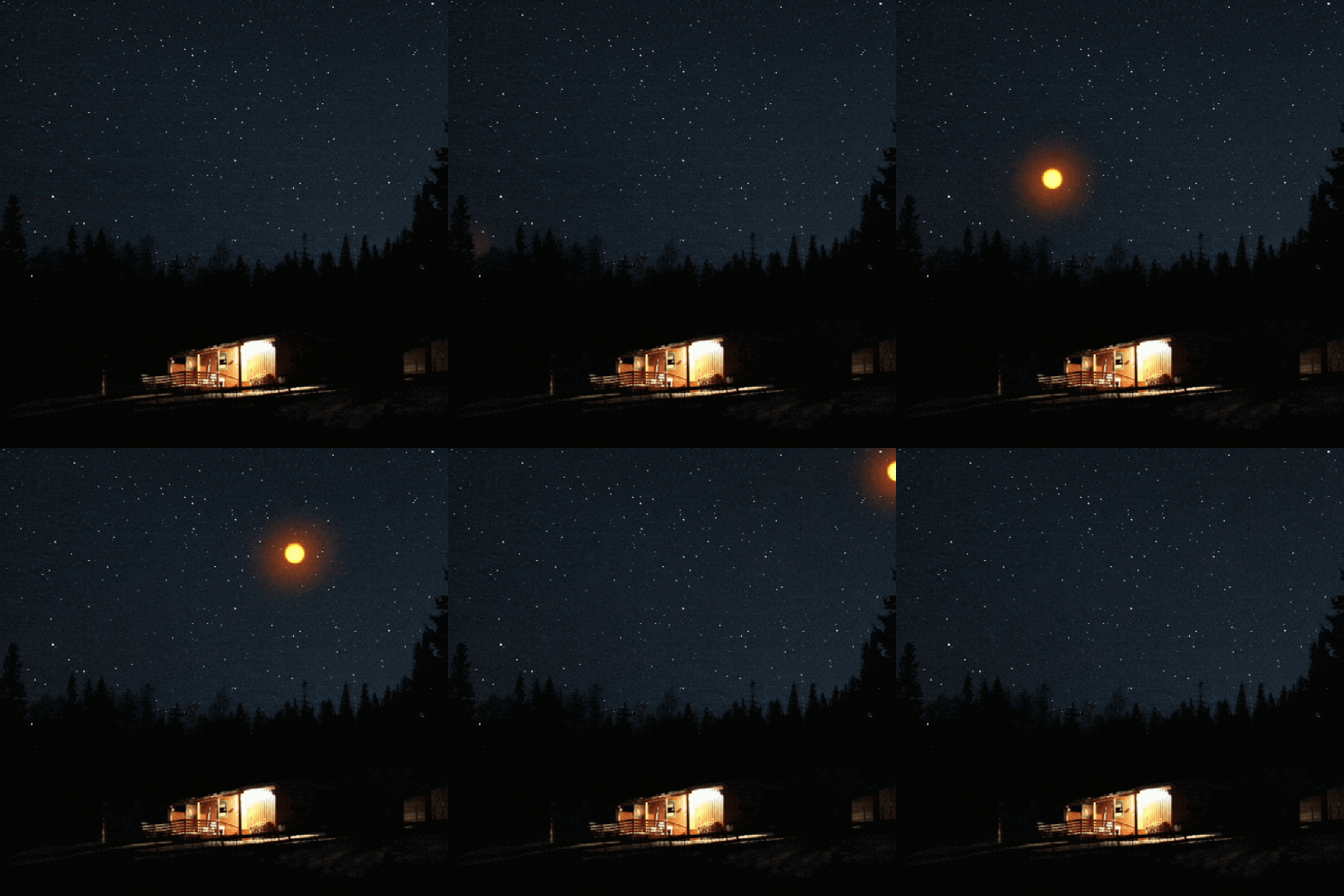
Lots of people have seen lots of bizarre events and phenomena that defy our conventional experience. But is there a scientific explanation?

With a bigger, better, and more sensitive detector, the XENON collaboration joins LZ and PANDA-X in constraining WIMP dark matter.

What do we mean by a black hole's size? A photon sphere? The minimal stable orbit? The event horizon? The singularity? Which one is right?