




















Search


Our mission is to answer the biggest questions of all, scientifically.
What is the Universe made of? How did it become the way it is today? Where did everything come from? What is the ultimate fate of the cosmos?
For most of human history, these questions had no clear answers. Today, they do. Starts With a Bang, written by Dr. Ethan Siegel, explores what we know about the universe and how we came to know it, bringing the latest discoveries in cosmology and astrophysics directly to you.
Read Less
with
Full Profile
Ethan Siegel is an award-winning PhD astrophysicist and the author of four books, including The Grand Cosmic Story, published by National Geographic.

Ask Ethan: What’s the biggest misconception in astronomy?
Many facts are well-known to professionals, but are unappreciated or even rejected outright by the public. "How stars work" takes the cake.


The fact that our Universe's expansion is accelerating implies that dark energy exists. But could it be even weirder than we've imagined?

The laws of physics obey certain symmetries and defy others. It's theoretically tempting to add new ones, but reality doesn't agree.

For centuries, vaccines have been the top life-saving, expert medical intervention known to humans. How can individuals make the right call?

It took nearly 400,000 years, after the Big Bang, to first form neutral atoms. The imprints from that early time can now be seen everywhere.

The COSMOS-Web survey is now complete, combining JWST and Hubble infrared data. Its spectacular views show us the Universe as never before.

Since 1998, we've known our Universe isn't just expanding, but the expansion is accelerating. Could the Big Bang itself be the reason why?

For millennia, diamonds were the hardest known material, but they only rank at #7 on the current list. Can you guess which material is #1?

As democracy recedes and fascism rises in the USA and around the world in 2025, history provides a lesson in how science can fight fascism.

The laws of nature are almost perfectly symmetric between matter and antimatter, and yet our Universe is made ~100% of matter only. But why?
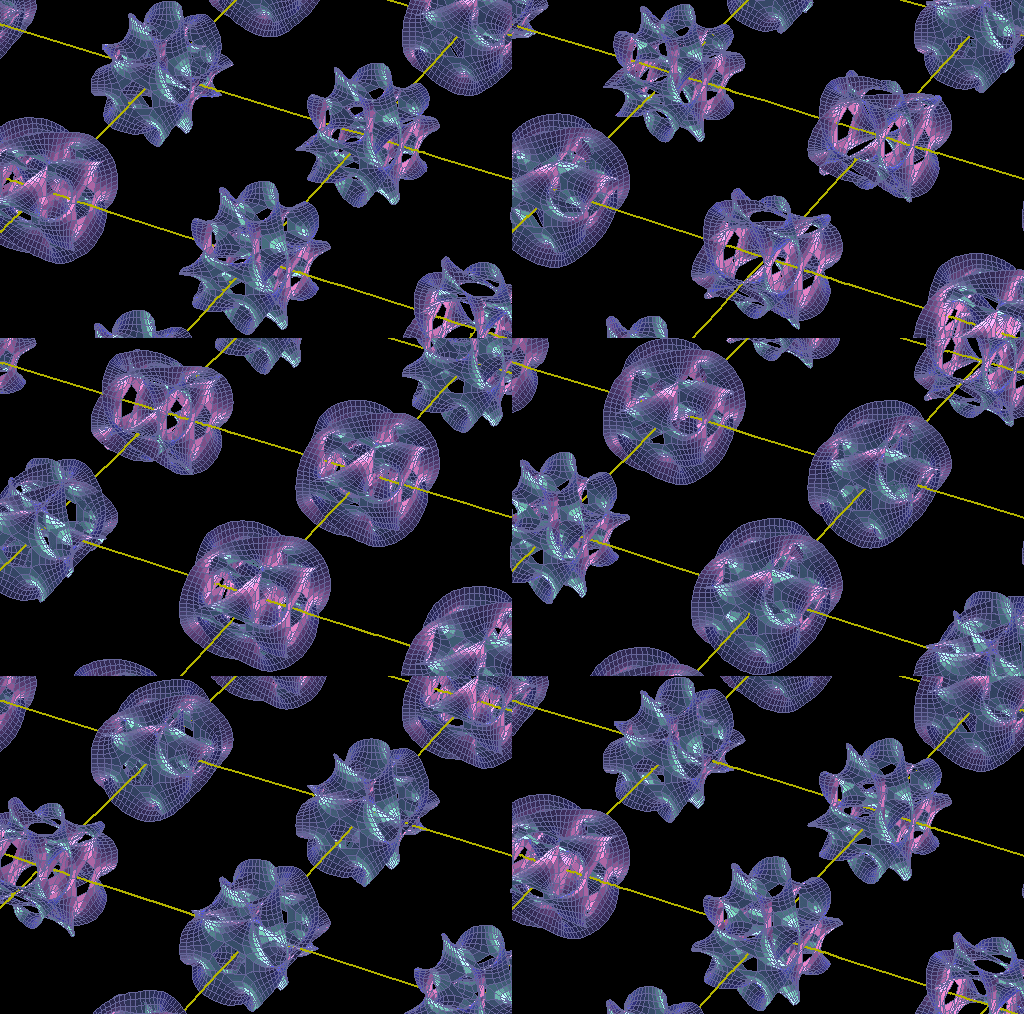
There are limits to where physics makes meaningful predictions: beyond the Planck length, time, or energy. Here's why we can't go further.

All stars shine due to an internal source of energy. Usually, it's nuclear fusion: converting mass into energy. What makes them most bright?

Photons come in every wavelength you can imagine. But one particular quantum transition makes light at precisely 21 cm, and it's magical.

You don't need to be a scientist or a philosopher for facts, reality, and the truth to matter. The alternative is simply known as bullshit.

A Cambridge-based team claims to find molecules on an exoplanet that are only produced by life on Earth. Don't fall for the unfounded hype.

According to Stephen Hawking, spontaneously emitted radiation should cause all black holes to decay. But we've never seen it: not even once.

In all the known Universe, Earth is the only planet known to have native life. What should guide us in expanding humanity beyond our world?

Empty space itself, the quantum vacuum, could be in either a true, stable state or a false, unstable state. Our fate depends on the answer.

After drastic cuts to the NIH, the FDA, the NSF, and the DOE, NASA science faces down its smallest budget ever. All of society will suffer.

Perhaps no existential question looms larger than that of our ultimate cosmic origins. At long last, science has provided the answers.

The Hubble Space Telescope, launched in 1990, was originally seen as a colossal mistake. This one image, taken in 1995, changed everything.