




















Search


Our mission is to answer the biggest questions of all, scientifically.
What is the Universe made of? How did it become the way it is today? Where did everything come from? What is the ultimate fate of the cosmos?
For most of human history, these questions had no clear answers. Today, they do. Starts With a Bang, written by Dr. Ethan Siegel, explores what we know about the universe and how we came to know it, bringing the latest discoveries in cosmology and astrophysics directly to you.
Read Less
with
Full Profile
Ethan Siegel is an award-winning PhD astrophysicist and the author of four books, including The Grand Cosmic Story, published by National Geographic.

Ask Ethan: What’s the biggest misconception in astronomy?
Many facts are well-known to professionals, but are unappreciated or even rejected outright by the public. "How stars work" takes the cake.


At extremely close distances to their stars, even rocky planets can be completely disintegrated. We've just caught our first one in action.

Ring galaxies are rare, but we think we know how they form. A new, early-stage version, the Bullseye galaxy, provides a new testing ground.

Here in our Solar System, terrestrial bodies get moons from gravitational capture or collisions. The Pluto-Charon system? It was both.

Only 5% of the Universe is made of normal "stuff" like we are. Could there be dark matter or dark energy life, or even aliens, out there?

When we divide matter into its fundamental, indivisible components, are those particles truly point-like, or is there a finite minimum size?

The primary causes of global climate change are all due to human activity. Adding aerosols to our atmosphere only exacerbates the problem.
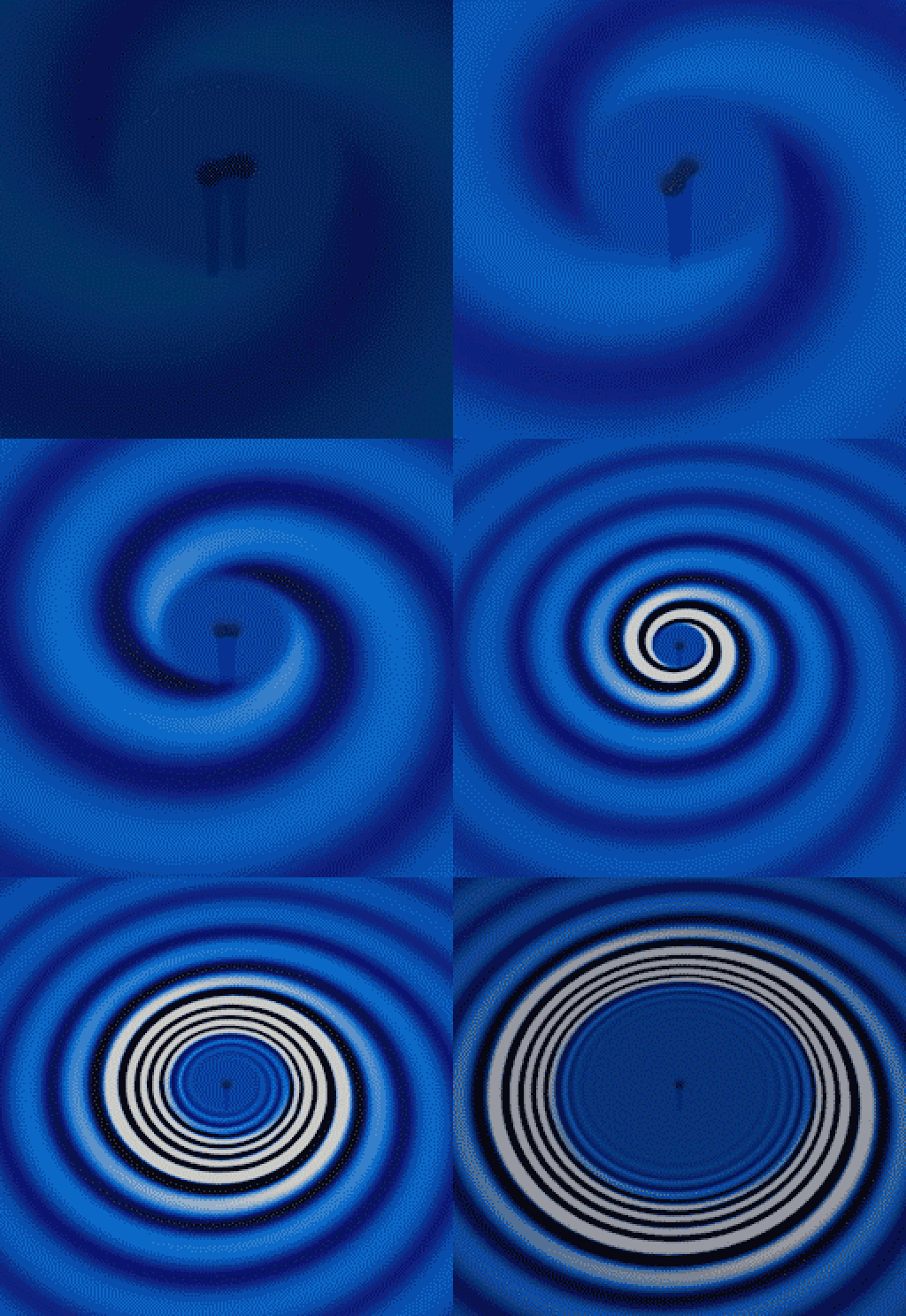
The ultimate multi-messenger astronomy event would have gravitational waves, particles, and light arriving all at once. Did that just occur?

A young, nearby, massive star, whose protoplanetary disk appears perfectly edge-on, was just viewed by JWST, with staggering implications.

Historically, astronomers have often named things creatively, bizarrely, and often inaccurately. But which terms are the most egregious?

If we wish to tackle the very real problems society faces, we require expert-level knowledge. Valuing it starts earlier than we realize.

Seeking life beyond the Solar System, we first look to the closest star systems with Earth-like planets. Here's why that's not good enough.

Our Moon is full of craters, basins, and ancient lava flows. But two large lunar Grand Canyons have the same origin: a single, giant impact.

There are only four super star clusters in all the Local Group: rarities today. Here's what the youngest, the just-discovered N79, shows us.

Here in our Universe, both normal and dark matter can be measured astrophysically. But only normal matter can collapse. Why is that?

With a flurry of threats to scientists, science funding, and health policy, the USA now faces a crisis reminiscent of Soviet-era Lysenkoism.

First discovered in the mid-1960s, no cosmic signal has taught us more about the Universe, or spurred more controversy, than the CMB.

From LIGO, there weren't enough neutron star-neutron star mergers to account for our heavy elements. With a JWST surprise, maybe they can.

It's the ultimate game of cosmic "cover up," as the dimming occurs when a circumbinary disk from a nearby star passes in front of T Tauri North.

Matter is made up largely of atoms, where atomic nuclei can contain up to 100 protons or more. But how were the heaviest elements made?

Cosmic inflation, proposed back in 1980, is a theory that precedes and sets up the hot Big Bang. After thorough testing, is it still valid?