




















Search
Philosophy

From landscaped gardens to road systems, the Persians were among the first to create many things we still enjoy today.

For decades, theorists have been cooking up "theories of everything" to explain our Universe. Are all of them completely off-track?

"I will not reason and compare: my business is to create."

A growing movement is trying to turn energy directly into food — reviving an old dream of escaping the violence and inefficiency of eating.

George Szpiro explores the philosophical ideas that explain why justice — not freedom or efficiency — may better anchor a fair society.

TikTok gave an old practice a terrible name. Neuroscience explains why it actually works.

What a fragile flower can teach us about resilience, death, and becoming someone new.

When can a kid play outside alone? Two parents, one stranger, and the state collide.

AI is unlocking unprecedented capabilities — and exposing new vulnerabilities just as quickly.

In a 13.8 billion year old Universe, a few seconds hardly seems like it matters. But these minuscule changes sure do add up over time.

Neuroscientist Christof Koch on why reflective self-consciousness separates us from intelligent machines.

Biblical scholar Bart Ehrman contends that our modern sense of altruism can be traced back to the radical shift in ethical thinking sparked by Jesus' teachings.
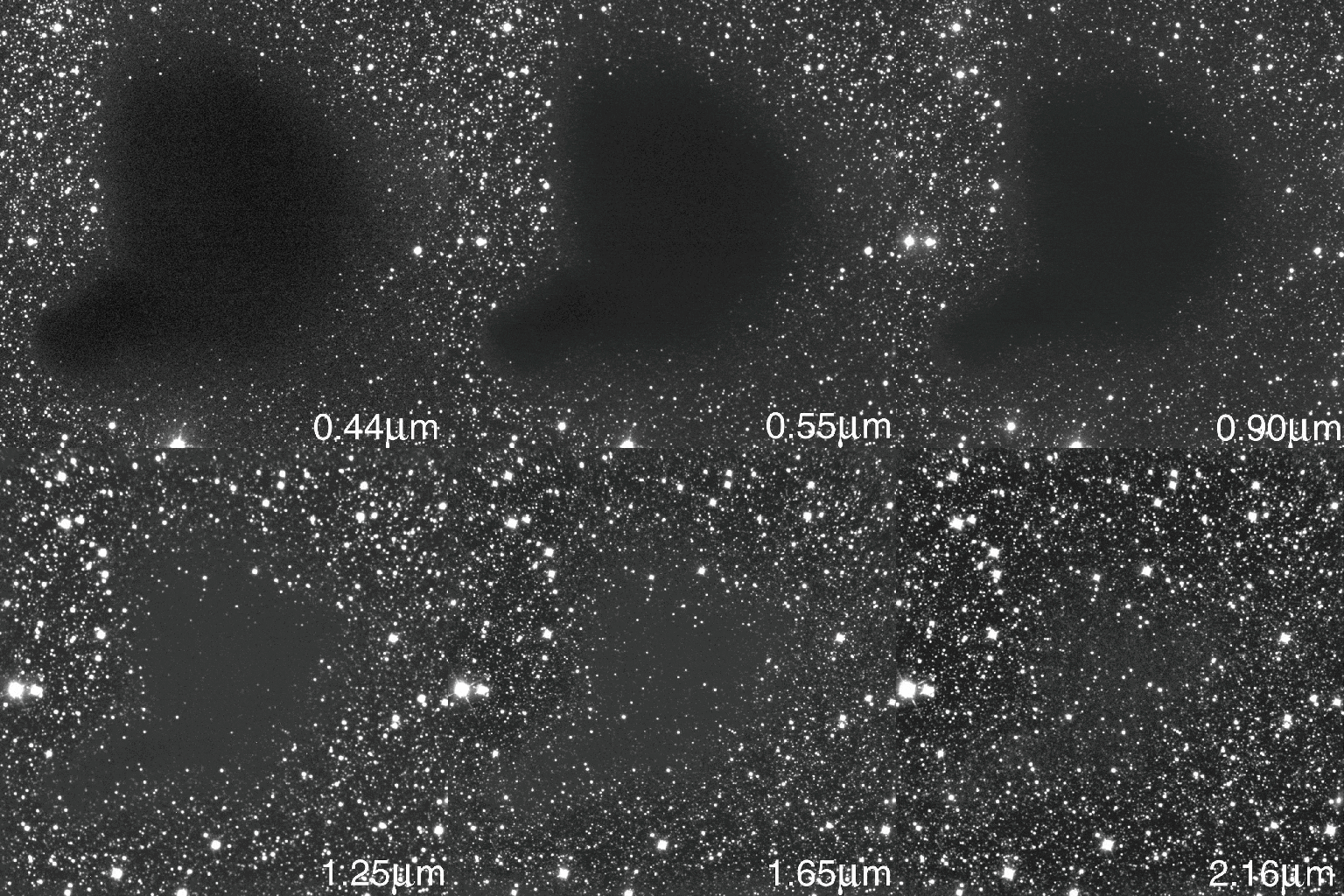
The image you're seeing isn't a hole in the Universe, and the cosmic voids that do exist aren't hole-like at all.

While LooksMaxxing often headlines the news, the idea of BrainMaxxing deserves real attention. Growing your mind never goes out of style.

Andy Weir’s novel blends humor, scientific rigor, and human ingenuity to make science fiction feel believable and thrilling.

We have two descriptions of the Universe that work perfectly well: general relativity and quantum physics. Too bad they don't work together.

Looking up at the night sky gives us a glimpse of the Universe beyond our terrestrial concerns. Here's the science of what's out there.

No matter what physical system we consider, nature always obeys the same fundamental laws. Must it be this way, and if so, why?

Classic literature reveals how resilience can be both a source of strength in troubled times — and a dangerous ideal.

Nick was always an angry boy, but he was unlucky as well.

Every generation has faced a version of this moment — the question has never been what our tools can do, but what we choose to do with them.

In this preview, the Stanford professor muses on how emergence, arriving at complex patterns from simple parts, explains AI, brains, and life itself.

Over billions of years, fewer stars form, galaxies mutually recede, and the Universe becomes ever darker. Here's how fast it all happens.

A preview of the latest novel by the New York Times bestselling author.

Skim or scan this. No need to deep-read.

A new framework suggests that bursts of neural chaos could be the fingerprints of a conscious mind at work.

Anne Lamott and Neal Allen join us to discuss why embracing constraints can be the best way to find freedom in the craft.


No civilization, no matter how successful, can last forever. What does the non-detection of intelligent aliens mean for our own longevity?
Throughout history, the ability to tell increasingly believable stories has become available to more people. Kevin Ashton says that’s a blessing and a curse.