
This idea was suggested by Big Think Delphi Fellow Brendan Meade
What’s the Big Idea?
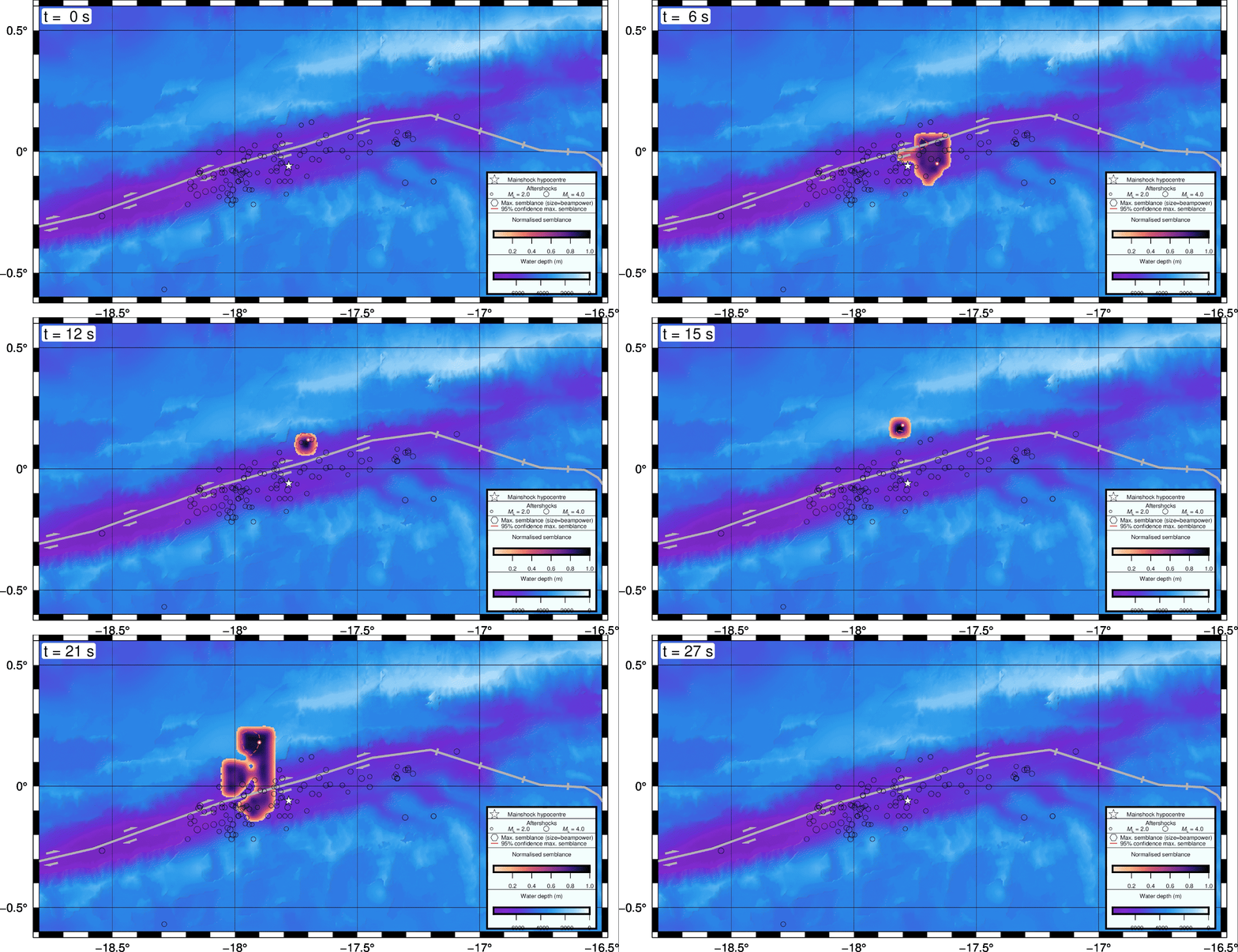
Snap! Crrrunch. Groan . . . That’s the sound of the Earth changing beneath you. Above the seething, molten core, massive tectonic plates split, grind against, and impact one another with unimaginable force. Energy builds up, sometimes over millenia, and is released suddenly in the form of earthquakes.
In human terms, the cost can be devastating: the magnitude 9.0 earthquake near Japan in March created a tsunami that left 24,000 dead or missing and did billions of dollars in damage. Running for 25 miles directly under Los Angeles, the Puente Hills fault has experienced four massive earthquakes in the past 11,000 years. It will almost certainly rupture again.
When, however, is a tough call. By studying individual faults, seismologists are accurately able to pinpoint “hotspots” where future earthquakes are likely to occur. But the science of forecasting earthquake timing and magnitude lags far behind, relying on theoretical models which turn out to be woefully incomplete.
According to Harvard professor Brendan Meade, the lithosphere––the earth’s solid crust––is evolving much faster than previously supposed. Earlier models linked changes in the lithosphere to convection in the Earth’s plastic outer mantle, or aesthenosphere. But this movement does not fully account for what’s happening on the surface. A myriad of other factors are involved, including rock composition, gravity, and the complex interplay of stresses throughout the tectonic system. At the frontiers of seismology, scientists are extending what they know about the physics of individual fault lines to explain the behavior of the lithosphere as a whole.
Snap! Crrrunch. Groan . . . That’s the sound of the Earth changing beneath you. Above the seething, molten core, massive tectonic plates split, grind against, and impact one another with unimaginable force. Energy builds up, sometimes over millenia, and is released suddenly in the form of earthquakes.
In human terms, the cost can be devastating: the magnitude 9.0 earthquake near Japan in March created a tsunami that left 24,000 dead or missing and did billions of dollars in damage. Running for 25 miles directly under Los Angeles, the Puente Hills fault has experienced four massive earthquakes in the past 11,000 years. It will almost certainly rupture again.
When, however, is a tough call. By studying individual faults, seismologists are accurately able to pinpoint “hotspots” where future earthquakes are likely to occur. But the science of forecasting earthquake timing and magnitude lags far behind, relying on theoretical models which turn out to be woefully incomplete.
According to Harvard professor Brendan Meade, the lithosphere––the earth’s solid crust––is evolving much faster than previously supposed. Earlier models linked changes in the lithosphere to convection in the Earth’s plastic outer mantle, or aesthenosphere. But this movement does not fully account for what’s happening on the surface. A myriad of other factors are involved, including rock composition, gravity, and the complex interplay of stresses throughout the tectonic system. At the frontiers of seismology, scientists are extending what they know about the physics of individual fault lines to explain the behavior of the lithosphere as a whole.

IMAGE: GPS base stations are located at fixed, known coordinates. The movement of the base stations is tracked over time in three dimensions, demonstrating the deformation of land due to geological and seismic events. Parts of Southern California, on the San Andreas fault line, are shifting 30mm/yr.
What’s the Significance?
Earthquakes don’t happen in a vacuum. Fault lines are part of larger fault networks, which are themselves a feature of the lithosphere. When, and how fast, an individual fault will slip or rupture depends on what’s happening elsewhere in the system.
Earthquakes don’t happen in a vacuum. Fault lines are part of larger fault networks, which are themselves a feature of the lithosphere. When, and how fast, an individual fault will slip or rupture depends on what’s happening elsewhere in the system.
Istanbul, Tokyo, Mexico City, New Delhi . . . across the globe, major cities sprawl over deadly fault lines. The development of new, more comprehensive models of lithospheric movement will enable geologists to forecast more accurately the location, magnitude, and timing of major earthquakes. Such forecasts are key to saving human lives and reducing the global economic impact of seismic events. The new models will also inform the science of structural engineering, resulting in homes and buildings better designed to withstand seismic shock. In the words of Dr. James Dolan, a geologist at the University of Southern California, “Earthquakes don’t kill people, buildings do.”
It may be a while before mainstream earthquake prediction can claim the numerical precision of, say, radio evangelist Harold Camping (whose May 21 date for the “devastating global earthquake” that would signal the Rapture has since been revised to October 21). But these advances in seismology will profoundly change the way we understand, and live upon, the earth’s surface.
VIDEO: This animated model, from the Southern California Earthquake Center, shows in unprecedented detail the more than 300 fault lines under Southern California. The Puente Hills thrust fault, a site of intense energy buildup, lies directly under Northern Los Angeles.
Watch here:
Monthly Issue
April 2026
The Energy Transition
In this monthly issue, we examine how our understanding of energy — and how we source and use it — is evolving.
1 video
11 articles