




















Search
History & Society
Trace how culture, power, and ideas shape societies across time.

Fantasy, meet statistics: The census comes to Middle-earth!

Sometimes called “the new gold,” sand is the second most exploited natural resource in the world after fresh water.

Like many of us, the Roman emperor Marcus Aurelius hated waking up early, but his stoic philosophy always helped him get out of bed.
Today, the star-formation rate across the Universe is a mere trickle: just 3% of what it was at its peak. Here's what it was like back then.


Millions of people have had a near-death experience, and it often leads them to believe in an afterlife. Does this count as good proof?

As early as we've been able to identify them, the youngest galaxies seem to have large supermassive black holes. Here's how they were made.

A basement renovation project led to the archaeological discovery of a lifetime: the Derinkuyu Underground City, which housed 20,000 people.
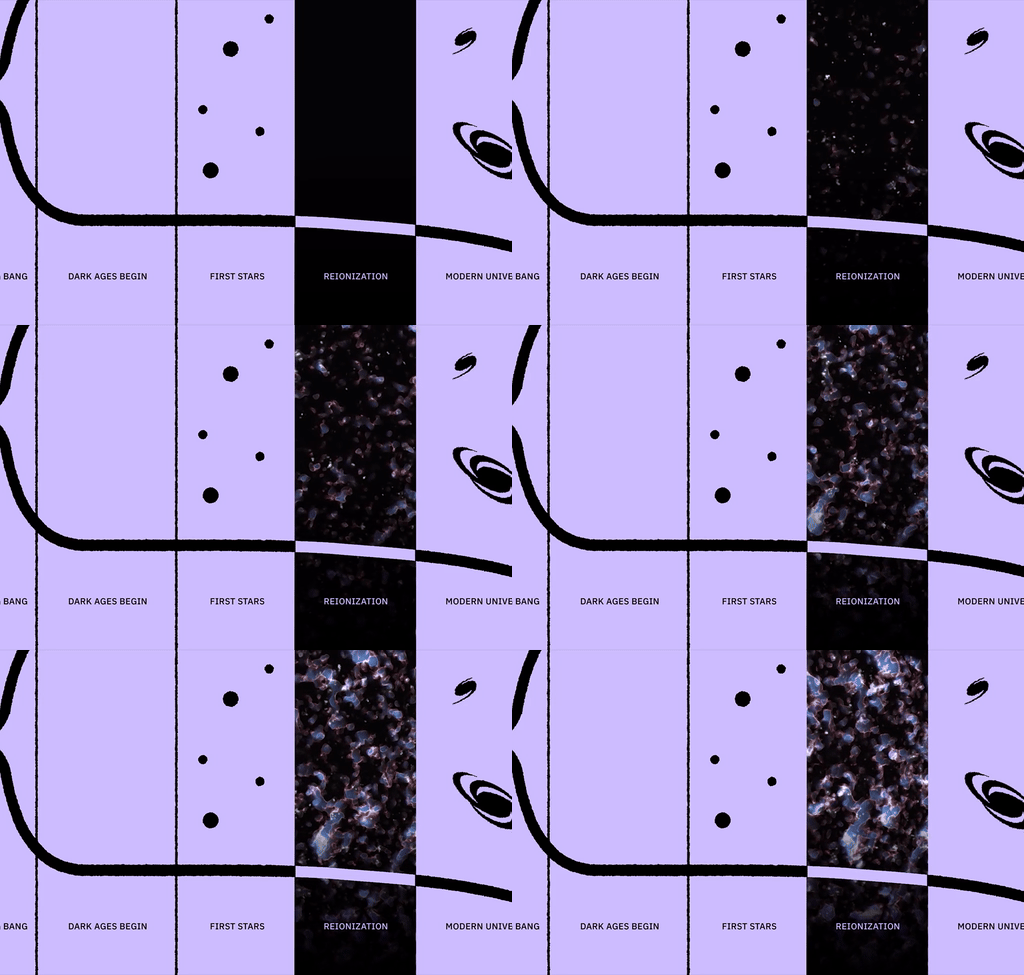
For 550 million years, neutral atoms blocked the light made in stars from traveling freely through the Universe. Here's how it then changed.

A volley of new insights reignites the debate over whether our choices are ever truly our own.
The first stars in the Universe were made of pristine material: hydrogen and helium alone. Once they die, nothing escapes their pollution.

When battles raged in ancient cities, their rocks blazed so brightly that they could be reoriented according to Earth's magnetic field.

Along with obsidian that dazzled scientists in Canada.

How to say, "In many ways, Proust is similar to Joyce" and get away with it.

Omer Bartov, who spent decades studying the unspeakable horrors of genocide, shares how his studies have impacted his own mental health.

The first stars took tens or even hundreds of millions of years to form, and then died in the cosmic blink of an eye. Here's how.

These hard-to-finish books are still worth the effort.

Meet the people paid to rouse the workers of industrial Britain.

When you own your career, work becomes more than a means to an end — it becomes a vehicle for growth and happiness.

The Big Bang's hot glow faded away after only a few million years, leaving the Universe dark until the first stars formed. Oh, the changes!