




















Search
History & Society
Trace how culture, power, and ideas shape societies across time.

Michael Faraday's 1834 law of induction was the key experiment behind the eventual discovery of relativity. Einstein admitted it himself.

After Albert Einstein’s death in 1955, a pathologist—searching for the secret of genius—removed, dissected, and ultimately stole the mathematician’s brain.

In one experiment, the Viking landers added water to Martian soil samples. That might have been a very bad idea.

A cute mathematical trick can "rescale" the Universe so that it isn't actually expanding. But can that "trick" survive all our cosmic tests?

Is the vast "Khan Khentii Strictly Protected Area" the final resting place of Genghis Khan?

Take a closer look before judging a book by its title.

As the Earth spins and wobbles on its axis and revolves elliptically around the Sun, each day changes from the last. "24 hours" isn't right.

These core teachings make an ideal starting point for exploring Buddhist philosophy.


A photographer captured Bern’s eclectic and charming feline structures.

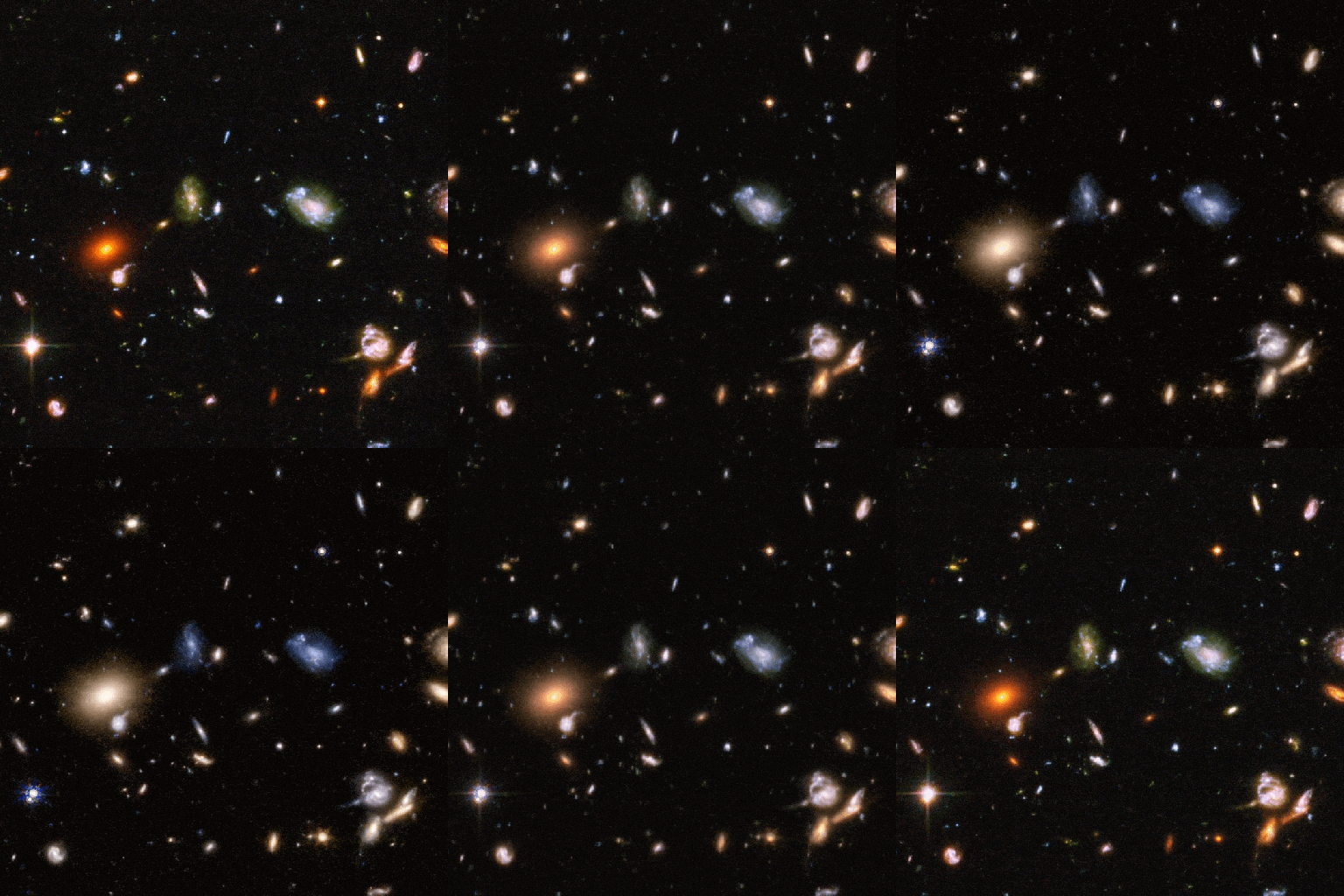
The farther away they get, the smaller distant galaxies look. But only up to a point, and beyond that, they appear larger again. Here’s how.

The truth is out there, but it's probably not in the latest whistleblower's report.

The fear of deep bodies of water may be evolutionarily ingrained.

In many ways, we are still novices playing with toy models seeking to understand the stars.

Despite the enormous mass of the Earth, simply depleting our groundwater is changing our axial tilt. Simple Newtonian physics explains why.

On the menu: stews, cheese, and fermented drinks.

An insect? A vermin? An unwanted animal? What in the world is Franz Kafka talking about?

To advance the gender-affirming healthcare of all those who transition, we must also understand the nature and causes of those who detransition.

More than a century ago, Halifax suffered an accidental blast one-fifth the size of the atomic bomb dropped on Hiroshima.