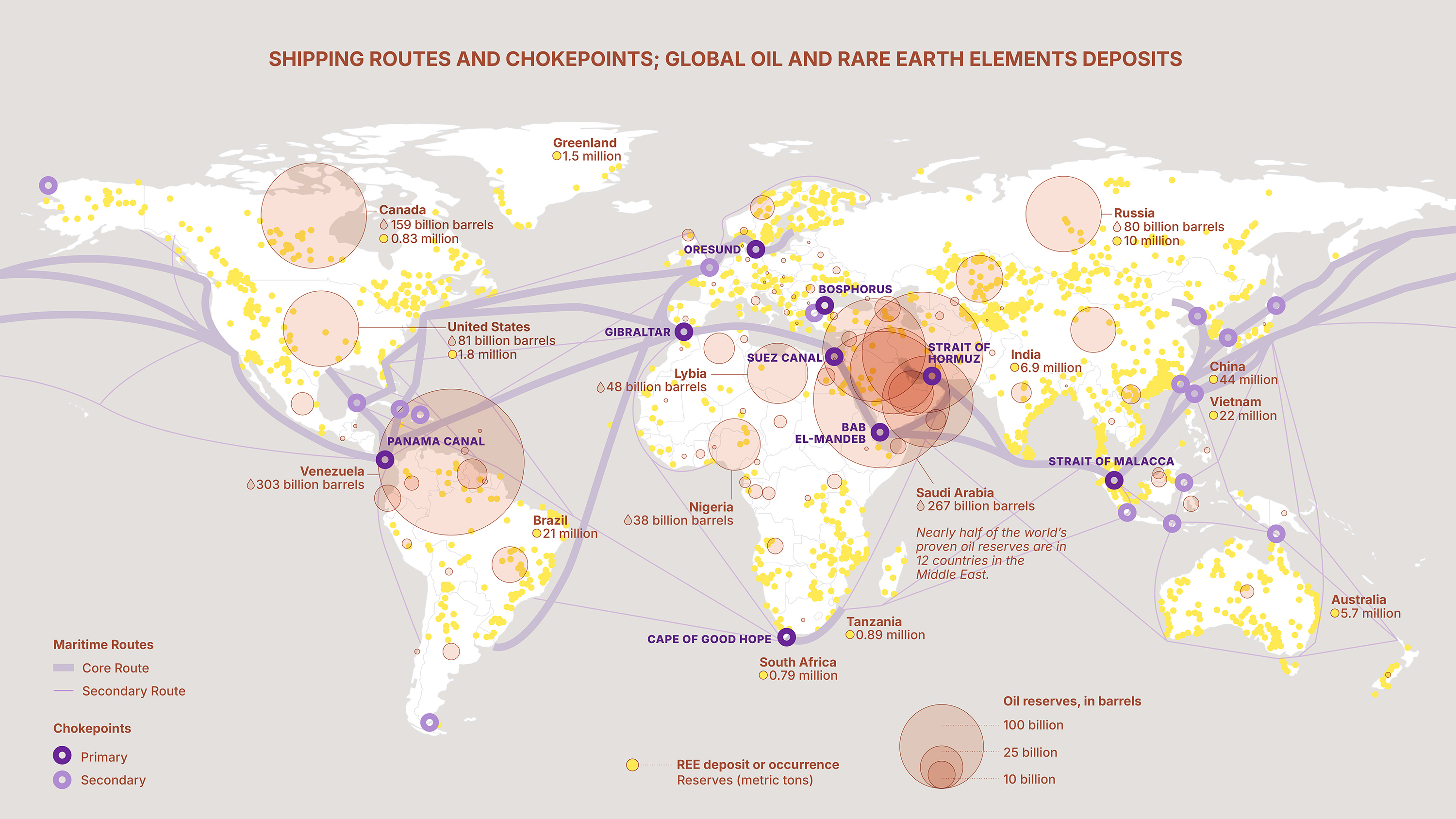
In the early 1980s, I hitchhiked from London to Cape Town at the tip of South Africa. The overland trip took more than six months, and I traveled about 11,000 miles — almost half the circumference of the Earth. I dropped down through Europe, crossed into Morocco via the Strait of Gibraltar, and then traveled across North Africa. From Egypt, I followed the Nile all the way to its source in East Africa before making my way down to South Africa, which was still under apartheid at the time.
I was no newbie to hitchhiking. Since high school, I had hitched rides across the United States numerous times, traveling from coast to coast on many of the nation’s major interstate freeways. Hitching was also the main way I moved between my home in the Midwest and my university on the East Coast. I loved hitchhiking because it offered a fantastic way to get to know an amazing cross section of people from many different classes and races and walks of life. Hitching is particularly good at connecting you to those living at the margins of society — the kinds of people many of us don’t encounter often through normal channels and the media. Upper-middle-class people almost never pick you up.
I learned something hitching that I later used in my career as a journalist. Everyone is an expert on at least one thing: themselves. All you have to do is ask a person open-ended questions and be genuinely interested, and they will talk forever about almost anything they have ever done. I used to climb out of trucks after 10 hours of driving through the night and know the most intimate details about the truck driver’s life — and he would not know a single detail about me, including my name. I was fine with that. I knew my story, and I wanted to learn as much as I could about him.
I may have cut my teeth hitching in America, but these same insights hold true in other parts of the world. I have hitchhiked through most countries in Western Europe and some in Eastern Europe. I hitchhiked through Turkey, Syria, Jordan, and Israel in the Middle East. I did some hitching in Asia (the length of Japan), but buses and trains in most Asian countries were so cheap that I usually went that route. I’ve also hitchhiked through Central America, from Nicaragua all the way up to Chicago.

I hitchhiked through six war zones back in those days. I had to carefully pick my way through three regions in Africa that were seriously contested by armed forces. And I had to maneuver through war zones in El Salvador, Nicaragua, and Guatemala in Central America as well. There were many nights when I fell asleep listening to gunfire.
I once calculated that I have hitchhiked about 50,000 miles in my lifetime and visited more than 50 countries (though through more conventional means of transport later in life).
People are pretty much the same wherever you go on Earth. The vast majority of those I have gotten to know are good, decent, and generous. On that entire trip from London to Cape Town, I rarely had to pay for a place to stay because the drivers would almost invariably take me home and put me up.
My experience in South Africa under apartheid was particularly striking. I got picked up by drivers from all three of the major races, which were legally required to live in separate areas. Yet they all picked up this white guy on the side of the road and took him home — to a hut in a Black homeland, a white Afrikaner’s farmhouse, or a modest home run by someone from the Asian commercial class.
I was friends with all of them, and they each were friends with me. We were all just human beings on planet Earth.
Stage One in human development: The post-World War II era
During my prime hitchhiking years, I was a late end Boomer living through the last stages of the Cold War between the U.S. and the Soviet Union.
For the previous four decades, the world had been deeply divided between two really incompatible systems. In that 1945 to 1985 period, there was very little overlap in the economies, technologies, or communications of the communist and the capitalist worlds. They operated separately in ways that many people have largely forgotten. Both sides were also actively working to convert people in other parts of the world to their way of life — sometimes through the barrel of a gun.
In other words, don’t overly romanticize the post-World War II era. Yes, a new model was devised that showed how a modern economy could sustain a large middle-class society that shared in its general prosperity and great progress. For all of the classes in the relatively privileged West — the Americans and Europeans — that period was a golden age during which all boats rose with the tide.
But for the average human being on planet Earth, it was a much more difficult and dangerous time. The lives of those living outside the West after 1945 were better, on average, than during the previous period, when most of their countries were impoverished colonies of Western empires, and the world overall was making progress — but it still had a long way to go.
Let’s call that phase of global human development Stage One — and take a look at what came next.
Stage Two in human development: The era of globalization
The bifurcated world — split between capitalism and communism — came to an end in a handful of years, with the Soviet Union’s spectacular collapse and Communist China’s move to economically embrace capitalism.
By about 1985, the world had started clearly shifting into what would become known as the era of globalization, which would last for the next 40 years until 2025. For the first time in history, nearly every country on the planet was deeply enmeshed in the same global market economy. This level of integration was unprecedented — and it brought with it profound consequences.
My last essay explained how higher productivity rates lead to higher economic growth rates and speculated on how the productivity boosts from AI might play out. Lowering the friction points of an economy — its transaction costs — leads to higher growth rates, too. When you make it easier to move money, products, and workers of various skill levels around, that also accelerates growth. The spread of digital technologies facilitated all that global integration and far-flung coordination.
We saw the long boom of globalization and digitization roll for decades, and from the perspective of a human being on planet Earth, the benefits were largely indisputable. This was an era of unprecedented progress for a far wider expanse of people than during the post-WWII era. Let’s call it Stage Two of the upward trajectory of all human beings.
There are many metrics that can be used to prove this point. Just consider some of these milestones:
Extreme poverty: In 1980, 44% of the world’s population was living in extreme poverty, which the United Nations defines as living on less than US $2 a day. By 2020, about 9% of the world remained in that condition — mostly because of the extraordinary transformation of China, India, and other parts of Southeast Asia. The transition is accelerating, too. Since 1990, an average of 130,000 people have moved out of extreme poverty every day.
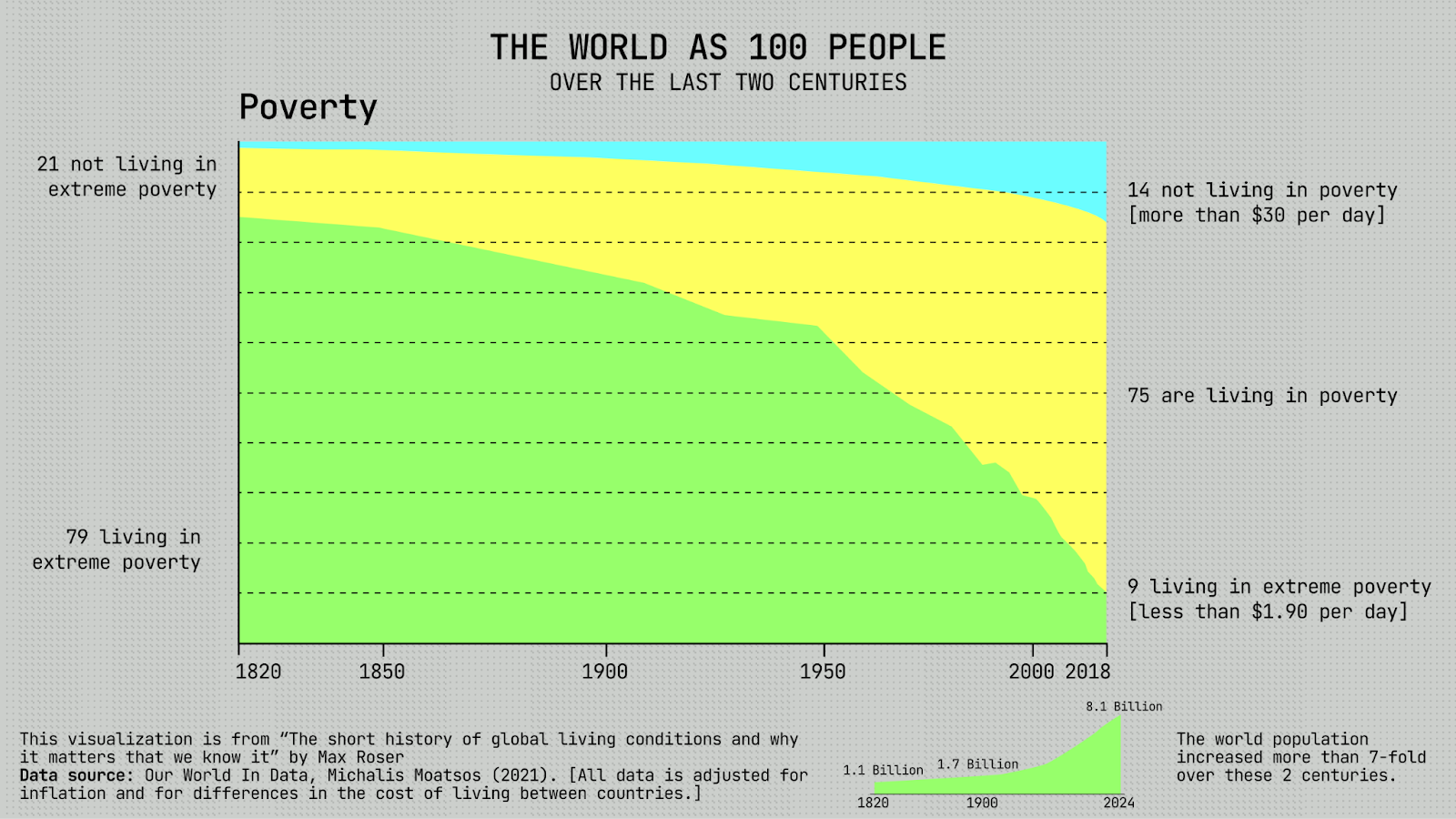
Child mortality: In 1980, roughly 1 in 8 children died before they reached age 5. By 2020, that number had dropped to just 1 in 27. This translates to a shift from 12.5% of all kids dying by age 5 to less than 4%. That’s still too many, but it’s dramatically better than any other time in history.
Life expectancy: Then we can shift to the other end of the age spectrum. In 1980, the average lifespan of a human being was 63 years, but by 2020, it was a full decade longer: 73 years.
Electricity access: As late as 1990, only 71% of the global population had access to electricity, but by 2022, that figure had climbed to more than 90% — and it’s continuing up. Since 2000, an average of 334,000 people have gained access to electricity every single day.
Clean water: In 1990, just 76% of people had access to an improved drinking water source — one that has the potential to deliver water that is safe to drink. By 2020, 94% did — meaning more than 2.6 billion people gained access to drinkable water over that time.
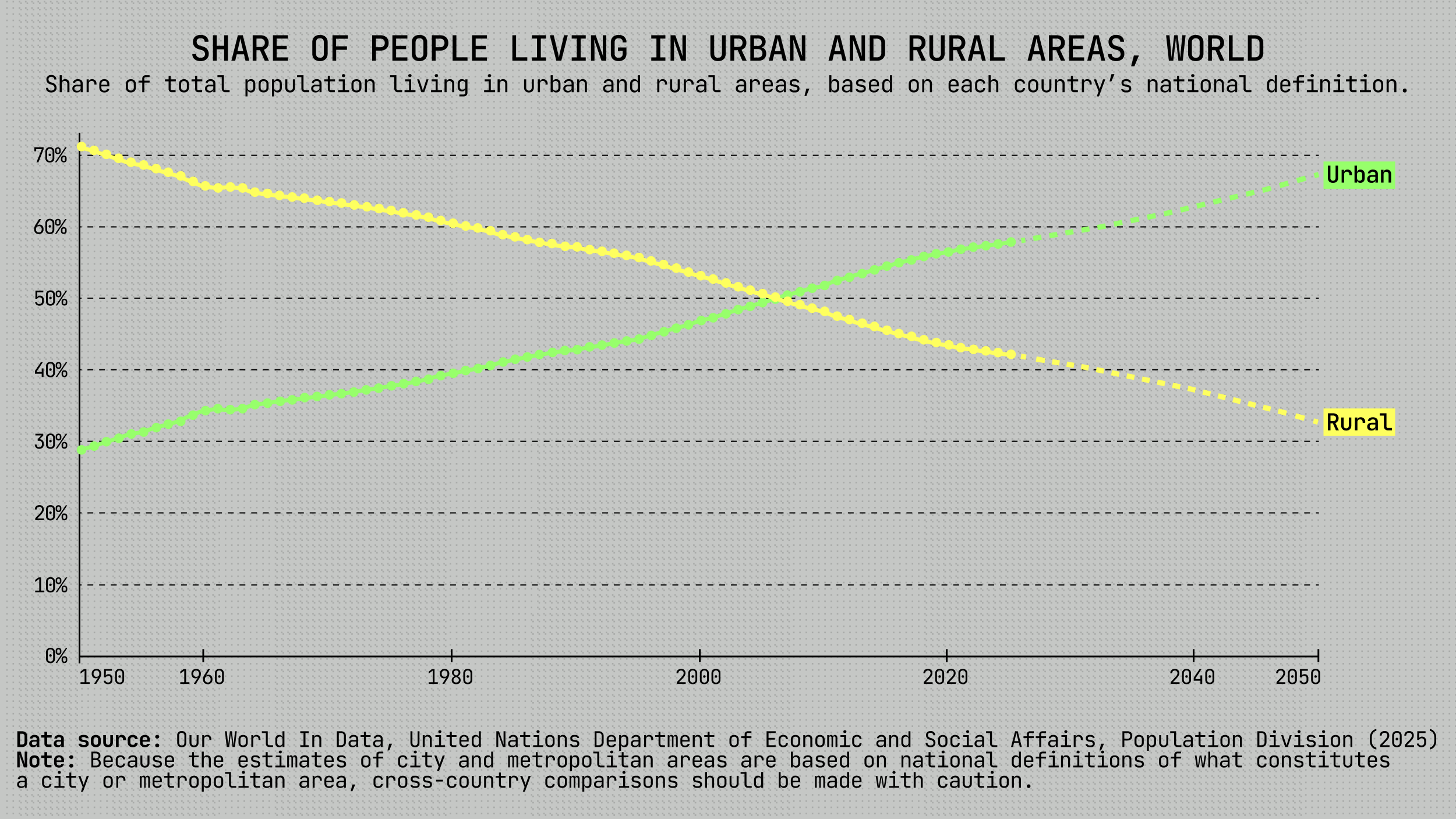
Urbanization: In 1980, about 60% of people lived in rural areas and about 40% lived in urban areas. Today, those percentages have flipped to almost 60% urban and 40% rural. This is good news because urbanization is a good proxy for higher incomes and higher educational levels. (About 80% of people in high-income countries in the West live in cities.)
This is doubly good news because we will need to move more people into urban areas to deal with the decarbonization needed for climate change. People living in cities have a much lower carbon footprint than rural people. And we’re now tracking to have about 70% of the population in cities by 2050.
Global middle class: In 1980, the global middle class was estimated at fewer than 1 billion people — less than 20% of the world’s population — and most of those people were living in the West. By 2025, the total number was 4 billion, meaning half the people on the planet were middle class. We quadrupled the number of middle-class people in 40 years, even as the total global population doubled.
Note that the “global middle class” category does not map directly onto Western notions of middle class. It instead relates to a more modest global standard that means the person has some economic security and enough discretionary income to buy classic consumer goods like a refrigerator and air conditioner. At the upper end of this category, people earn $120 a day (about $44,000 a year), while at the lower end, they earn $12 a day (about $4,380 a year).
Democratic governance: In 1980, there were 39 democracies in the world (27% of all nations), but after the collapse of the Soviet Union and global communism, the number skyrocketed. By the year 2000, there were 120 democracies (63% of all nations).
However, there has been quite a bit of backsliding since then, as well as an elastic understanding of what defines a democracy. In 2017, there were 96 electoral democracies — they technically held elections, but they would not necessarily be considered free liberal democracies like in the West. By 2024, the number of nations considered democracies was down to 88, and an estimated 3.1 billion people currently live in countries getting less democratic.
And that brings us to our next topic.
The current backlash to globalization from the incumbents
The era of globalization looks less positive from the perspective of the formerly privileged incumbents. While all this progress was happening on the global level, some workers in the West lost their relative power, prestige, and position as the global economy shifted and much of the world’s manufacturing moved to Asia over those 40 years.
The factory workers in the so-called Rust Belt of the American Midwest fall into that group, and comparable workers could be found in Europe, too. These people not only lost their ability to earn a decent living and provide for their families, but also their sense of identity and purpose. They lost their community of colleagues at the workplace and, eventually, the vitality of the communities they lived within, too.
The businesses and governments of America and Europe could have done a much better job transitioning those disrupted workers to the parts of the evolving economy that still remained vital in the West. No question we did not have enough strategic foresight about what needed to happen to pull off this economic transformation.
Instead, we saw many people in those working-class sectors of the economy really struggle to make their way into this new world. Recent decades have been filled with stories of suffering — opioid abuse and deaths of despair.
Formerly privileged incumbents in Russia have struggled to cope with their lost power, prestige, and position since the end of the Soviet Union in 1991, too. There was a decade where the nation seemed to be genuinely attempting to transition into the dynamic flux of the world of globalization. Again, you could assign some blame to the West for not doing enough to help Russia through the fledgling stage of its new democracy and capitalist economy.
But it’s possible that no amount of help would have been enough to stop a relatively unknown Vladimir Putin from being elected president of Russia in 2000. Over his next two presidential terms, he played on Russians’ wounded nationalism from the Soviet Union days to consolidate power. He did step aside in 2008 — in adherence with term limits set by the constitution — only to return to the presidency in 2012. He then got his tenure extended through 2036. In just 13 years, Putin warped Russia’s once-promising constitutional democracy into an authoritarian dictatorship.
Stage Three in human development: Toward planetary abundance
Conventional wisdom has it that globalization somehow “failed,” and the world is now shifting gears — pulling back from that economic system to return to systems that worked in previous eras. The analysts and pundits assume the rise of Donald Trump and right-wing populism in Europe is somehow indicative of where the world is going. They follow the logic of Trump’s rhetoric and mash-up of old policies, including tariffs, to try to glean some insight into what might be coming. They speculate that we may be going back to an era of great powers constantly fighting each other, similar to what happened for centuries.
I think that conventional wisdom is wrong. We are mistaking the (frankly, predictable) backlash of right-wing populists — and left-wing populists, for that matter — as the new way forward. We are fixated on watching the losers of the globalization game try to restore the old world, but it is not coming back.
Trump and MAGA explicitly frame “Making America Great Again” as returning to the 1950s, the heyday of the post-World War II boom. They want to return to that age when the white working-class was empowered and thriving, when America dominated manufacturing and most other leading industries in the world. And which constituency is most likely to back MAGA in America and the equivalent right-wing populists in Europe? The Baby Boomers and old people, in general. They are the ones trying to restore their supposedly idyllic past — the period when they were the center of the universe.
The world isn’t going back to that lost world. Despite the machinations of Boomer Trump (age 79) and Boomer Putin (age 73), the world is now on the cusp of moving on to the next stage of development for all human beings on planet Earth. We’re going to pick up where we left off with globalization and move upward and outward towards what might someday be understood as Stage Three in human development: a period that fully leverages artificial intelligence, clean energy technologies, and bioengineering.
I elaborate on this Stage Three in the final chapters of my upcoming book, The Great Progression: 2025 to 2050. I also expect to share more of my ideas on the concept in future essays, which I will release in the months leading up to the book’s publication in early 2027. The purpose of this essay is to remind everyone that the overall trajectory of humans is towards more, not less, integration and cooperation.
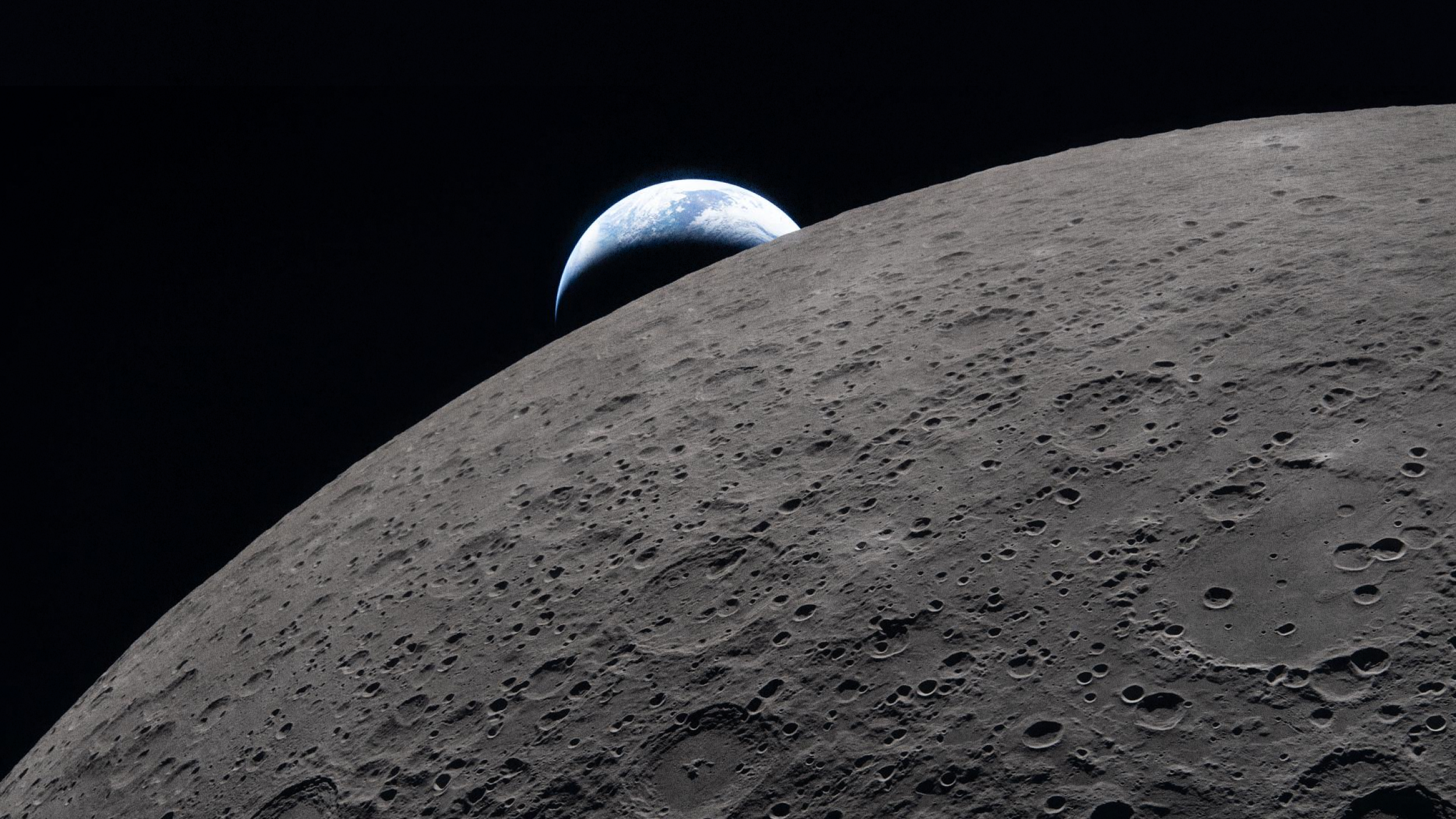
In this essay, I’ve included two new photographs of Earth — the pale blue dot — released just last week as part of the Artemis II lunar mission. They serve as a good reminder that the ultimate destiny of all human beings is to work together within one planetary system. We’ll get there over time.

The Energy Transition