




















Search

"No matter where consumers buy books, their belief that electronic media should cost less—that something you can’t hold simply isn’t worth as much money—will exert a powerful force," writes Ken Auletta.
"Although there must be a physical limit to how many memories we can store, it is extremely large. We don’t have to worry about running out of space in our lifetime," writes Paul Reber.
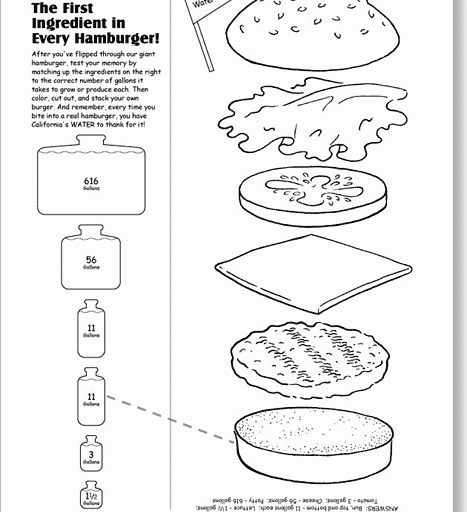
One of the highest-impact lifestyle changes a person can make in the name of environmentalism is to go veggie. It takes – as this blog’s image illustrates – 698 and […]
A study has found that people who report having had "near-death experiences" also have elevated levels of carbon dioxide in their blood—indicating that oxygen deprivation may be the cause.

"A few snapshots." According to novelist Tim O'Brien, that's all our minds retain of our childhoods, adulthoods, and even the people we've loved most deeply. "And that's memory? Little remnant […]

3mins
Our minds don’t capture and record reality, but rather blend experience with fantasy—a process that often results in convincing, yet completely false, memories.

4mins
Remaining mentally active and engaged is critical to retaining information as we age.

4mins
The neuroscientist explains how our mind produces memories and why they actually alter our DNA.

4mins
Less than 5% of Alzheimer’s Disease cases are genetically transmitted. The disease is a consequence of aging, and doesn't target specific demographics.

4mins
Simply paying attention can do a lot to improve recollection, but scientists are also working on a wide variety of memory-boosting drugs.

5mins
A protein that scientists once thought was a "piece of garbage in the brain" turns out to play a key role in memory formation. At high concentrations, however, it spells […]

27mins
A conversation with the professor at the Taub Institute for Research in Alzheimer's Disease and the Aging Brain at Columbia University.

"It has been clear to me since the time of the commission that I led in the '80's, that no doubt the historic responsibility for where we are has to […]
As we push for better health care and longer lives, Gregory Rodriguez writes that we should think about the societal consequences of having so many old people hanging around.
Scientists have created an ultrathin, flexible, electronic implant that essentially melts into place on the brain's surface, and may pave the way for a new generation of medical devices.
"Hummers are stupid and wasteful and if they go away because no one wants to buy one, that'll be just a little sad," writes Penn Jillette. "It's always a little sad to lose some stupid."
Felix Salmon writes that executives need "to imagine their companies 30 years down the line, struggling with the deleterious effects of climate change on profitability."
"Increasingly, neuroscientists, psychologists and educators believe that bullying and other kinds of violence can indeed be reduced by encouraging empathy at an early age," Maia Szalavitz.
The Oklahoma City bombing fifteen years ago "proved once again that without the law there is no freedom," writes former President Bill Clinton.
"While most of the blame for the crisis should reside with those in the financial markets ... a considerable portion of it lies with the economics profession," writes Joseph Stiglitz.