




















Search
Ethan Siegel
Theoretical astrophysicist and science writer

Ethan Siegel is a Ph.D. astrophysicist and author of "Starts with a Bang!" He is a science communicator, who professes physics and astronomy at various colleges. He has won numerous awards for science writing since 2008 for his blog, including the award for best science blog by the Institute of Physics. His two books "Treknology: The Science of Star Trek from Tricorders to Warp Drive" and "Beyond the Galaxy: How humanity looked beyond our Milky Way and discovered the entire Universe" are available for purchase at Amazon. Follow him on Twitter @startswithabang.
Read Less

Did the Universe begin at time t=0? Did space and time emerge from that? The Universe, today, is expanding and cooling, as the volume of the Universe increases while the number […]

If our current laws of physics can’t predict what will happen, even probabilistically, we need something new. There are two theories we have that explain all the particles and their […]

Humanity’s greatest-ever view of the Big Bang’s leftover glow has just released their final analysis. Here’s what we’ve learned. It’s been more than 50 years since humanity discovered a uniform bath […]

The Universe was born with equal amounts of matter and antimatter. How did matter win? 13.8 billion years ago, at the moment of the Big Bang, the Universe was the hottest […]

Our best physical theories predict that a multiverse exists. But if we can’t test it, is it really scientific? The Universe is all there ever was, all there is, and […]

A new set of images from NASA’s Chandra X-ray observatory shows us what we’ve never seen before. The Pillars of Creation, 7,000 light years away in the Eagle Nebula, represents one […]

If we know how big the observable Universe is, why can’t we figure out how big the unobservable part is? 13.8 billion years ago, the Big Bang occurred. The Universe was […]

The most unusual star known has finally had its dimming scientifically explained. Here’s the unusual, dusty resolution. The science of planet-hunting has truly taken off in the 21st century, with […]

In 1987, we detected neutrinos from another galaxy in a supernova. After a 30 year wait, we’ve found something even better. One of the great mysteries in science is determining not […]

Immediately after the Big Bang, the Universe was more energetic than ever. What was it like? When we look out at the Universe today, we see that it’s full of stars […]
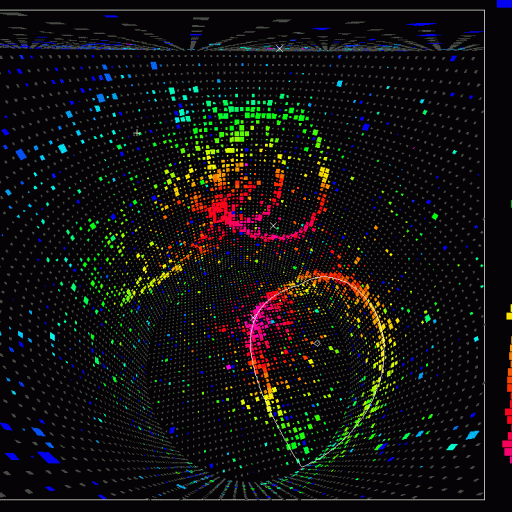
Before there were gravitational waves, multi-messenger astronomy got its start with the neutrino. Sometimes, the best-designed experiments fail. The effect you’re looking for might not even occur, meaning that a […]

The brightest galaxies of all neither have the most stars nor the biggest black holes. Here’s how to solve the mystery. With some 400 billion stars burning steadily, the Milky Way […]

How ‘special’ are we for life to have survived and thrived the way it did? While there are hundreds of billions of stars in our galaxy, many with Earth-sized planets at […]

Finding the ingredients for life is a very different prospect than finding the products of life. Perhaps the greatest quest in science today is to find life that originated beyond Earth. […]

North Korea’s statements, actions, and the physics of how to do it all point to the same terrifying conclusion. There are few things in this world that have the capability […]

13.8 billion years ago, our Universe as-we-know-it came into existence. Here’s what it was like. Looking out at our Universe today, we not only see a huge variety of stars and […]

There’s a halo of dark matter permeating every galaxy, and that means its particles pass through us, too. The Universe, despite all the planets, stars, gas, dust, galaxies, and more we […]

Forget the spectacular explosions we create here on Earth. The Universe outdoes us in every way imaginable. Forget mere chemical reactions; in space, matter-energy conversion creates unprecedentedly powerful explosive events. […]

Dark energy is pushing distant galaxies apart from one another at an increasing rate. If the Big Rip hypothesis is true, things will only get worse from here. One of the […]

The rate at which the Universe has expanding has changed tremendously in 13.8 billion years. So why do we call it the Hubble constant? The Universe is an enormous place, […]