




















Search
Ethan Siegel
Theoretical astrophysicist and science writer

Ethan Siegel is a Ph.D. astrophysicist and author of "Starts with a Bang!" He is a science communicator, who professes physics and astronomy at various colleges. He has won numerous awards for science writing since 2008 for his blog, including the award for best science blog by the Institute of Physics. His two books "Treknology: The Science of Star Trek from Tricorders to Warp Drive" and "Beyond the Galaxy: How humanity looked beyond our Milky Way and discovered the entire Universe" are available for purchase at Amazon. Follow him on Twitter @startswithabang.
Read Less

After years of analysis, the Event Horizon Telescope team has finally revealed what the Milky Way's central black hole looks like.

In Sun-like stars, hydrogen gets fused into helium. In the Big Bang, hydrogen fusion also makes helium. But they aren't close to the same.

Drop sodium in water, and a violent, even explosive reaction will occur. But quantum physics is needed to explain why.

The Standard Model may or may not be in trouble, but particle physics definitely needs saving. Here's what the new LHC can do.

Everything that gets heated up has to, somehow, radiate that energy away. Here's what we see when that happens in the Universe.

For a thousand light-years in all directions, there's a "bubble" that the Sun sits at the center of. Here's the story behind it.

Probably not. Even though we're still investigating the origin of life, the evidence suggests that cells came much later.

Most potentially hazardous asteroids remain unidentified. NEO surveyor could change that, but only if it's funded, and soon.

Was there ever life on Mars? Is there life on Mars now? Did it originate there or here, on Earth? All possibilities are fascinating.

Look out at a distant object, and you're not seeing it as it is today. It's size, brightness, and actual distance are all different.

It was supposed to have a 5.5-10 year lifetime, and take 6 months to calibrate. It's performing better than anyone anticipated.
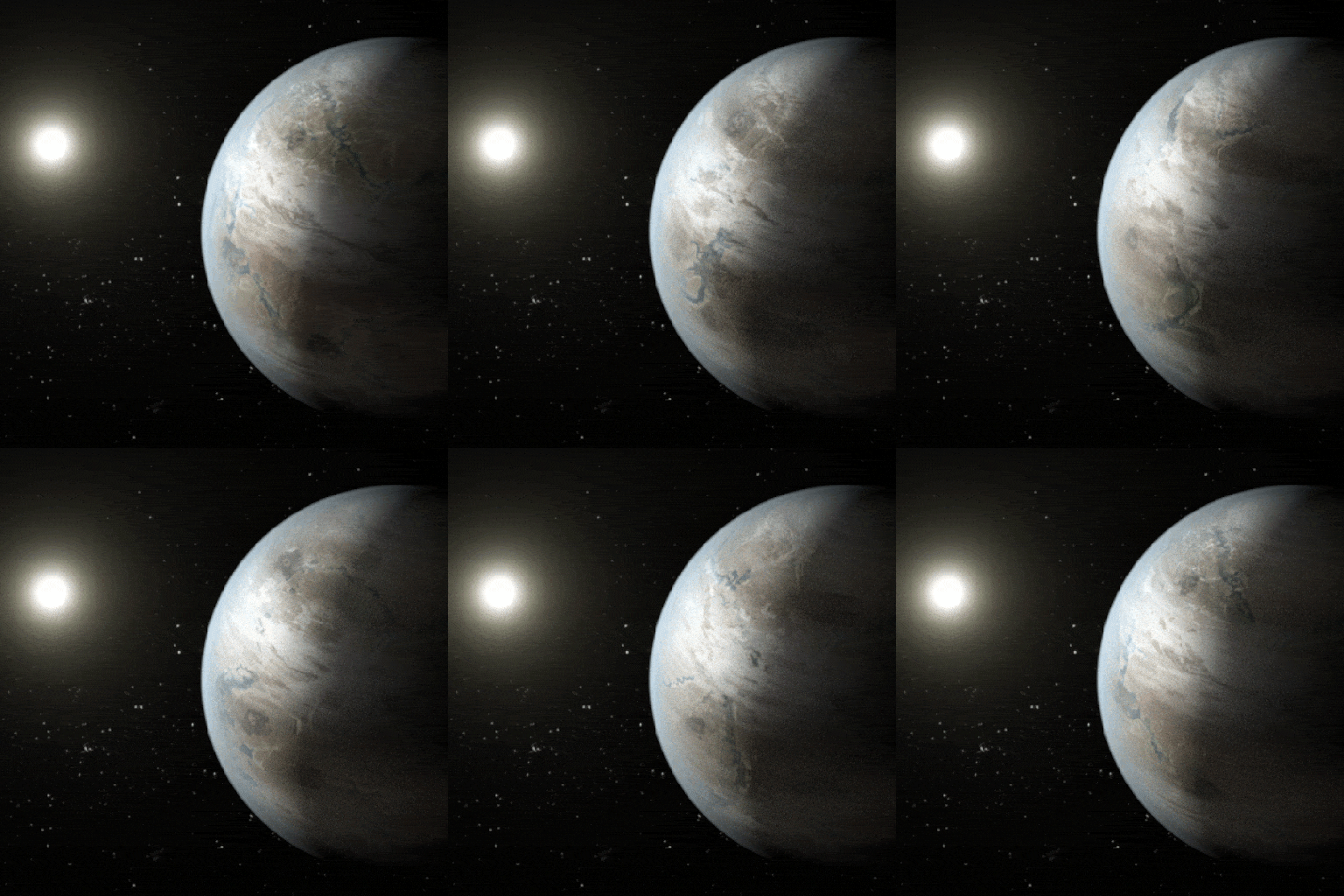
If there are human-sized creatures walking around on other planets, would we be able to view them directly?

Two types of nanotechnology, metalenses and metamaterials, could soon make Harry Potter's invisibility cloak a reality.

It didn't look like anything I'd seen before, but I'd be a great fool to consider "aliens" as a reasonable possibility.

We take for granted that time is real. But what if it's only an illusion, and a relative illusion at that? Does time even exist?

You've spent almost a decade gaining extremely specialized skills. But that's ok; your value is greater than you realize.

The recently discovered Oort cloud comet, Bernardinelli–Bernstein, has the largest known nucleus: 119 km. Here's what it could do to Earth.

Single objects rarely change the course of an entire scientific field. Distant object GNz7q, a galaxy-quasar hybrid, might do exactly that.

For some reason, the charges on the electron and proton are equal and opposite, and their numbers are equal, too. But why?

As far as we can tell, there's no limit to how far it goes on; only a limit to how far we can see. Could the Universe truly be infinite?