
















Kristin Houser

Kristin Houser

Kristin Houser is the Managing Editor of Big Think. Her articles on science and technology have been featured in NBC News, RealClearDefense, and the World Economic Forum’s Agenda, among other publications, and Stephen Colbert once talked about a piece on “The Late Show,” to her delight.

Kristin is currently based in Pittsburgh, and prior to joining Big Think, she was a staff writer for Futurism, launched an LA-based music blog, and wrote several animated and live action web series.

A wide shot of a man walking down an aisle between tall stacks of server racks in a data center filled with computer hardware.
We need more data centers for AI. Developers are getting creative about where to build them.
Two astronauts in orange spacesuits and helmets prepare for a mission. A digital countdown displays "T-MINUS," with an Artemis mission patch visible on one spacesuit.
These missions will put us one step closer to the ultimate goal: crewed trips to Mars.
A black background with the text "ARC PRIZE" in pixelated white and grey font. Two colored squares, one pink and one yellow, are placed above the letters "I" and "Z" in the word "PRIZE.
His $1 million ARC Prize competition is designed to put us on the right path.
A hand holding tweezers grips a small black square against a blue background with concentric white circles.
The lithium-ion alternatives could help create a safer, greener future.
Three Masai men, dressed in traditional attire and adorned with beaded jewelry, gather around a smartphone in an outdoor setting.
And, more importantly, what’s being done to get them online?
A search bar with the phrase "the future" being typed and a blue search button below it. An arrow cursor points to the search phrase. The background is black.
Can AI-powered “answer engines” replace the 10 blue links model?
A rocket launches from a pad at a coastal space center with ocean in background. The word "TMNTUS" is overlaid in large letters.
Comparing Elon Musk's Mars rocket to NASA's new ride.
A drone flying in the sky at sunset with clouds in the background.
The military is courting tech startups to help it win the AI arms race.
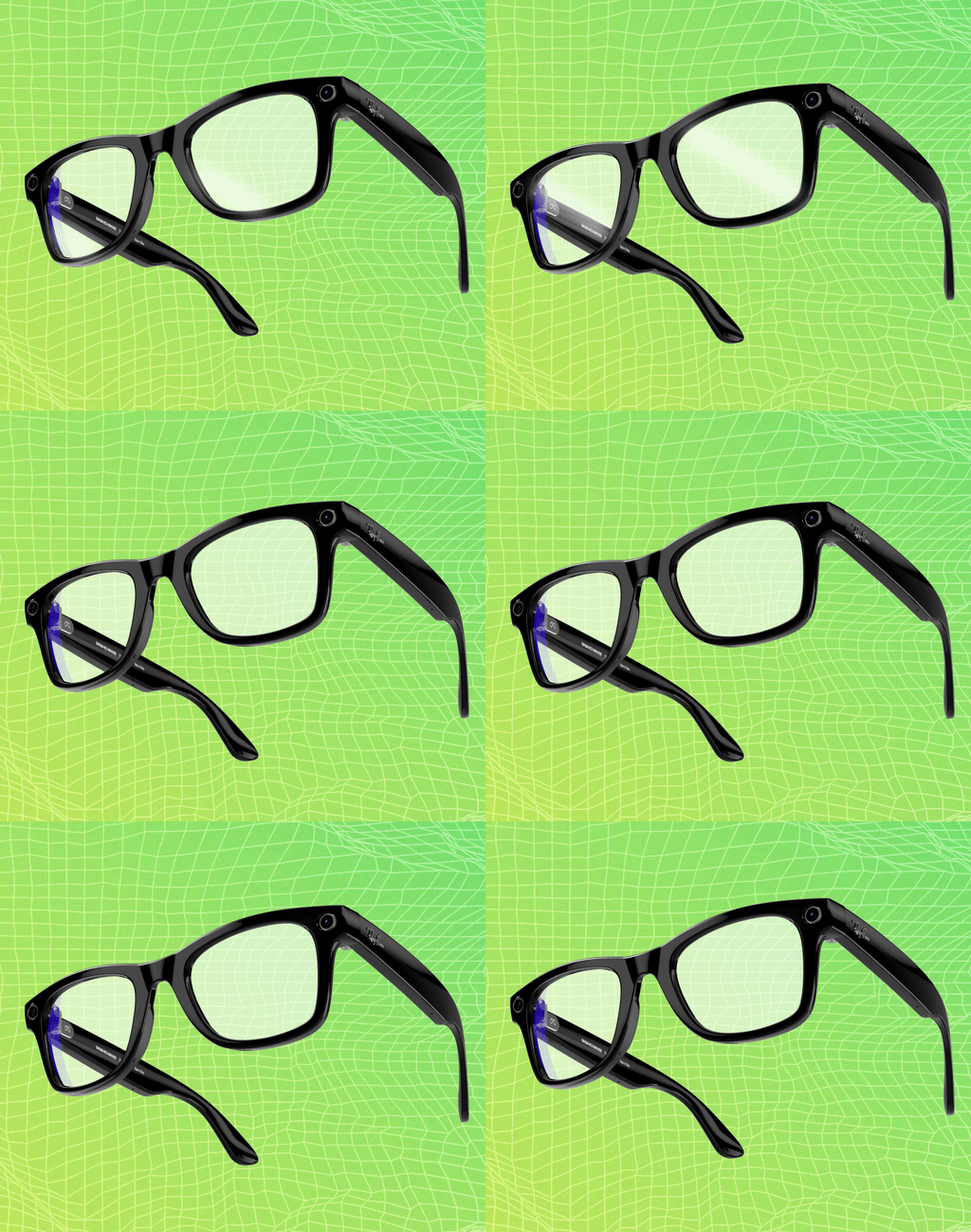
Black smart glasses with clear lenses are displayed against a green and yellow gradient background with a grid pattern.
Smart glasses have flopped before. AI could finally make them mainstream.
A collage of agricultural imagery including a drone, fields, tomatoes, a plant sprout diagram, and various charts and graphs related to farming data.
Hunger rates are rising. These technologies could turn the tide.
Aerial view of a solar farm with rows of solar panels installed on grassy fields on a sunny day.
A look back at the rise of solar power in the US and what's next.
A 3D structural representation of a protein with intertwined helices and strands, depicted in shades of pink and purple, set against a black background.
"By 2040, we hope to see a number of new drugs that have been designed with AI reaching patients."
A solar image with digital counter displaying "0:MINUS" overlaid against the background of the sun with solar flares.
To know how to protect its astronauts, NASA needs to first understand the threat.
Person flexing arm muscles with a photo-negative effect applied, overlaid with semi-transparent geometric shapes. Person is facing away, showing arm and shoulder. Background is indistinct.
While GLP-1 agonists help people lose weight, different drugs could help them retain muscle at the same time.
A robotic hand holds a clapperboard, preparing to slate a scene. The background is dark with faint purple streaks.
Freethink asks three different kinds of experts to answer this question.

Animated countdown timer at zero with the word "MINUS" appearing after the countdown, displayed over a background transitioning from red to blue.
The threats Mars astronauts face — and how NASA is working to solve them.
Close-up of a hand holding a blue object, with a digitally altered, grainy effect and a circular line overlay on the image. The background features a mix of white, red, and pink hues.
GLP-1 agonists may be able to treat addiction, prevent Alzheimer’s, and more.
A 3D molecular model showing a complex structure of intertwined green proteins and grey DNA strands on a black background.
Profluent’s new platform is like ChatGPT for genetic technology.
High-tech robotic arms equipped with cameras digitizing an ancient manuscript in a library.
The burial spot was found in one of the Herculaneum scrolls charred by Mt. Vesuvius.
Fluorescence microscopy image showing a close-up of cells in vibrant blue and green colors, with an arrow indicating a magnified section.
Cancers can’t develop without genetic mutations — or can they?