
















Science & Tech

Science & Tech

Explore the discoveries that reveal how the world works, alongside the technologies that extend, reshape, and sometimes challenge what’s possible.

Two side-by-side images of a galaxy cluster in space, captured by JWST, showcase numerous bright galaxies and stars on a dark background—highlighting one of the most extreme gravitational lens effects ever observed.
Massive galaxy cluster Abell S1063, 4.5 billion light-years away, bends and distorts the space nearby. Here's what a JWST deep field shows.
Infographic illustrating three steps to measure the Hubble Constant, showing Cepheid variable stars, supernovae, and galaxies at increasing distances with redshifted light—highlighting how these methods reveal that the hubble tension is real.
Is the Universe's expansion rate 67 km/s/Mpc, 73 km/s/Mpc, or somewhere in between? The Hubble tension is real and not so easy to resolve.
parallel universe
The ANITA experiment found cosmic rays shooting out of Antarctica. One interpretation claims "parallel Universes," but is that right?
A composite image showing a galaxy with red circles marking stars on the left and multicolored expanding rings with Earth on the right, all set against a grid background, illustrating concepts like Hubble tension studied by Wendy Freedman.
Different methods of measuring the Universe's expansion rate yield high-precision, incompatible answers. But is the problem robustly real?
A silhouette of a person sitting and reading under a white tree made from electronic circuit lines on a gray background.
"The rise of the internet brought about similar fears, yet it ultimately made learning richer and more accessible."
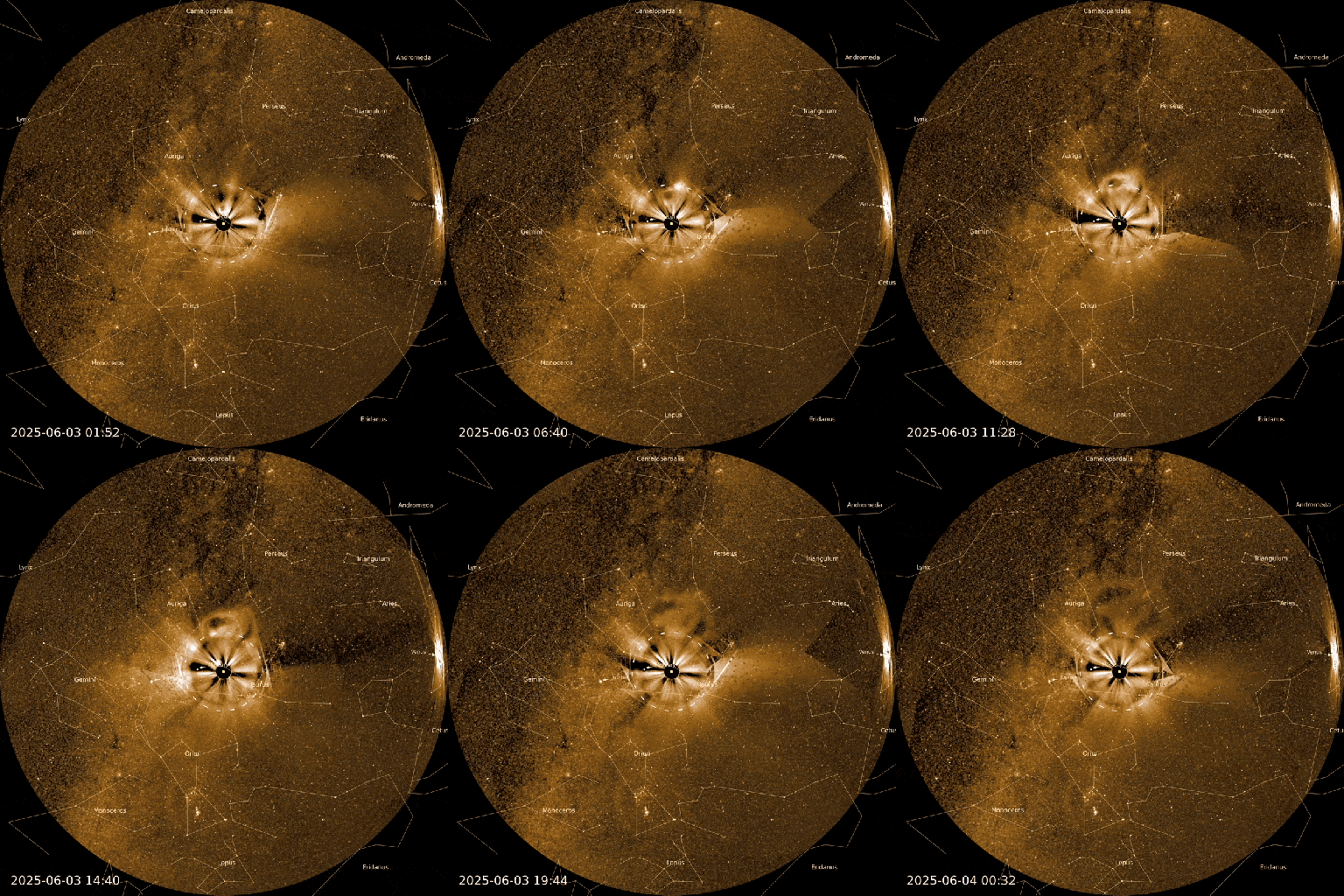
Circular astronomical image showing constellations and celestial objects labeled against a dark sky, reminiscent of a NASA PUNCH video sun corona visualization, with a timestamp of 2025-06-03 01:52 at the bottom left.
Launched in March, the PUNCH mission has viewed two incredible coronal mass ejections, tracking them farther from the Sun than ever before.
A flowchart with a large question mark at the top leads to boxes containing photos, abstract patterns, and arrows connecting each step on a textured green background.
Annie Duke, a poker champion turned decision scientist, talks with Big Think about how to choose well under uncertainty.
The tiniest galaxies of all are the most severely dominated by dark matter. Could black holes be the cause of the extra gravity instead?
A digital illustration showing a glowing blue particle on the left, evoking cosmic inflation, transitioning into a geometric, grid-like structure on a purple background on the right.
A few physical quantities, in all laboratory experiments, are always conserved: including energy. But for the entire Universe? Not so much.
A woman, resembling a paranormal investigator, holds a rectangular glass dish above her eyes, which are illuminated by light shining through the dish in a dark setting.
For his new book, “The Ghost Lab,” Matt Hongoltz-Hetling spent time with paranormal investigators to understand their relationship with science and society.
Timeline of the universe from the Big Bang, as described in cosmology, showing inflation, formation of atoms, stars, galaxies, and expansion to the present day over 13.8 billion years.
If you want to understand the Universe, cosmologically, you just can't do it without the Friedmann equation. With it, the cosmos is yours.
A large yellow hot air balloon with a smiley face is shown on the left; on the right, a bunch of parfit smiley face balloons float against a cloudy sky.
If happiness is an absolute good, would 1 billion slightly happy people be better than 1 million incredibly happy people?
A blue planet with visible rings and several small, bright Uranus moons is set against a darkened black background.
Viewing Uranus's largest moons with Hubble, astronomers hoped to find darkening on the trailing side. They found the exact opposite instead.
A worker in protective gear operates machinery in an industrial facility, with a partial overlay of solar panels and geometric patterns above—hinting at the innovative spirit found in stellar societies.
The cofounders of think tank RethinkX are convinced that humanity is undergoing civilizational phase change.
A white dinosaur skull silhouette on a black background with red, rough, scribbled lines evokes the intrigue of the dinosaur myth.
In "The Shortest History of the Dinosaurs," Riley Black reveals the bold mammals that thrived in the Age of Reptiles.
An illustration shows a cosmic ray entering Earth’s atmosphere, creating a cascade of secondary particles—some of the highest energy particles astronomers study—detected by an array of sensors on the ground.
On Earth, our particle accelerators can reach tera-electron-volt (TeV) energies. Particles from space are thousands of times as energetic.
Image of two large elliptical galaxies surrounded by several smaller, colorful galaxies and stars against a dark background in space.
The first galaxies were irregular blobs of gas and stars. But modern features, like spiral arms and bars, appeared earlier than expected.
A grey, icy planet or moon with surface cracks is shown against a backdrop of stars and the Milky Way galaxy.
The hunt for extraterrestrial life begins with planets like Earth. But our inhabited Earth once looked very different than Earth does today.
An artist's impression of a cluster of stars.
If the Universe is 13.8 billion years old today, but different ages the farther we look back, what does it mean for a star to be the first?
A man in glasses and a suit jacket, resembling John Green, stands in front of a light background with a purple rectangle and abstract black lines.
John Green opens up about his struggle to remain hopeful while writing about suffering and injustice.