




















Search
Science & Tech
Explore the discoveries that reveal how the world works, alongside the technologies that extend, reshape, and sometimes challenge what’s possible.

Someday, we'll look back and see a young galaxy forming stars for the first time. JADES-GS-z14-0, the farthest ever, isn't early enough.

Einstein's general relativity has reigned supreme as our theory of gravity for over a century. Could we reduce it back down to Newton's law?

A fresh view of intelligence — spanning living systems from bacteria to human civilization — challenges the idea that it’s merely problem-solving.

In his new book, the popular science writer tells the story of how scientists discovered the “gaseous ocean” we all swim in — and the trillions of invisible life forms we share it with.

Our scientific instruments are constantly improving, revealing nature's workings as never before. Without them, we'll remain in the dark.
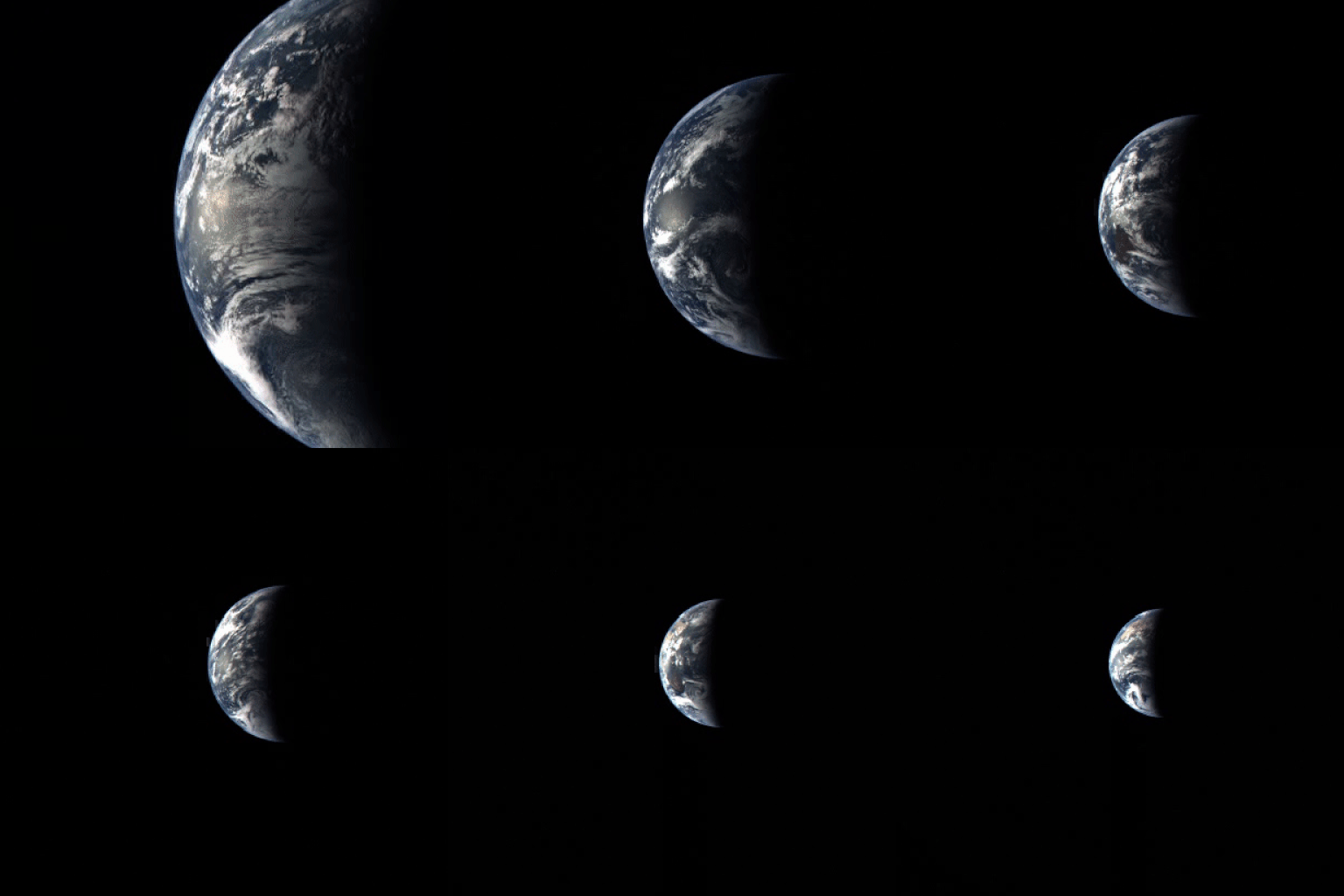
All scientific theories are limited in scope, power, and application, being mere approximations of reality. That's why consensus is vital.

When we see spiral galaxies, some are face-on, others are edge-on, but most are tipped at an angle. But which side is closest to us?

The tiniest galaxies of all are the most susceptible to violence by their larger, bullying siblings. That's why we need them in isolation.

The Universe is expanding, and individual, bound structures are all receding away from one another. How, then, are galaxies still colliding?

Welcome to The Nightcrawler — a weekly newsletter from Eric Markowitz covering tech, innovation, and long-term thinking.

Barnard's star, the closest singlet star system to ours, has long been a target for planet-hunters. We've finally confirmed it: they exist!

Back in 1970, Sister Mary Jucunda wrote NASA, decrying large investments in science. A former Nazi's legendary response is still relevant.

Cognitive neuroscientist and AI researcher Christopher Summerfield explores the differences, and similarities, of how AI and humans make meaning of the world.

Since the dawn of history, humans have pondered our ultimate cosmic origins. Now in the 21st century, science has gone beyond the Big Bang.

Memory takes effort, and our brains know it.

Just 165,000 light-years away, the Large Magellanic Cloud is suspected to house a supermassive black hole. At last, evidence has arrived.

Fears of celestial collisions — and calculations of their likelihood — go back to the very origins of modern science itself.

There are some 26 fundamental constants in nature, and their values enable our Universe to exist as it does. But where do they come from?

Welcome to The Nightcrawler — a weekly newsletter from Eric Markowitz covering tech, innovation, and long-term thinking.

Under extreme conditions, matter takes on properties that lead to remarkable, novel possibilities. Topological superconductors included.