




















Search
Science & Tech
Explore the discoveries that reveal how the world works, alongside the technologies that extend, reshape, and sometimes challenge what’s possible.

From tulips to Bitcoin, bubbles have been given a bad rap as destroyers of dreams — but they’re essential for our brightest future. Here’s why.

From a hot, dense, uniform state in its earliest moments, our entire known Universe arose. These unavoidable steps made it all possible.

It was barely a century ago that we thought the Milky Way encompassed the entirety of the Universe. Now? We're not even a special galaxy.

It’s been 65 years since Richard Feynman saw “plenty of room” in the nano-world. Are we finally getting down there?

"Personhood" credentials could cleanse the internet of bots — but are the costs worth it?

50 years ago, Stephen Hawking showed that black holes emit radiation and eventually decay away. That fate may now apply to everything.

The closest known star that will soon undergo a core-collapse supernova is Betelgeuse, just 640 light-years away. Here's what we'll observe.

The Wharton School professor — and author of Co-Intelligence — outlines ways we can tap into the AI advantage safely and effectively.

We have very specific predictions for how particles ought to decay. When we look at B-mesons all together, something vital doesn't add up.

The integration of artificial intelligence into public health could have revolutionary implications for the global south—if only it can get online.

By looking back at future dreams we can see our current hopes and visions in a whole new light.

Most waves need a medium to travel through. But the way that light and gravitational waves travel shows that space can't be a medium at all.

The Sombrero is the closest bright, massive, edge-on galaxy to us. JWST's new image, taken with MIRI, finally shows what's under its hat.

Behind America's hunt for a superior semiconductor.

The nonprofit made a bold gamble on the limits of "fair use" — and federal courts have not backed their play.

How many scientists does it take to ruin a good conspiracy?

One of the fundamental constants of nature, the fine-structure constant, determines so much about our Universe. Here's why it matters.

Welcome to The Nightcrawler — a weekly newsletter from Eric Markowitz covering tech, innovation, and long-term thinking.
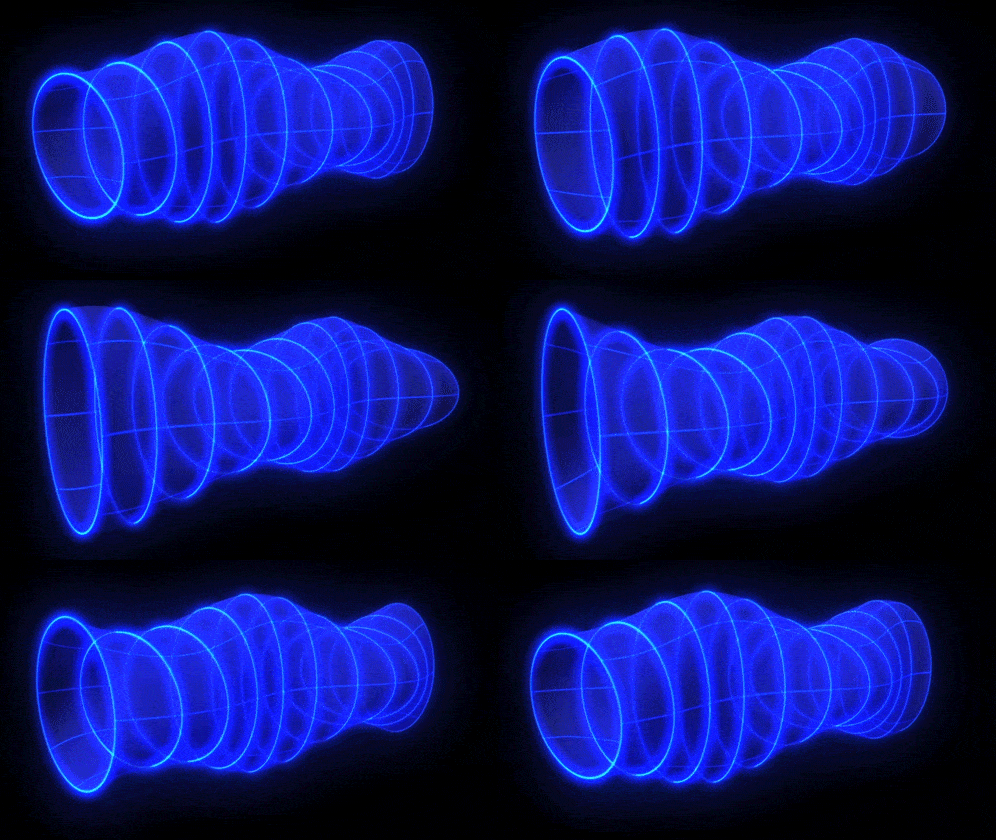
Gravitational waves are the last signatures that are emitted by merging black holes. What happens when these two phenomena meet in space?

“We can build AI scientists that are better than we are… these systems can be superhuman,” says the FutureHouse co-founder.