
















Science & Tech

Science & Tech

Explore the discoveries that reveal how the world works, alongside the technologies that extend, reshape, and sometimes challenge what’s possible.

A world map displays global climate zones with colors representing varying levels of temperature and precipitation: green for temperate, yellow for arid, orange and red for hotter regions, and blue for wet zones.
The salinity of the oceans is not just a matter of taste. Saltier water behaves differently, too.
A person is giving a presentation at a podium with a large abstract, colorful light pattern displayed on a screen behind them.
Inflation, dark matter, and string theory are all proposed extensions to the prior consensus picture. But what does the evidence say?
A satellite orbits Earth against a backdrop of space. Below, the Earth's curvature and cloud formations are visible, making our planet seem even bigger.
The observation that everything we know is made out of matter and not antimatter is one of nature's greatest puzzles. Will we ever solve it?
A historical timeline featuring notable figures from 1400 to present, including scientists, writers, politicians, and artists. The timeline is categorized by different historical eras.
"The Big Map of Who Lived When" plots the lifespans of historical figures — from Eminem all the way back to Genghis Khan.
A person lies in bed reading a book, wearing a white blouse, in a painting with soft, muted colors.
With the right prompts, large language models can produce quality writing — and make us question the limits of human creativity.
Portrait of an older man with a beard wearing a hat, depicted in purple tones, with scientific and alchemical symbols in the background, capturing the essence of a truth machine.
Why human attempts to mechanize logic keep breaking down.
A storefront with signs for psychic telepathy readings and a phone number. Two white plastic chairs are placed in front. The storefront is pink with a black awning and a large hand sign advertising $10 readings.
Thinking of a number between one and ten? Here's how predictable human responses create the illusion of telepathy.
A room simulating a Martian landscape with red sand, rocky walls, a green tent, and NASA equipment.
"When you feel the isolation setting in at times, you have to reframe your mindset."
Interior of a particle physics laboratory showing a complex particle accelerator setup with multiple cables, detectors, and machinery designed to study glueball particles.
Scientific surprises, driven by experiment, are often how science advances. But more often than not, they’re just bad science.
Close-up view of a translucent, flatfish-like biohybrid organism with a thin body and short, spiky fins suspended in clear liquid against a plain background.
As creatures and machines meld together in increasingly advanced forms, ethicists are starting to take note.
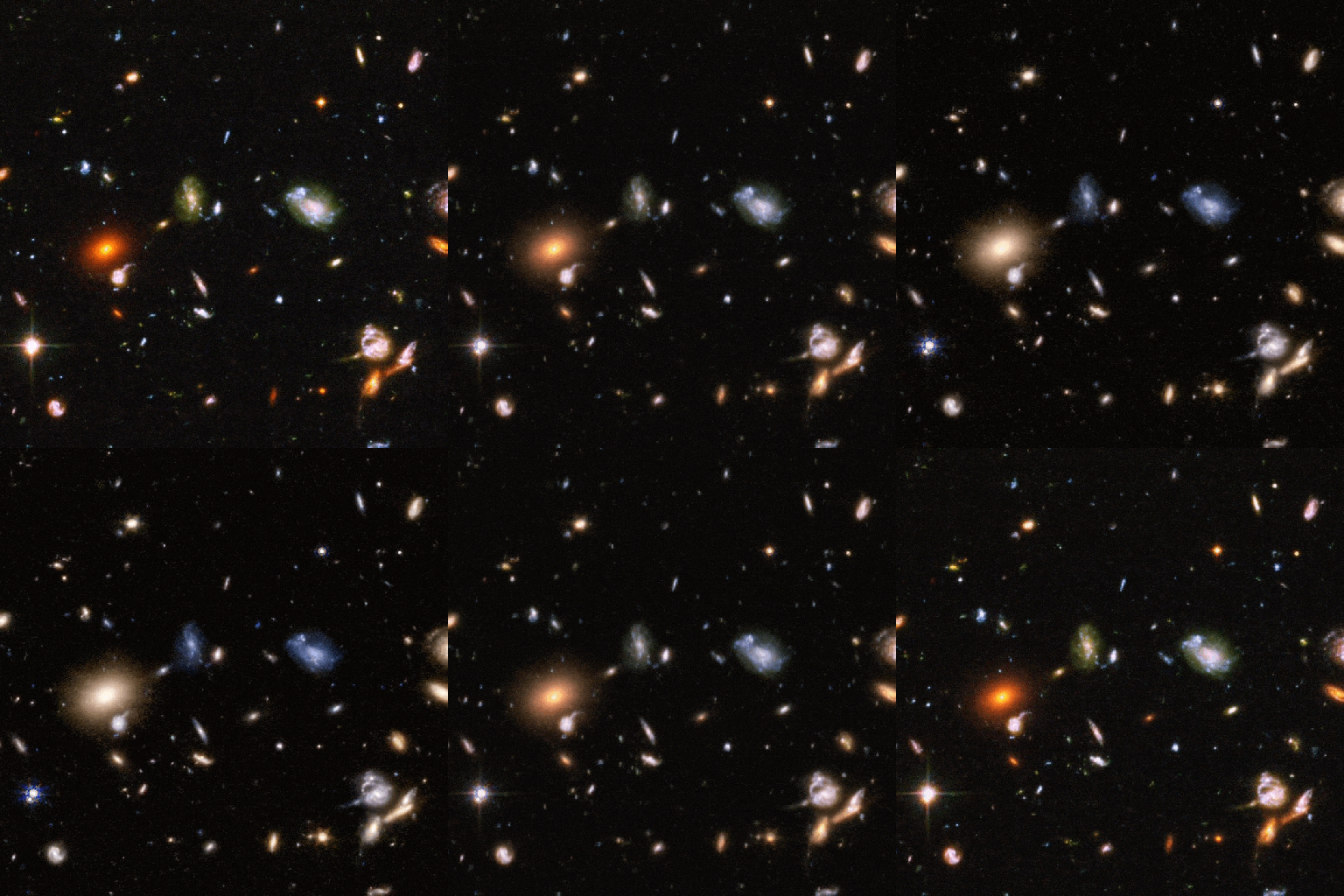
JWST deep field vs hubble
The "little red dots" were touted as being too massive, too early, for cosmology to explain. With new knowledge, everything adds up.
Diagram showing four circles, each containing a different particle symbol: antiproton (n-bar), antineutron (n-bar), anti-lambda (Λ-bar), and antiproton (p-bar), set against a graph-like background.
Researchers at the Brookhaven National Laboratory recently created the heaviest exotic antimatter hypernucleus ever observed.
Comparison of weight on Earth and Mars for a 1 kg mass. On Earth: gravity = 9.81 m/s², weight = 9.81 N. On Mars: gravity = 3.72 m/s², weight = 3.72 N; demonstrating that weight and mass are not the same across different planets due to varying gravitational forces.
Here on Earth, we commonly use terms like weight (in pounds) and mass (in kilograms) as though they're interchangeable. They're not.
A black and white image of a curled fern leaf is centered on a black background with faint, star-like specks, capturing an ethereal beauty reminiscent of Sara Walker's scientific explorations.
In "Life As No One Knows It," Sara Imari Walker explains why the key distinction between life and other kinds of "things" is how life uses information.
So far, Earth is the only planet that we're certain possesses active life processes. Here's what we shouldn't assume about life elsewhere.
cosmic inflation
The Universe isn't just expansion, but the expansion itself is accelerating. So why can't we feel it in any measurable way?
A collage-style graphic features a man with a goatee, the title "The Nightcrawler," stock charts, and abstract shapes in orange and green.
Welcome to The Nightcrawler — a weekly newsletter from Eric Markowitz covering tech, innovation, and long-term thinking.
A colorful, abstract scientific illustration with a central glowing sphere, circular patterns, and various lines and circles suggesting quantum connections or uncertainty data points, on a dark background with blue accents.
No matter how good our measurement devices get, certain quantum properties always possess an inherent uncertainty. Can we figure out why?
Image with a split view: the left half shows a black-and-white image of Earth, the right half depicts a grayscale crowd scene. Text overlay: "More Humans Are Better," with the number "3" in the top right corner.
In a world of rising cynicism, a celebration of our capacity to create, adapt, and thrive.