




















Search
Science & Tech
Explore the discoveries that reveal how the world works, alongside the technologies that extend, reshape, and sometimes challenge what’s possible.

The first supernova ever discovered through its X-rays has an enormously powerful engine at its core. It's unlike anything ever seen.

A professor of educational psychology explains what and what not to do.

The Solar System isn't a vortex, but rather the sum of all our great cosmic motions. Here's how we move through space.

This article was originally published on our sister site, Freethink. Fifteen volunteers in France just spent more than a month living in a cave — without any way to tell time — […]

Some stars burn through their fuel as expected, and die of natural causes. But others, instead, get murdered. Here's their story.

Humanity's most advanced tech still hasn’t unraveled the mysteries of the human mind. Can brain scans show us how we store memories?

Space missions in 2022 will include massive rockets and asteroid collisions. This is also the year space tourism starts to hit its stride.

A levitating vehicle might someday explore the moon, asteroids, and other airless planetary surfaces.

With around 5,000 summertime residents, increased tourism, and a warming planet, it is becoming difficult to protect Antarctica from invasion.

Treatments for depression have significantly improved since the 1980s. So why isn't the rate of depression decreasing?

With advanced laser technology and an appropriate sail, we could accelerate objects to ~20% the speed of light. But would they survive?

New technology is helping physicists move forward in the search for the Theory of Everything.

In movies and TV shows, aliens look like pointy-eared humans. Is this realistic? If evolution is predictable, then it very well might be.

After a night of partying and heavy drinking, you might be tempted to Google "hangover cures." Unfortunately, there aren't any.

Particle physics needs a new collider to supersede the Large Hadron Collider. Muons, not electrons or protons, might hold the key.

Centuries ago, the plague forced people into quarantine for years. Isaac Newton and Galileo used the time to revolutionize the world.

Hybrid working, robot fast food workers, and the rapid acceleration of NFTs are just the beginning.

Known as primordial black holes, they could thoroughly change our Universe's history. But the evidence is strongly against them.
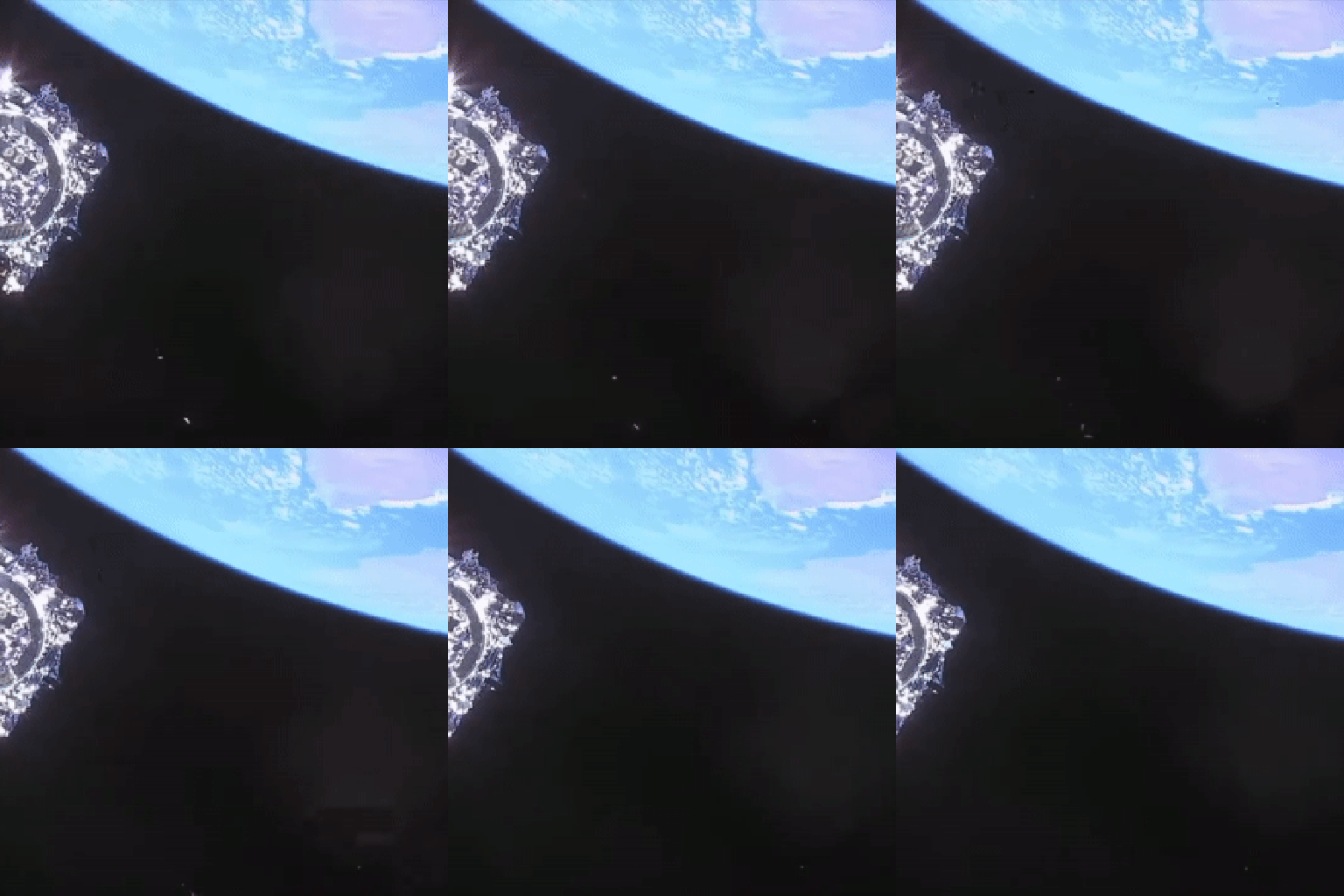
For many, it was just a successful launch like any other. But for scientists around the globe, it was a victory few dared to imagine.

Historical geniuses used the "creative nap" to give their minds a boost. Apparently, the "hypnagogic state" can help with problem solving.