




















Search
Astrobiology

Most exoplanets have been found around single stars via the transit method. But binary star systems might contain even more of them.

NASA is creating a planet habitability index, and Earth may not be at the top. With our current data, ranking habitability is guesswork.

Yes, NASA's Perseverance rover found organics on Mars. So did Curiosity. Unfortunately, that doesn't mean anything in the search for life.

One book will gather all topics on the search for life in the Cosmos.

Venus Life Finder could launch as early as 2023.

Remembering Frank Drake, who transformed the search for alien life & extraterrestrial intelligence into a full-fledged scientific endeavor.

Oxygen isn't strictly necessary for combustion, but it is ideal. Any advanced (alien) civilization probably uses oxygen to burn things.

Should we be searching for life on other planets, or technology?

Unless you have a critical mass of heavy elements when your star first forms, planets, including rocky ones, are practically impossible.

There's an extremely good chance that there is, or at least was, life on Mars. But is it native to Mars, or did it originate from Earth?

With a telescope at just the right distance from the Sun, we could use its gravity to enhance and magnify a potentially inhabited planet.

"You develop an instant global consciousness, a people orientation, an intense dissatisfaction with the state of the world, and a compulsion to do something about it."

The emergence of life in the universe is as certain as the emergence of matter, gravity, and the stars. Life is the universe developing a memory, and our chemical detection system could find it.
John Templeton Foundation

The psychology of alien contact largely revolves around the concept of "otherness." We need to learn to be comfortable around strange things.

On Earth, carbon can form millions of compounds, while silicon is largely stuck inside rocks. But elsewhere, silicon could form the basis of life.


Any alien civilization that grows to span an entire planet would spark the same effects that we have. So, what do we do about it?

Earth is the Solar System's only known inhabited planet. Could Venus, if its phosphine signal is real, be our second world with life?

Researchers have discovered 830-million-year-old microbes living inside a salt rock on Earth. Could the same occur on Mars?

A new study of Martian dust gives insights into the ancient Martian climate. The findings hint at a wetter world.

Some astrobiologists believe life is rare, while others believe it is common in the Universe. How can we find out which view is correct?

The answer may lie in the particular way sand forms on Titan.

Europa may be difficult to access. But if a recent study is correct, its subsurface ocean would be more accessible than previously thought.

Probably not. Even though we're still investigating the origin of life, the evidence suggests that cells came much later.

Was there ever life on Mars? Is there life on Mars now? Did it originate there or here, on Earth? All possibilities are fascinating.
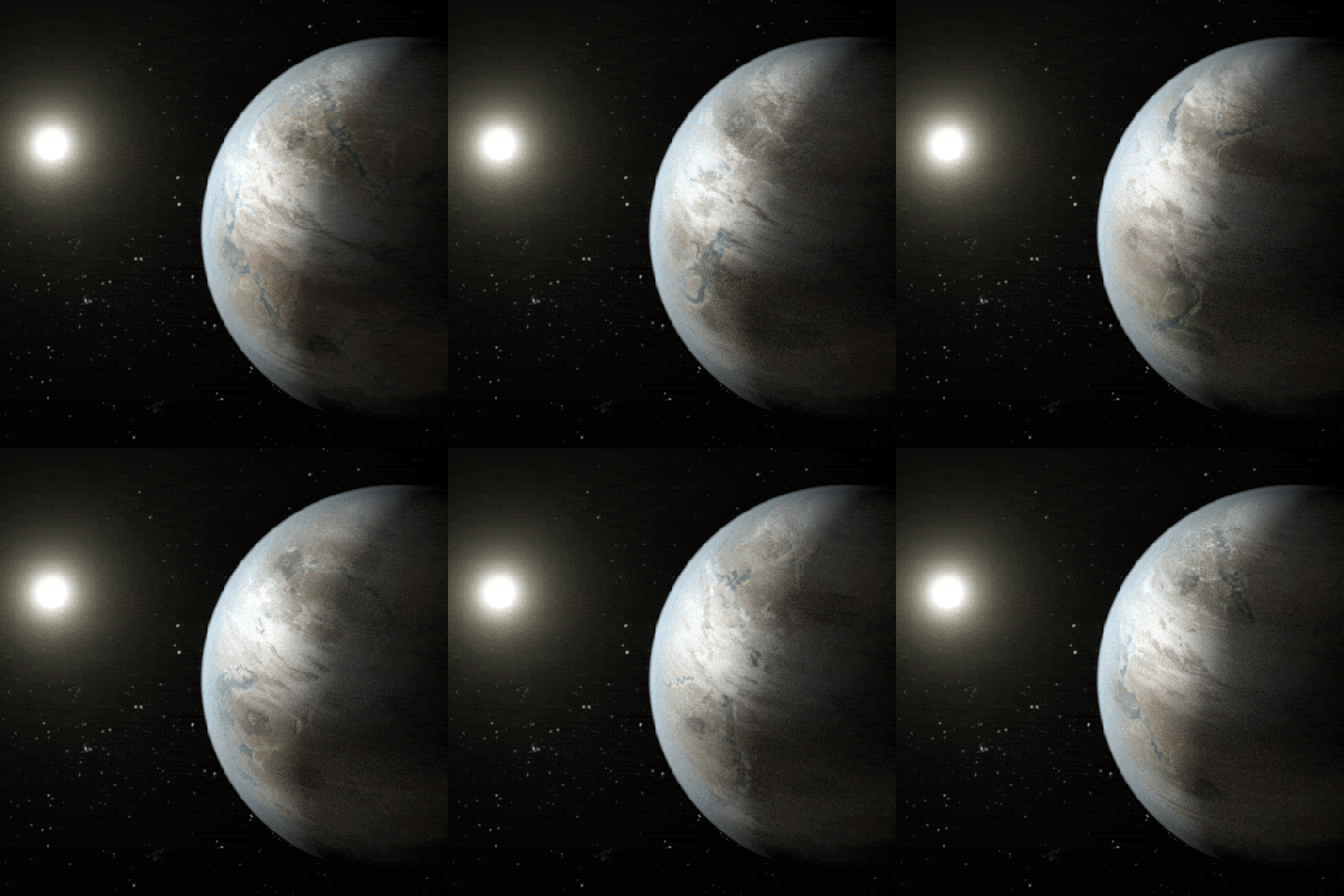
If there are human-sized creatures walking around on other planets, would we be able to view them directly?

There are pros and cons to sending interstellar messages to aliens that may or may not exist.

Ancient helium-3 from the dawn of time leaks from the Earth, offering clues to our planet’s formation. A key question is where it leaks from.

The recently discovered Oort cloud comet, Bernardinelli–Bernstein, has the largest known nucleus: 119 km. Here's what it could do to Earth.

We should not expect aliens to look anything like us. Creatures that resemble octopuses or birds or even robots are legitimate possibilities.