




















Search
Astronomy

1hr 33mins
"Many astronomers are really driven by the search for Earth twins because I think deep down the natural endpoint of this whole goal of looking for planets is to answer the question, are we alone?"

For centuries, even after we knew the Sun was a star like any other, we still didn't know what it was made of. Cecilia Payne changed that.

Even from a single pixel, multiwavelength data taken over time can reveal clouds, icecaps, oceans, continents, and even signs of life.

Someday, we'll look back and see a young galaxy forming stars for the first time. JADES-GS-z14-0, the farthest ever, isn't early enough.

Our scientific instruments are constantly improving, revealing nature's workings as never before. Without them, we'll remain in the dark.

These books helped build the empirical case that life's origins differ from those described in myths and legends.

Some nebulae emit their own light, some reflect the light from stars around them, and some only absorb light. But that's just the beginning.

When we see spiral galaxies, some are face-on, others are edge-on, but most are tipped at an angle. But which side is closest to us?

The tiniest galaxies of all are the most susceptible to violence by their larger, bullying siblings. That's why we need them in isolation.

Barnard's star, the closest singlet star system to ours, has long been a target for planet-hunters. We've finally confirmed it: they exist!

Since the dawn of history, humans have pondered our ultimate cosmic origins. Now in the 21st century, science has gone beyond the Big Bang.

21mins
"Asking the question of, where did the entire universe come from, is no longer a question for poets and theologians and philosophers. This is a question for scientists, and we have some amazing scientific answers to this question that have defied even the wildest of our expectations."

Just 165,000 light-years away, the Large Magellanic Cloud is suspected to house a supermassive black hole. At last, evidence has arrived.

Fears of celestial collisions — and calculations of their likelihood — go back to the very origins of modern science itself.

One of the most promising dark matter candidates is light particles, like axions. With JWST, we can rule out many of those options already.

Astronomers see spiral and elliptical nebulae nearly everywhere, except by the Milky Way's plane. We didn't know why until the 20th century.
Perhaps the most well-known equation in all of physics is Einstein's E = mc². Does mass or energy increase, then, near the speed of light?

The full extent of the Andromeda galaxy, the nearest large galaxy to our own, has been entirely imaged with Hubble's exquisite cameras.

Dark matter doesn't absorb or emit light, but it gravitates. Instead of something exotic and novel, could it just be dark, normal matter?

Asteroid 2024 YR4, which could devastate a city's worth of humans, has gone from 1.2% to 2.3% to 2.6% to 3.1% chances of impact. Here's why.

At extremely close distances to their stars, even rocky planets can be completely disintegrated. We've just caught our first one in action.

Ring galaxies are rare, but we think we know how they form. A new, early-stage version, the Bullseye galaxy, provides a new testing ground.

Here in our Solar System, terrestrial bodies get moons from gravitational capture or collisions. The Pluto-Charon system? It was both.
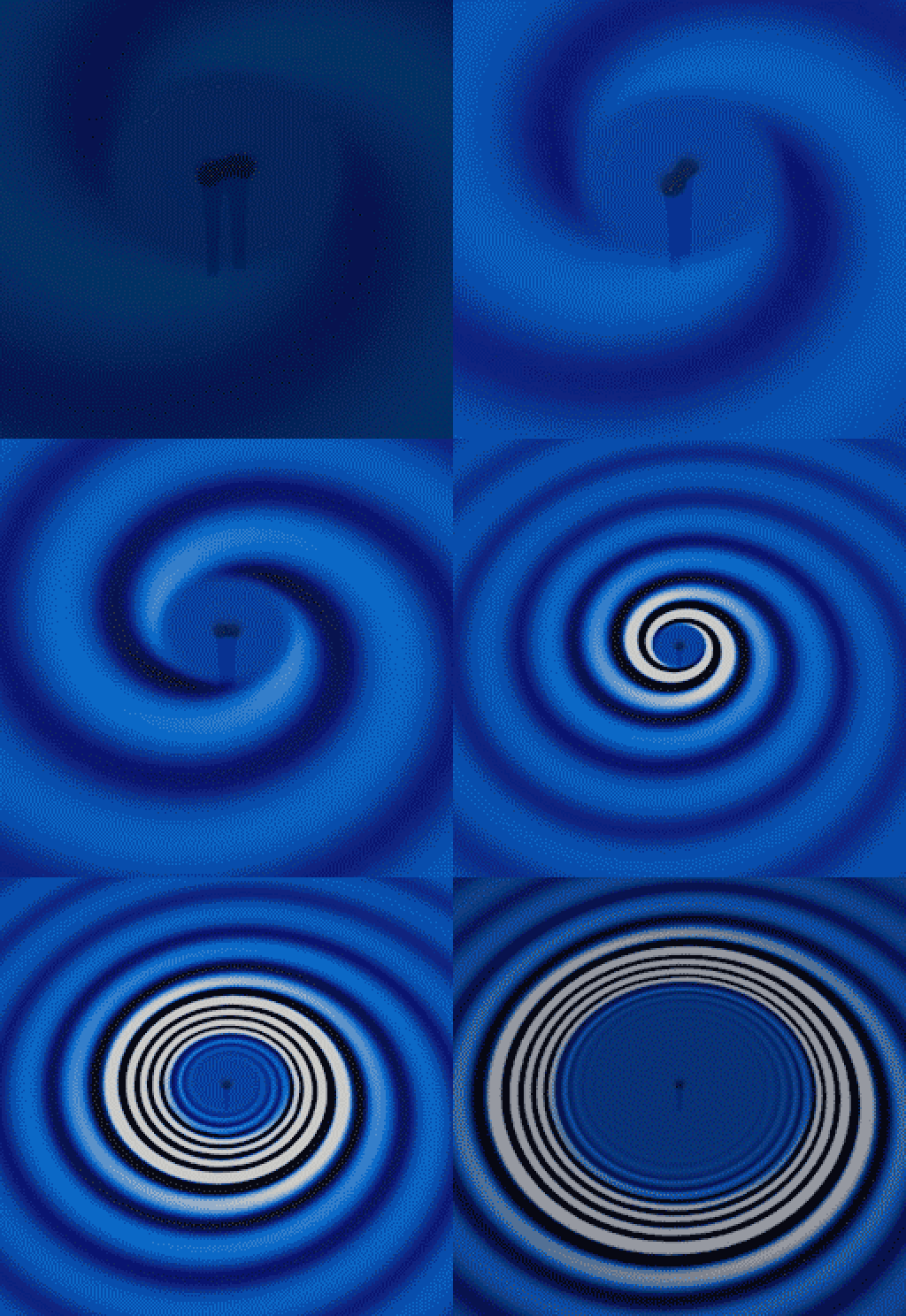
The ultimate multi-messenger astronomy event would have gravitational waves, particles, and light arriving all at once. Did that just occur?

A young, nearby, massive star, whose protoplanetary disk appears perfectly edge-on, was just viewed by JWST, with staggering implications.

A new SETI study shows how far the field of technosignatures has come.

Historically, astronomers have often named things creatively, bizarrely, and often inaccurately. But which terms are the most egregious?

Seeking life beyond the Solar System, we first look to the closest star systems with Earth-like planets. Here's why that's not good enough.

Our Moon is full of craters, basins, and ancient lava flows. But two large lunar Grand Canyons have the same origin: a single, giant impact.

There are only four super star clusters in all the Local Group: rarities today. Here's what the youngest, the just-discovered N79, shows us.