




















Search
Astronomy

From astrobiology to geology, a Moon base could serve as a laboratory unlike anything on Earth.

At 1,600 light years away, the black hole is practically in our cosmic backyard.

It's rare that one single image packs so much beauty and science simultaneously. This Hubble view of a nearby star-forming region has both.

Supermassive black holes at the centers of galaxies gobble up whatever matter ventures too close, becoming active. Here's how they work.

We're used to scientists telling us about the math and physics behind astronomical events. But what does studying space make us feel?

Astronomers have been looking for radio waves sent by a distant civilization for more than 60 years.

All across the Universe, planets come in a wide variety of sizes, masses, compositions, and temperatures. And most have rain and snow.

The ESA's Gaia mission just broke the record for closest black hole by over 1,000 light-years. Is there an even closer one out there?


Science is for everyone, even those possessing strongly held beliefs that seem to conflict with the best available evidence.

IceCube just found an active galaxy in the nearby Universe, 47 million light-years away, through its neutrino emissions: a cosmic first.

We know the Universe is expanding, but scientists don't agree on the rate. This is a legitimate problem.

The largest hazardous asteroid found in the last 8 years showcases a little-known class of planet-killers. And we're woefully unprepared.

In 1995, Hubble peered at the Pillars of Creation, forever changing our view. Now in 2022, JWST completes the star-forming puzzle.

The stars circle each other every 51 minutes, confirming a decades-old prediction.

Most exoplanets have been found around single stars via the transit method. But binary star systems might contain even more of them.

Early relics and late-time objects give incompatible results for the expanding Universe. This independent anomaly intensifies the problem.

The DART mission tested whether it's possible to deflect an asteroid by crashing something into it.

The Universe gravitates so that normal matter and General Relativity alone can't explain it. Here's why dark matter beats modified gravity.

1.9 billion years ago, a star's explosive death created a black hole. Its light just arrived at Earth. But did it set a cosmic record?


NASA is creating a planet habitability index, and Earth may not be at the top. With our current data, ranking habitability is guesswork.

Over the past 50 years, 27 leap seconds have been added to our time.

With its first view of a protoplanetary disk around a newly forming star, the JWST reveals how alone individual stellar systems truly are.
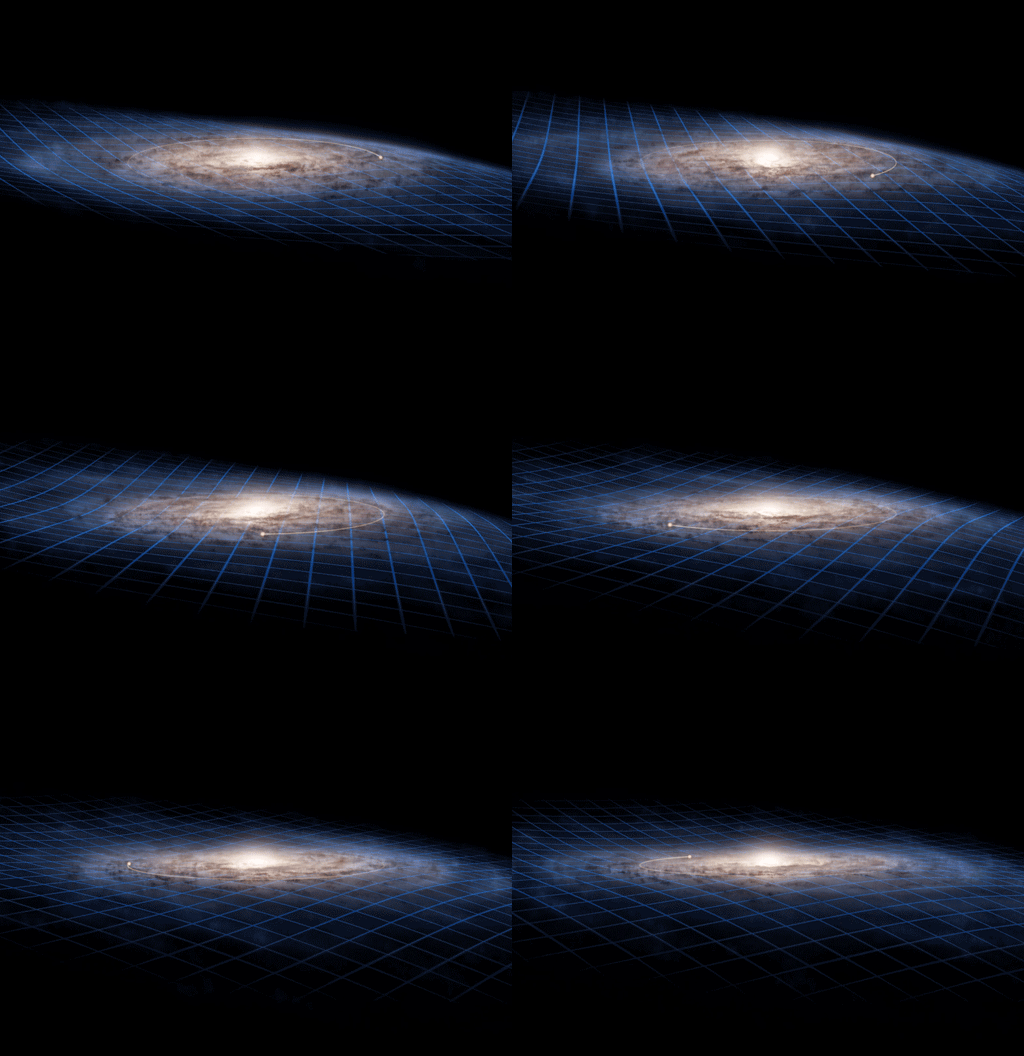
The Universe begins with negligible amounts of angular momentum, which is always conserved. So why do planets, stars, and galaxies all spin?

Venerated astrophysicist Carl Sagan entertained the possibility.

Before we discovered gravitational waves, multi-messenger astronomy got its start with light and particles arriving from the same event.

It's the very closest stars to us that hold the key to unlocking the possibilities for life in star systems all throughout the Universe.

This technological feat changes our cosmic history.