




















Search
Astronomy

Earth is the Solar System's only known inhabited planet. Could Venus, if its phosphine signal is real, be our second world with life?

On July 12, 2022, NASA will release the first science images taken with the James Webb Space Telescope. Here's what to hope for.

The James Webb Space Telescope is about to begin science operations. Here's what astronomers are excited about.

We've only seen Uranus up close once: from Voyager 2, back in 1986. The next time we do it, its features will look entirely different.

Researchers have discovered 830-million-year-old microbes living inside a salt rock on Earth. Could the same occur on Mars?

The observable Universe is 92 billion light-years in diameter. These pictures put just how large that is in perspective.

Some astrobiologists believe life is rare, while others believe it is common in the Universe. How can we find out which view is correct?

"The pulsar sort of consumes the thing that recycled it, just as the spider eats its mate.”

The answer may lie in the particular way sand forms on Titan.

In all of human history, only 5 spacecraft have had the right trajectory to exit the Solar System. Will they ever catch Voyager 1?

Data from the Zhurong rover suggests the Red Planet was wet more recently than we thought.

The sky is blue. The oceans are blue. While science can explain them both, the reasons for each are entirely different.

At four million solar masses, the Milky Way's supermassive black hole is quite small for a galaxy its size. Did we lose the original?

The idea of black holes has been around for over 200 years. Today, we're seeing them in previously unimaginable ways.

Astronomers in 2017 caught an image of a supermassive black hole in a galaxy far, far away. Doing it in our own galaxy is a huge milestone.

After years of analysis, the Event Horizon Telescope team has finally revealed what the Milky Way's central black hole looks like.

We have long thought that Pluto was completely frozen solid, but the discovery of cryovolcanoes challenges that assumption.

Speculation about the existence of aliens goes all the way back at least to the Greek philosophers. Their arguments will sound familiar.

Everything that gets heated up has to, somehow, radiate that energy away. Here's what we see when that happens in the Universe.

For a thousand light-years in all directions, there's a "bubble" that the Sun sits at the center of. Here's the story behind it.

Europa may be difficult to access. But if a recent study is correct, its subsurface ocean would be more accessible than previously thought.

Most potentially hazardous asteroids remain unidentified. NEO surveyor could change that, but only if it's funded, and soon.

All life forms, anywhere in our Universe, are chemically connected yet completely unique.

Was there ever life on Mars? Is there life on Mars now? Did it originate there or here, on Earth? All possibilities are fascinating.

It was supposed to have a 5.5-10 year lifetime, and take 6 months to calibrate. It's performing better than anyone anticipated.
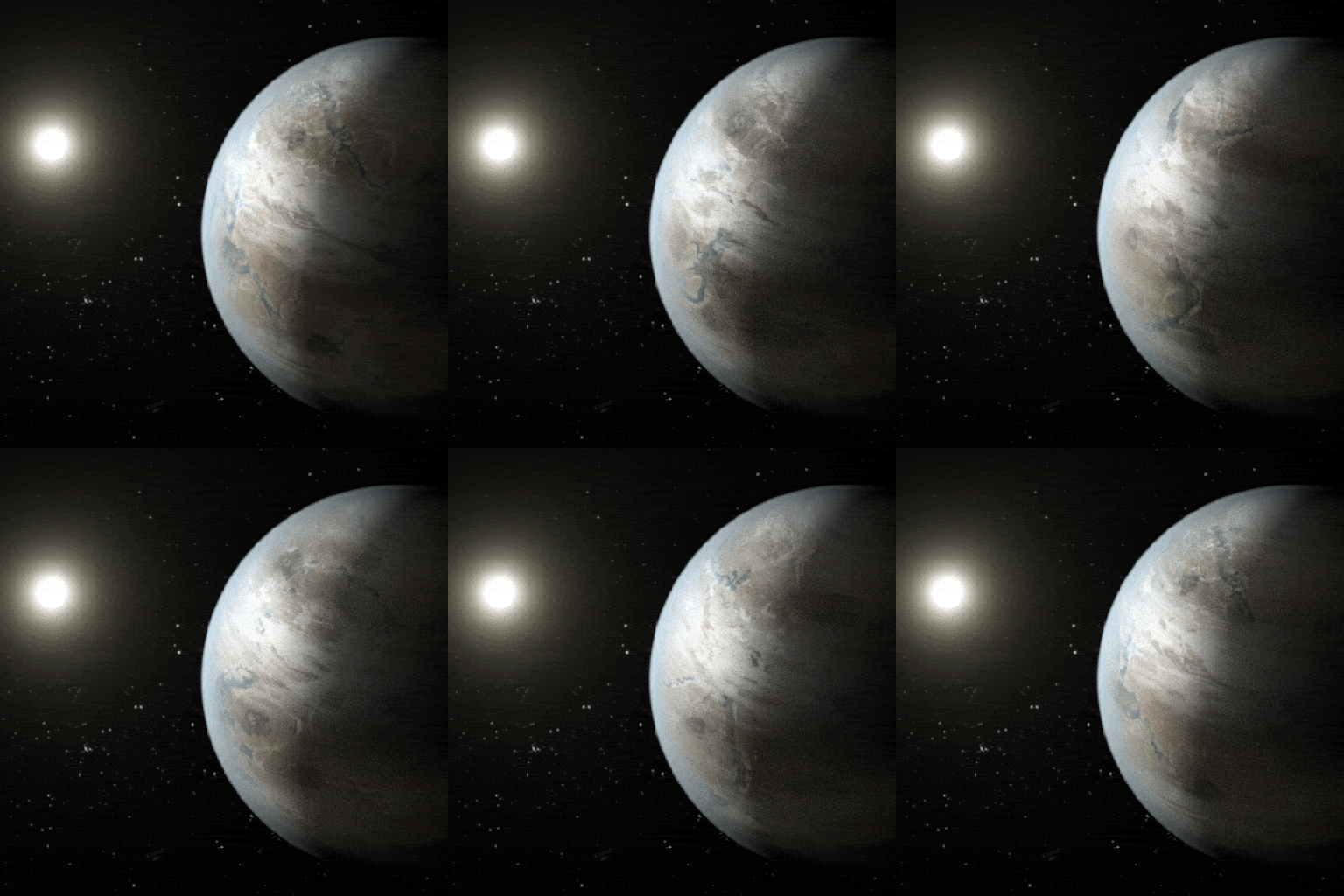
If there are human-sized creatures walking around on other planets, would we be able to view them directly?

There are pros and cons to sending interstellar messages to aliens that may or may not exist.

Pluto failed to meet the definition of a planet, but some astronomers think there might be a legitimate Planet 9 out there.

The European Space Agency’s Solar Orbiter recently captured images that could help scientists better under the mysterious physics of our Sun.

Dr. Tyson explains where we might find aliens, why "dark matter" is a misleading term, and why you can blame physics for your favorite team's loss.