




















Search
Astronomy

In a distant galaxy, a cosmic dance between two supermassive black holes emits periodic flashes of light.

As the Earth spins and wobbles on its axis and revolves elliptically around the Sun, each day changes from the last. "24 hours" isn't right.
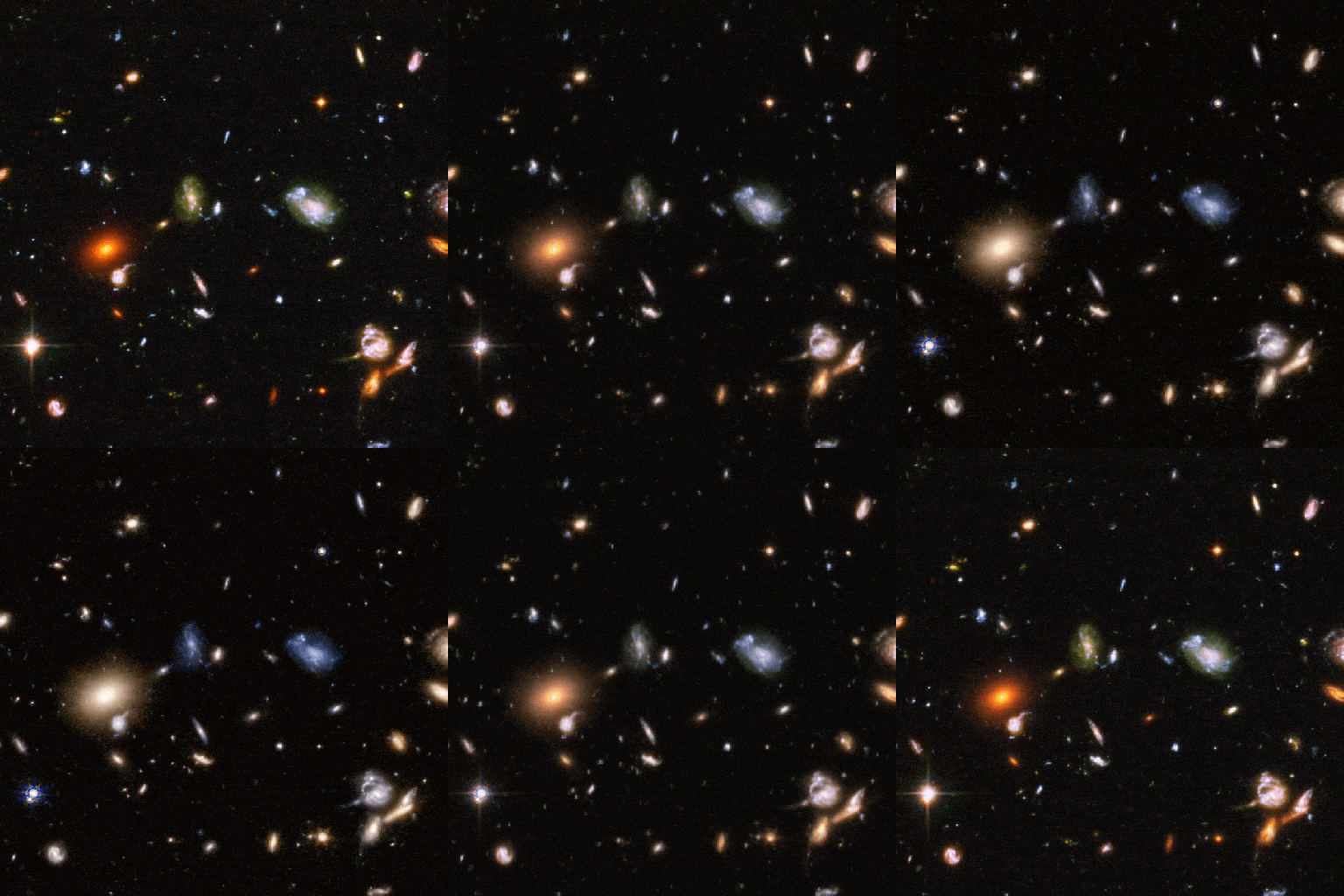
The farther away they get, the smaller distant galaxies look. But only up to a point, and beyond that, they appear larger again. Here’s how.

The familiar terrain of solids, liquids, and gases gives way to the exotic realms of plasmas and degenerate matter.

What do the dark recesses of the early Universe and Zelda: Tears of the Kingdom have in common? More than you could have ever hoped for.

The brightest gamma-ray burst ever observed, GRB 221009A behaved in unexpected ways that might help us understand how they occur.

Sun-like stars live for around 10 billion years, but our Universe is only 13.8 billion years old. So what's the maximum lifetime for a star?

With hundreds of billions of stars burning bright, some galaxies are already dead. Their inhabitants might not know it, but we're certain.

There are 40 billion billion black holes in the universe. Here’s how our Solar System stacks up against ten of them.

Exoplanet LP 791-18d is likely to have an atmosphere and liquid water.

Gamma-ray bursts are so powerful they could vaporize the Earth from 200 light-years away. Recreating them in the lab is not easy.

Hubble showed us what our modern day Universe looks like. JWST's big goal was to teach us how the Universe grew up. Here's where we are now.

With no other galaxies in its vicinity for ~100 million light-years in all directions, it's as isolated and lonely as a galaxy can be.

The outer planets' clouds hide the weirdness within.

A surprising JWST discovery around Fomalhaut has a different, superior explanation: not a great dust cloud, but a mere background object.

Massive objects like black holes, stars, and rogue planets routinely pass near our Solar System. An ensuing comet storm could destroy us.

Some say that the Sun is a green-yellow color, but our human eyes see it as white, or yellow-to-red during sunset. What color is it really?

Archaeologists can learn how societies lived by studying what they left behind when they died. Astronomers are doing much the same thing.

A new, unexpected brightening, just 3 years after a massive dimming event, has astronomers watching Betelgeuse. Is a supernova imminent?

The odds are slim, but the consequences would be literally world-ending. There really is a chance of a black hole devouring the Earth.

Back in 1990, we hadn't discovered a single planet outside of our Solar System. Here are 10 facts that would've surprised every astronomer.

The nearby, bright star Fomalhaut had the first optically imaged planetary candidate. Using JWST's eyes, astronomers found so much more.

They're the most common type of exoplanet known today, and many astronomers have called them "super-habitable." None of that is true.

Mars, the red planet, was a world we knew almost nothing about until our first spacecraft visited it. In just ~50 years, how far we've come!

Before there were planets, stars, and galaxies, before even neutral atoms or stable protons, there was the Big Bang. How did we prove it?

Einstein's relativity overthrew the notion of absolute space and time, replacing them with a spacetime fabric. But is spacetime truly real?

Many planets will eventually be devoured by their parent star. For the first time, we caught a star in the act, eating its innermost planet!

These high-mass, rapidly star-forming galaxies have called modern cosmology into question. But hi-res simulations show no tension at all.

All forms of energy affect the expanding Universe. But if matter and radiation slow the expansion down, how does dark energy speed it up?

Finding out how the Universe grew up was the biggest science goal of JWST. This ultra-early proto-galaxy cluster is one amazing discovery.