




















Search
Astronomy
UAP are no laughing matter anymore.

When people pick the greatest scientist of all-time, Newton and Einstein always come up. Perhaps they should name Johannes Kepler, instead.

Recent research suggests that Earth’s magnetic field bounced back just as complex life was starting to emerge on our planet.

Yes, NASA's Perseverance rover found organics on Mars. So did Curiosity. Unfortunately, that doesn't mean anything in the search for life.

"Spanish Stonehenge" contains 526 giant stones, three circular burial sites, a quarry, and four necropolises.

“The more we understand ourselves and the universe, the more magnificent it is.”

You would think that with all our technology, like the James Webb Space Telescope, we would know how big the Universe is. But we don't.
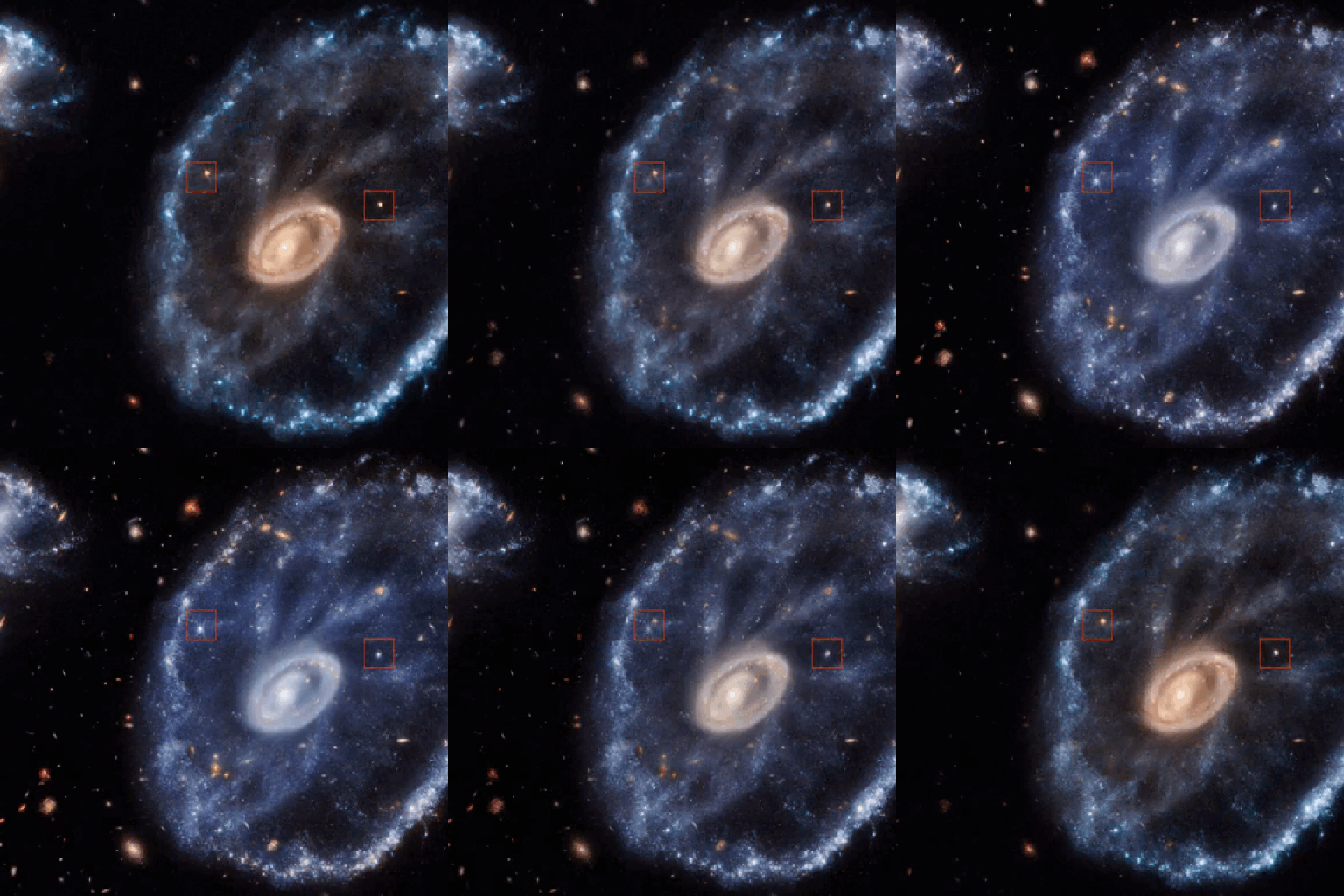
The first set of James Webb's images blew us all away. In just 2 mere months, it's seen highlights that no one could have predicted.

As recently as 1990, we didn't know of any planets beyond our Solar System. Today, with 5000+, we're deep into the weeds of how they form.

One book will gather all topics on the search for life in the Cosmos.

No planet enters retrograde more frequently than Mercury, which does so 3-4 times each year. Here’s the scientific explanation for why.

Asteroid collisions aren't always bad.

Spaceguard shows that we can manage risks to the extinction of humanity — if only we put our mind to it.

The concept is so complex that scientists still argue whether it exists or if it is an illusion.
John Templeton Foundation

Remembering Frank Drake, who transformed the search for alien life & extraterrestrial intelligence into a full-fledged scientific endeavor.

The last 70 years have taken us farther than the previous 70,000. But can we accomplish more than creating a record saying, "We were here?"

If your computer crashes, it might be due to a star that exploded somewhere in the Universe millions of years ago.

From black holes to dark energy to chances for life in the Universe, our cosmic journey to understand it all is just getting started.

Unexpected images of galaxies from the James Webb Space Telescope do not disprove the Big Bang. There are other likelier explanations.

Hubble revolutionized astronomy more than once. Here's what we can expect from the James Webb Space Telescope.

Should we be searching for life on other planets, or technology?

Do aliens dream about meeting us, too?

At their cores, stars can reach many millions or even billions of degrees. But even that doesn't touch the hottest of all.

The key problem with the dark matter hypothesis is that nobody knows what form dark matter might take.

There's an extra source of massive "stuff" in our Universe beyond what gravitation and normal matter can explain. Could light be the answer?

If you have an old TV set with the "rabbit ear" antennae, and you set it to channel 03, that snowy static can reveal the Big Bang itself.

Unless you have a critical mass of heavy elements when your star first forms, planets, including rocky ones, are practically impossible.

There's an extremely good chance that there is, or at least was, life on Mars. But is it native to Mars, or did it originate from Earth?
In all the Universe, only a few particles are eternally stable. The photon, the quantum of light, has an infinite lifetime. Or does it?

With a telescope at just the right distance from the Sun, we could use its gravity to enhance and magnify a potentially inhabited planet.